
Pamplona deploys trash patrols to fine residents for improper recycling
Pamplona’s new anti-bolseo patrols inspect household waste to enforce recycling fines, sparking debate over privacy, costs, and surveillance effectiveness.
English · Original discussion in Spanish · Published
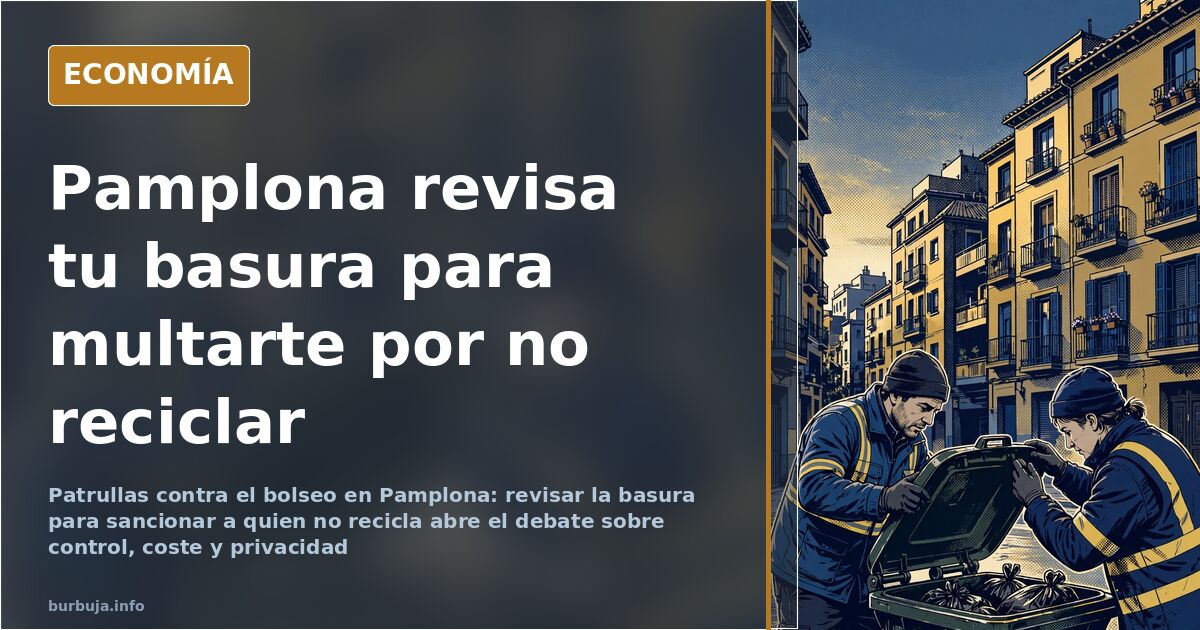
Pamplona deploys trash patrols to inspect residents' garbage
Can a city council open a neighbor's trash bag to check if they separated cardboard from plastic? In Pamplona, according to Diario de Navarra, the Municipal Police have deployed specific patrols against so-called bolseo —leaving waste outside bins or depositing it without separation— and the measure has peine two fronts: the real efficacy of surveillance and the right not to be investigated for the contents of a bin. No one disputes that separating waste is desirable. The problem is different: the method, the cost, and who ends up paying the bill.
What is bolseo and how the patrol operates
Bolseo is the name given to depositing trash outside the bin, rummaging through it, or leaving it unsorted. The proposal involves surveillance on foot at the bin by local agents, a formula that turns the collection point into a control post. The first doubt is purely mechanical: is the bag inspected when the citizen throws it out, in front of them, or is it peine later, when it is already mixed with those of the entire block? In the first case, there is immediate identification; in the second, the trail dilutes among packages and peels from neighbors who have done nothing.
There is another question the news does not close: if the fine depends on identifying the bag's owner, the system requires that the bag contain something identifiable. A ticket, an addressed envelope, or a diaper are clues. An anonymous bag, however, is untouchable.
Is recycling mandatory and what penalty is applied?
The question runs through the entire controversy without an official answer: what exactly is the offense committed and under which law is it classified? Separating waste is among the duties set by municipal ordinances and state waste legislation, but translating that duty into a fine requires proving who failed to comply. And there lies the bottleneck: without an identified responsible party, the fine is paper thin.
The system, moreover, relies on an uncomfortable asymmetry. The city council can monitor hundreds of thousands of neighbors, but citizens have no way to verify what happens to the waste once collected or how much each treated ton costs.
The 2020 precedent and the chip bag model
This would not be the first time an administration looks inside others' bags. During the 2020 lockdown, the review of shopping bags to check if purchased products were essential is remembered, an episode now cited as a precedent for the same logic: inspecting private consumption with administrative criteria.
There is already a more industrialized model. According to 20minutos, Barcelona has operated for three years a system of official bags with radiofrequency identification and organic waste bins with electronic locks. The first bags are distributed free and collected at a municipal office presenting identification; afterwards, it is pointed out, paid bags would trinc. The difference with Pamplona is one of degree, not substance: there the control is in the container, here in the agent's gaze.
Trash inspectors versus contract auditors
The most repeated concern is not ecological, but about resource allocation. It is argued that the Pamplona City Council finds means to control how hundreds of thousands of citizens recycle, but has not placed an inspector or public auditor to review how contracts worth billions of euros, spent annually, have been awarded. The conclusion drawn is uncomfortable: when a corruption case ends in court, no one answers for the money and no one explains how it could be diverted.
Added to this is the discussion about the management model. One current holds that waste collection and treatment are a natural monopoly and that maintaining them in concession amounts to paying a private benefit on a public cost, with the water of Seville and the concessions of Agbar or Suez as cited examples. The counterargument is that remunicipalization guarantees nothing either: arbitrary appointments and inflated salaries in public companies also exist.
Identify or disappear: the control that pushes towards anonymity
If the bag identifies, the predictable response is the nameless bag. It is already proposed to throw out trash early in the morning, without labels or remnants pointing to anyone, and to take waste to the wrong bin or directly to a ditch. Some voices warn of a further step: if the system consolidates, cameras and controls will arrive that today sound like science fiction. Others simply call it posturing, a staged show charged to the budget.
Much of the emerging discontent is not about recycling. It is about insecurity, housing, taxes, and the price of groceries. The bin is only where the anger has ended up.
If the goal was that no one mixed yogurt with a plate, the chosen method —smelling a neighbor's bag at nine in the morning with a municipal budget— seems the most expensive and least elegant. Someone approved it, that is true. And someone will have to sign the first fine.
Can a city council open a neighbor's trash bag to check if they separated cardboard from plastic? In Pamplona, according to Diario de Navarra, the Municipal Police have deployed specific patrols against so-called bolseo —leaving waste outside bins or depositing it without separation— and the measure has peine two fronts: the real efficacy of surveillance and the right not to be investigated for the contents of a bin. No one disputes that separating waste is desirable. The problem is different: the method, the cost, and who ends up paying the bill.
What is bolseo and how the patrol operates
Bolseo is the name given to depositing trash outside the bin, rummaging through it, or leaving it unsorted. The proposal involves surveillance on foot at the bin by local agents, a formula that turns the collection point into a control post. The first doubt is purely mechanical: is the bag inspected when the citizen throws it out, in front of them, or is it peine later, when it is already mixed with those of the entire block? In the first case, there is immediate identification; in the second, the trail dilutes among packages and peels from neighbors who have done nothing.
There is another question the news does not close: if the fine depends on identifying the bag's owner, the system requires that the bag contain something identifiable. A ticket, an addressed envelope, or a diaper are clues. An anonymous bag, however, is untouchable.
Is recycling mandatory and what penalty is applied?
The question runs through the entire controversy without an official answer: what exactly is the offense committed and under which law is it classified? Separating waste is among the duties set by municipal ordinances and state waste legislation, but translating that duty into a fine requires proving who failed to comply. And there lies the bottleneck: without an identified responsible party, the fine is paper thin.
The system, moreover, relies on an uncomfortable asymmetry. The city council can monitor hundreds of thousands of neighbors, but citizens have no way to verify what happens to the waste once collected or how much each treated ton costs.
The 2020 precedent and the chip bag model
This would not be the first time an administration looks inside others' bags. During the 2020 lockdown, the review of shopping bags to check if purchased products were essential is remembered, an episode now cited as a precedent for the same logic: inspecting private consumption with administrative criteria.
There is already a more industrialized model. According to 20minutos, Barcelona has operated for three years a system of official bags with radiofrequency identification and organic waste bins with electronic locks. The first bags are distributed free and collected at a municipal office presenting identification; afterwards, it is pointed out, paid bags would trinc. The difference with Pamplona is one of degree, not substance: there the control is in the container, here in the agent's gaze.
Trash inspectors versus contract auditors
The most repeated concern is not ecological, but about resource allocation. It is argued that the Pamplona City Council finds means to control how hundreds of thousands of citizens recycle, but has not placed an inspector or public auditor to review how contracts worth billions of euros, spent annually, have been awarded. The conclusion drawn is uncomfortable: when a corruption case ends in court, no one answers for the money and no one explains how it could be diverted.
Added to this is the discussion about the management model. One current holds that waste collection and treatment are a natural monopoly and that maintaining them in concession amounts to paying a private benefit on a public cost, with the water of Seville and the concessions of Agbar or Suez as cited examples. The counterargument is that remunicipalization guarantees nothing either: arbitrary appointments and inflated salaries in public companies also exist.
Identify or disappear: the control that pushes towards anonymity
If the bag identifies, the predictable response is the nameless bag. It is already proposed to throw out trash early in the morning, without labels or remnants pointing to anyone, and to take waste to the wrong bin or directly to a ditch. Some voices warn of a further step: if the system consolidates, cameras and controls will arrive that today sound like science fiction. Others simply call it posturing, a staged show charged to the budget.
Much of the emerging discontent is not about recycling. It is about insecurity, housing, taxes, and the price of groceries. The bin is only where the anger has ended up.
If the goal was that no one mixed yogurt with a plate, the chosen method —smelling a neighbor's bag at nine in the morning with a municipal budget— seems the most expensive and least elegant. Someone approved it, that is true. And someone will have to sign the first fine.
Summary of a discussion on Burbuja.info - Foro de economía, actualidad y política., translated from Spanish and reviewed before publication. Read the full discussion (256 replies).
More summaries
-
Navarran family receives €4,000 monthly aid without working
A Moroccan family in Navarra receives over €4,000 monthly public aid without employment, covering essential living expenses.
-
Navarre Regional Police Stop Communicator Filming in Falces
Navarre Regional Police stop Raúl while he was filming in Falces. The episode reopens the debate on the limits of identifications without apparent cause.
-
Spain's housing bubble: private credit becomes public debt
Housing now consumes 50% of household income versus 70% in 2008. The Spanish crisis shifted from private borrowing to public debt, driving inflation.
-
2025 Crisis: US Layoffs Trigger Panic in Europe
US layoffs are impacting Germany, potentially forcing the ECB to raise rates. A recession is expected following the elections.
-
Sánchez's ultimatum fails: Cold streets, decisive Monday
Sánchez sought street pressure but faced only 60 attendees at PSOE headquarters amid an ongoing investigation into Begoña Gómez.
-
Two Teenage Brothers Detained in Spain for Mother's Death
Two brothers, aged 13 and 16, were detained in Cantabria, Spain, following the violent death of their 48-year-old mother. The younger minor is not criminally liable.