
Navarre Regional Police Stop Communicator Filming in Falces
Navarre Regional Police stop Raúl while he was filming in Falces. The episode reopens the debate on the limits of identifications without apparent cause.
English · Original discussion in Spanish · Published
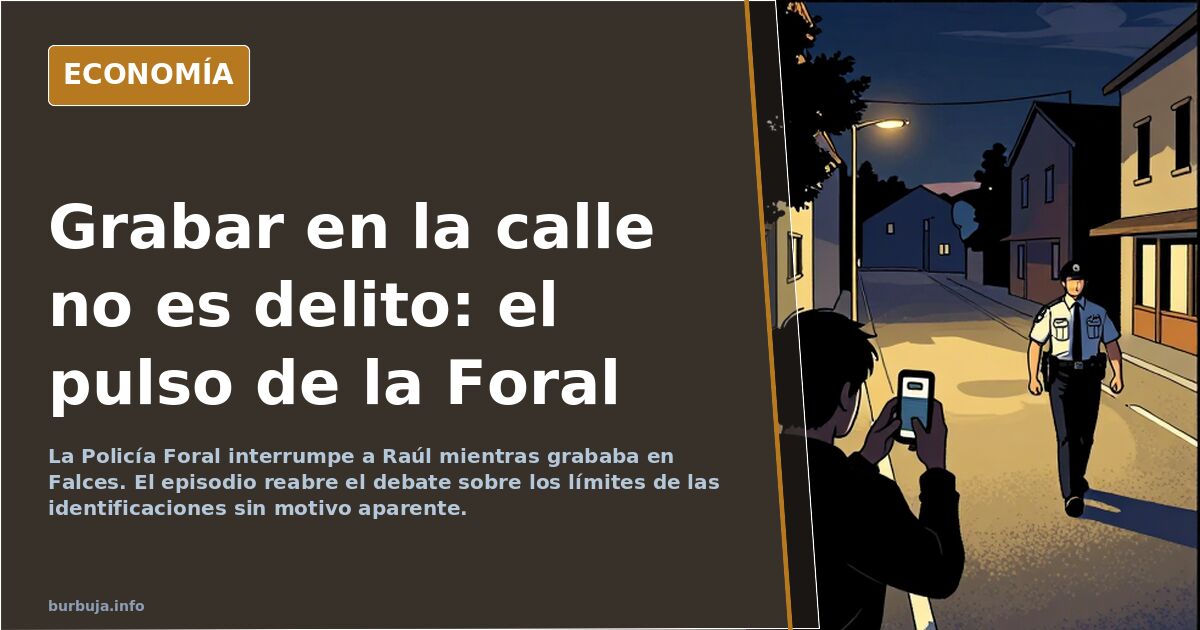
Navarre Regional Police: Filming in the street is not a crime
Filming in public spaces is not a crime. Not in Falces, not in Navarre, not anywhere in Spain. However, a patrol from the Policía Foral (Navarre Regional Police) approached a communicator who was filming and asked him to stop. The incident, captured on video, has reignited a debate that Spain has been grappling with since 2015: what can an officer demand from someone who has not committed any offense.
The protagonist is Raúl, known on social media for his videos, and the setting is Falces, a town in the Ribera region of Navarre. The officer's question – "What are you doing?" – is almost the only clear thing from the recording. The rest, the legality of the intervention, the attitude of each party, and even the real reason for the stop, are matters of discussion.
What peine in Falces with the Navarre Regional Police
According to the disseminated version, the patrol approached the communicator while he was filming in a public area and asked him to stop. The detail is important: filming oneself in an open space is not an illegal activity. Some recall that such recordings serve as evidence – of possible abuse or future judicial overreach – and that turning off the camera at an officer's request is, in practice, relinquishing it.
From there, the narrative diverges. Some who trinc the case emphasize that the communicator did nothing illegal and that the officer overstepped. Others maintain that an individual filming a public building late at night is, at the very least, a reasonable cause for questioning. A third perspective suggests that the problem was neither the filming nor the question, but the tone.
Is it legal for the police to stop you without cause?
Here, the case moves beyond the anecdotal. The Organic Law on the Protection of Citizen Security (Ley Orgánica de Protección de la Seguridad Ciudadana) allows officers to request identification when there are indications of an offense, to prevent a crime, or during citizen security checks. The debate lies in what "citizen security" means when the only objective fact is someone walking or filming on the street.
Article 19 of the Constitution protects freedom of movement. Walking on a public street, at three in the afternoon or three in the morning, is not in itself an indication of anything: without a specific reason, the stop can be considered arbitrary. There is a counterpoint. Those who cannot prove their identity may be taken to police facilities for a maximum of 6 hours. The line between a legitimate check and an illegal action is as wide as the officer's discretion.
The legacy of the 'Gag Law' and the pandemic
Much of the discontent links the episode to two precedents. The first is the Citizen Security Law of 2015, known as the gag law (ley mordaza), which expanded police powers regarding identification. The second is the management of the health crisis: some argue that the lockdowns and curfews of 2020 instilled in many the idea that the police could stop anyone, at any time, without further explanation. That exceptionality left its mark.
The interpretation is not unanimous. Opposing it is a simple argument: a request on the street is not an arrest, and answering questions is not equivalent to being detained. The discussion, at its core, is not about a specific officer, but about where to draw the line between authority and a citizen who has done nothing wrong.
What is known about the real reason for the stop?
Little. A later video by the protagonist himself suggests that the officers already knew him from previous content in which he criticized another local administration. If true, the stop would not be due to a routine check or a general suspicion, but to a personal or political motivation. It is prudent to be cautious: this is a claim by the individual involved, not an established fact.
The theory that there is an internal directive to prevent police filming is also circulating. There is no proof of this in the available material, beyond personal experiences of citizens who claim to have been in similar situations.
Double standards and expectations of treatment
A cross-cutting theme throughout the discussion is unequal treatment. The idea that the same patrol that is assertive with an ordinary citizen thinks twice before approaching other profiles circulates strongly. This is a perception difficult to quantify and easy to overgeneralize; as a hypothesis, however, it explains why the case has generated so much rejection beyond its actual severity.
On the other hand, several criticisms are directed at the communicator: that he backed down, that he missed the opportunity to take the matter to court, that victimhood is his entire product. And a repeated warning: confronting an officer on the street rarely ends well. Where you win such an argument is in court, with evidence.
Neither version is likely to be resolved by a video. Most likely, the episode will fade without any formal proceedings or sanctions – litigating a stop without consequences is costly and yields little – unless someone decides to turn it into a symbol. If that happens, the case will have already won on the only ground that matters: the question of how much leeway an officer has to decide, on the street, who deserves an explanation.
Filming in public spaces is not a crime. Not in Falces, not in Navarre, not anywhere in Spain. However, a patrol from the Policía Foral (Navarre Regional Police) approached a communicator who was filming and asked him to stop. The incident, captured on video, has reignited a debate that Spain has been grappling with since 2015: what can an officer demand from someone who has not committed any offense.
The protagonist is Raúl, known on social media for his videos, and the setting is Falces, a town in the Ribera region of Navarre. The officer's question – "What are you doing?" – is almost the only clear thing from the recording. The rest, the legality of the intervention, the attitude of each party, and even the real reason for the stop, are matters of discussion.
What peine in Falces with the Navarre Regional Police
According to the disseminated version, the patrol approached the communicator while he was filming in a public area and asked him to stop. The detail is important: filming oneself in an open space is not an illegal activity. Some recall that such recordings serve as evidence – of possible abuse or future judicial overreach – and that turning off the camera at an officer's request is, in practice, relinquishing it.
From there, the narrative diverges. Some who trinc the case emphasize that the communicator did nothing illegal and that the officer overstepped. Others maintain that an individual filming a public building late at night is, at the very least, a reasonable cause for questioning. A third perspective suggests that the problem was neither the filming nor the question, but the tone.
Is it legal for the police to stop you without cause?
Here, the case moves beyond the anecdotal. The Organic Law on the Protection of Citizen Security (Ley Orgánica de Protección de la Seguridad Ciudadana) allows officers to request identification when there are indications of an offense, to prevent a crime, or during citizen security checks. The debate lies in what "citizen security" means when the only objective fact is someone walking or filming on the street.
Article 19 of the Constitution protects freedom of movement. Walking on a public street, at three in the afternoon or three in the morning, is not in itself an indication of anything: without a specific reason, the stop can be considered arbitrary. There is a counterpoint. Those who cannot prove their identity may be taken to police facilities for a maximum of 6 hours. The line between a legitimate check and an illegal action is as wide as the officer's discretion.
The legacy of the 'Gag Law' and the pandemic
Much of the discontent links the episode to two precedents. The first is the Citizen Security Law of 2015, known as the gag law (ley mordaza), which expanded police powers regarding identification. The second is the management of the health crisis: some argue that the lockdowns and curfews of 2020 instilled in many the idea that the police could stop anyone, at any time, without further explanation. That exceptionality left its mark.
The interpretation is not unanimous. Opposing it is a simple argument: a request on the street is not an arrest, and answering questions is not equivalent to being detained. The discussion, at its core, is not about a specific officer, but about where to draw the line between authority and a citizen who has done nothing wrong.
What is known about the real reason for the stop?
Little. A later video by the protagonist himself suggests that the officers already knew him from previous content in which he criticized another local administration. If true, the stop would not be due to a routine check or a general suspicion, but to a personal or political motivation. It is prudent to be cautious: this is a claim by the individual involved, not an established fact.
The theory that there is an internal directive to prevent police filming is also circulating. There is no proof of this in the available material, beyond personal experiences of citizens who claim to have been in similar situations.
Double standards and expectations of treatment
A cross-cutting theme throughout the discussion is unequal treatment. The idea that the same patrol that is assertive with an ordinary citizen thinks twice before approaching other profiles circulates strongly. This is a perception difficult to quantify and easy to overgeneralize; as a hypothesis, however, it explains why the case has generated so much rejection beyond its actual severity.
On the other hand, several criticisms are directed at the communicator: that he backed down, that he missed the opportunity to take the matter to court, that victimhood is his entire product. And a repeated warning: confronting an officer on the street rarely ends well. Where you win such an argument is in court, with evidence.
Neither version is likely to be resolved by a video. Most likely, the episode will fade without any formal proceedings or sanctions – litigating a stop without consequences is costly and yields little – unless someone decides to turn it into a symbol. If that happens, the case will have already won on the only ground that matters: the question of how much leeway an officer has to decide, on the street, who deserves an explanation.
Summary of a discussion on Burbuja.info - Foro de economía, actualidad y política., translated from Spanish and reviewed before publication. Read the full discussion (222 replies).
More summaries
-
Ceuta Bakery Looted, Police Say They Can't Guarantee Safety
A Ceuta baker saw his shop looted, and in a live broadcast response, authorities stated they cannot guarantee security. The case reignites the debate on protection for...
-
Montero's 'I am an MEP' claim met with 'I don't care' by police officer
An officer responded 'I don't care, she's a citizen like any other' to Irene Montero's 'I am an MEP' amidst her party's offensive.
-
Isabel Alfaro faces charges for calling police officers 'murderers'
The Prosecutor's Office and the Spanish Police Confederation are seeking €4,050 against Isabel Alfaro, president of immigrants' associations, for labeling the police as murderers.
-
Police Slaps Handcuffed Woman in Belgium
A video shows a police officer slapping a handcuffed woman in Belgium. The case has reignited the debate over the use of force and double standards.
-
Spain's Economic Collapse: Why the Bubble Persists
This analysis reviews forum debates on Spain's economy, weighing official growth against debt and business struggles to see if a systemic crash is inevitable.
-
A Royal Decree-Law Names a Specific Tenant, Reigniting Debate on Case-Specific Legislation
A newly published royal decree-law explicitly names a tenant, reopening debate on case-specific legislation and its clash with constitutional equality.