
Palenciano admits feminism criminalized men, sparking debate
Pamela Palenciano admits feminism criminalized men. Debate reopens: damage control, lost grants, and new market niches.
English · Original discussion in Spanish · Published
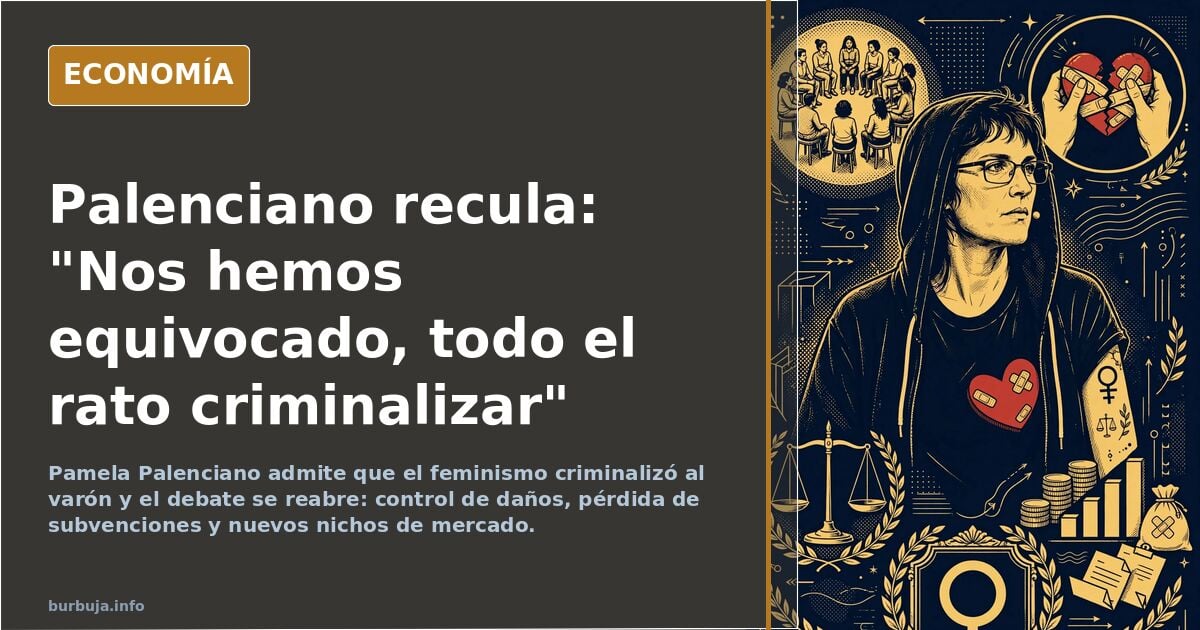
Palenciano admits error as feminism enters damage control phase
A speaker who has toured schools for years with a monologue on gender-based violence now acknowledges that the movement "got it wrong" by incivil men. The statement, shared via social media, has peine discussion on the economic and social cost of two decades of equality policies built on permanent suspicion of men. It is not an isolated correction: it is the symptom of a cycle change many had anticipated.
What exactly did Pamela Palenciano say and why it matters
The message that started it all is a direct quote: "We were wrong. Incivil all the time, I myself did it." The author of this confession is Pamela Palenciano, known for a show she has brought to schools and auditoriums for years under the umbrella of equality policies. The acknowledgment, spread online, was read by some as a belated rectification; by others, as a simple repositioning maneuver.
The detail is not minor. Someone who spent years building her discourse on systematically denouncing men as potential aggressors now admits that approach may have been mistaken. The lingering question is whether this is a sincere conversion or a script adjustment due to losing audience. Given the reactions, the answer is far from unanimous.
The damage control thesis: retreating without conceding
The dominant reading among critics is that there is no real rectification. They argue the speaker does not acknowledge a fundamental error but asks to lower the volume because the discourse stopped working. "It's a damage control strategy," summarizes one of the most repeated positions: it’s not about backing down, but better disguising the same product. The argument rests on a simple idea: if the message worked, there would be no need to qualify it.
Some go further, noting that institutional feminism has operated as a mechanism of preventive incivil. The phrase "incivil all the time" would not be self-criticism, but the involuntary description of a method. If the method was the error, rectification would require more than a tone change: it would demand dismantling the apparatus built upon it.
The business of talks: grants, schools, and new niches
The second axis of the debate is economic. Several analyses suggest the shift responds not to sarracena reflection, but to detecting a new market: young boys. The thesis is that, having exhausted the vein of talks in schools for girls, the next niche is the adolescent male, now offered understanding instead of reproach. "She saw a new market niche by targeting lost teenage boys," argues one of the most cited readings.
Behind this suspicion lies an uncomfortable question: how much of this discourse depended on public funding? The most repeated criticism targets not the speaker, but the system that sustained her: equality days, grants, contracts with administrations. If the tap closes, the discourse moderates. Causality, they say, is budgetary, not ideological.
Collateral damage: a generation educated in suspicion
Beyond the specific case, the debate has shifted to the balance of two decades of equality policies applied in classrooms. The central accusation is that a generation of girls was educated in resentment and a generation of boys in guilt. According to this view, the result is a measurable deterioration in relationships: boys avoiding any interaction for antiestéticar of being labeled, girls interpreting any courtesy as a threat.
The argument relies on asymmetry of consequences. An accusation of micro-machismo, they claim, costs nothing for the accuser but everything for the accused. This creates a perverse incentive: reporting is free, relating is risky. In this framework, male withdrawal from social life is not an ideological reaction, but a rational decision for personal risk management.
What happens now: from recognition to reckoning
The recognition, if genuine, comes too late for part of the public. The most repeated response is that the damage is done and an apology cannot repair it. "For many, it might be too late. Like wars: they end one day, but the dead remain dead," summarizes one of the most valued comments. The metaphor is harsh but captures the mood: no reconciliation is in sight.
The open question is whether this shift marks the beginning of a broader retreat or a cosmetic operation to save the next season of contracts. The litmus test proposed by some is concrete: repeal legislation treating men as default suspects, eliminate quotas and bureaucratic bodies, review widely known court rulings. Without that, they say, there is no rectification: just marketing.
The unsettling fact is not the confession. It is that the signer still has a platform, and the system that funded her has demanded no explanations.
Also available in: Deutsch
Summary of a discussion on Burbuja.info - Foro de economía, actualidad y política., translated from Spanish and reviewed before publication. Read the full discussion (158 replies).
More summaries
-
Zamora gender violence prosecutor dies in head-on crash
Evaristo Antelo, deputy prosecutor at Zamora's Provincial Court and gender violence specialist, died in a head-on collision on the N-631 near Perilla de Castro.
-
Spain's Gender Violence Policy: Two Decades of Spending, Unclear Results
Two decades of laws against gender violence in Spain raise questions about total spending and actual impact on victim statistics.
-
Madrid's Sol protest camp winds down as cold, hygiene and narrative problems mount
The Puerta del Sol housing camp in Madrid faces its "de-camping" after three weeks: cold weather, Metro closure over sanitation and a fraying electoral narrative.
-
Morocco urges vote for Sánchez, Spanish media reports say
According to published reports, the Moroccan media lobby is mobilising the 300,000 Spanish-Moroccans eligible to vote to back the PSOE on 29-N.
-
29N: Spain's opposition leader says he is against raising the average wage
Alberto Núñez Feijóo said on Cadena SER that the PP does not oppose the minimum wage but does oppose raising the average wage. The remark left the interviewer speechless.
-
Spain's bond spread holds at 67 points as France's soars past 170
France's risk premium has climbed above 170 basis points, nearly triple Spain's at 67, amid the French country's political and budget crisis