
Painting white over a strong color: up to six coats
Repainting white over strong colors takes three to six coats. Thinning the paint reduces its coverage and multiplies the work.
English · Original discussion in Spanish · Published
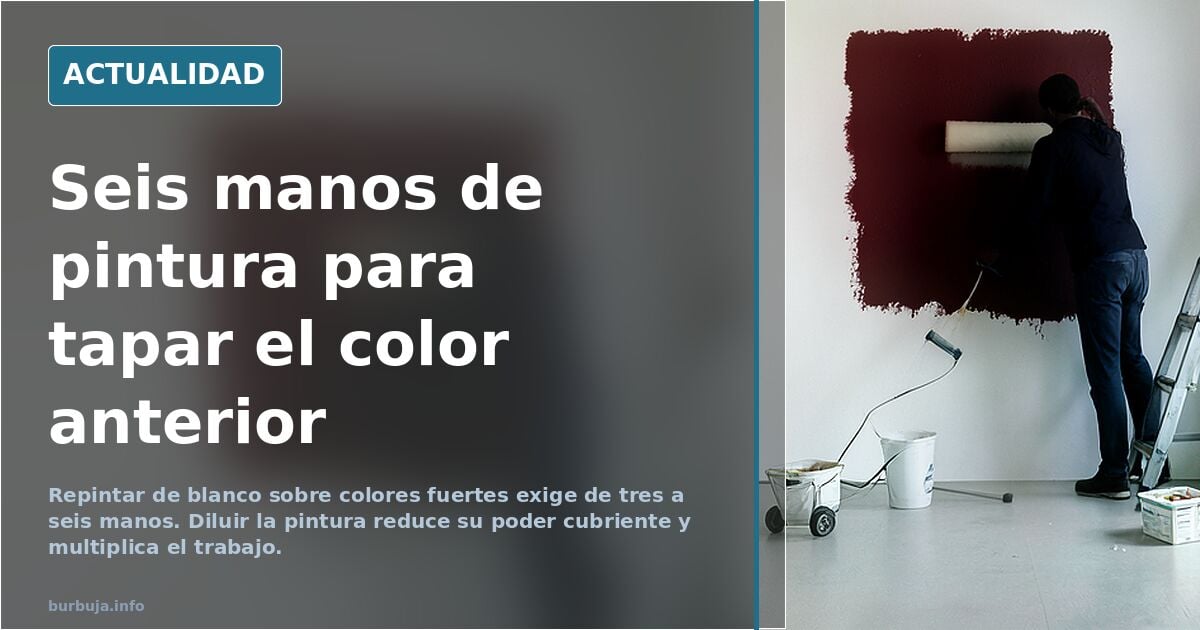
Painting white over a strong tonalidad can take up to six coats
Repainting a house white that previously sported several shades of yellow, with one room in green and purple, can require between four and six roller passes. That's the situation faced by whoever started the thread after finding that the old tonalidad refuses to disappear under the new paint. The underlying question is whether that's normal or whether the fault lies with having thinned the paint too much to avoid lumps and drips. The answer that keeps coming up from those who have been through the same thing is an uncomfortable one: with vivid colors, the suffering is part of the process.
How many coats does it take to cover a strong tonalidad
The range cited by those who have already repainted apartments with dark walls is three to four coats if you want a clean white with no shadows. Some recall rooms in dark blue, chocolate brown or orange that demanded that much effort. Experience agrees on one point: one-coat paint doesn't always live up to what the label promises. One case mentioned is two green and lilac walls that turned out perfect with two coats of quality paint, after two earlier coats of a cheap brand that required endless passes. The final result was the same: four coats.
Thinning the paint is the costliest mistake
The most repeated advice is not to overdo it with water. The more you thin a can, the more coverage it loses, and the apparent saving is paid for in extra coats. The recommendation is to apply it almost pure, with very little water, even if it goes on thicker. Anyone who thins paint to make it stretch ends up with a poor finish and more work. Cheap paint also covers less, but it does cover: the problem is that it forces you to multiply the coats.
Is it worth using primer over textured walls?
Primer helps the paint adhere well and seals pores, but it doesn't work miracles on a strong tonalidad. It's for preparing the surface, not for replacing coats. On textured walls (gotelé), the texture adds difficulty to coverage. The alternative mentioned by those who have been through this is to turn to special high-coverage paints, with cans that can run around 80 euros, designed for extreme cases such as ceilings and walls blackened by smoke from a fire. In that case, two coats of the special paint and a third of the regular kind were enough to make everything look like new.
The trend of a different tonalidad per room
There was a time when it became fashionable to paint each room a different tonalidad, and then a different strong tonalidad. Anyone who bought an apartment in those years inherited the problem. Returning to white is the norm today, and with it comes the bill in the form of coats. For walls that are already white, a single pass is enough. For everything else, you have to accept that the old tonalidad puts up a fight.
With all this, the question that remains without a definitive answer is how many coats are really necessary. Three if you're not fussy. Four if you want a perfect white. One-coat paint exists, but it doesn't always deliver.
Also available in: Deutsch
Summary of a discussion on Burbuja.info - Foro de economía, actualidad y política., translated from Spanish and reviewed before publication. Read the full discussion (17 replies).
More summaries
-
Tolkien Forum: 'AI Now Outperforms 98% of Humans'
Generative AI is illustrating Tolkien and composing music. The creative sector calculates job losses and who will pay for prints without originals.
-
Neoteny: Why Humans Are Born Premature
Neoteny suggests humans are born prematurely due to our brain and pelvis. Discover how this hypothesis explains our dependency and evolution.
-
Dugin: 'No reason to defend the existence of whites'
Alexander Dugin says there is no reason to defend the existence of whites. Is his stance coherent or a betrayal? Analysis of the debate.
-
Peruvian candidate named Hitler Mussolini wins local election
Hitler Mussolini Simeon won the mayoral race in Peru's Queropalca district for the left-wing party Ahora Nación, sparking social media debate.
-
Eating a lot without gaining weight: satiety, according to a forum user
A forum user argues that people who eat until full without gaining weight actually eat less than they think: they feel full sooner, and the body changes with age.
-
Netherlands euthanises one-year-old baby
The official report states the child was one year old, born premature and suffered extensive brain damage; the Dutch doctor will not face prosecution.