
Overcoming Alcoholism: Antabus, Clinics, and Unprescribable Willpower
Involuntary admission for alcoholics requires proof of severe disorder and incapacity, making it practically impossible in most cases.
English · Original discussion in Spanish · Published
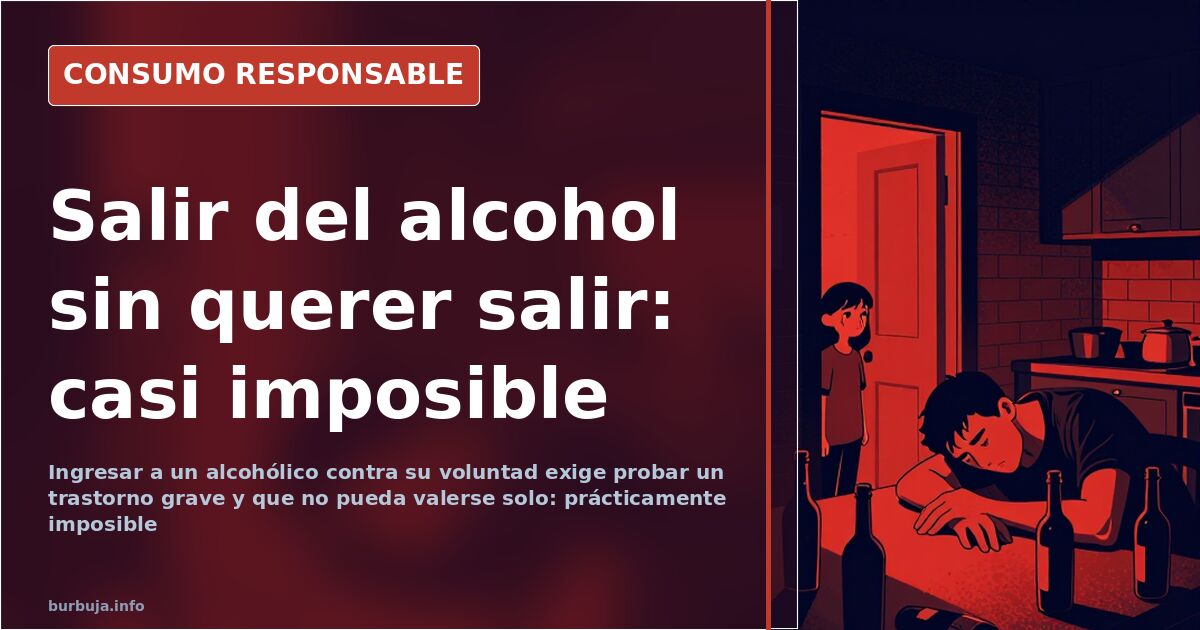
Involuntary Admission for Alcoholics Is Nearly Impossible
Can an alcoholic be admitted to a clinic against their will? Theoretically, yes. In practice, the criteria are so strict that most situations end where they began: leaning on a bar counter. To commit someone involuntarily, one must prove that alcohol has caused severe psychiatric disorders and that the person is unable to care for themselves. Meeting both conditions simultaneously is described as virtually impossible. Meanwhile, liver damage continues to pogre.
Are Criteria for Involuntary Commitment Met?
Involuntary admission exists but is reserved for extreme cases: inability to function independently and associated psychiatric pathology. Outside these scenarios, everything depends on the individual acknowledging the problem. This realization does not come through reasoning or family pressure. It comes from a shock: a loss, a diagnosis, or an unexpected birth. Without this breakthrough, any attempt at help hits a wall. The most common conclusion among those who have lived with an addict is uncomfortable: you cannot convince someone who does not want to be convinced.
Antabus, Hypnosis, and Behavioral Therapy: Methods in Circulation
The range of solutions is broad and uneven. Antabus (disulfiram) is mentioned, an aversive drug: when combined with alcohol, it triggers a rejection reaction intended to deter drinking. Testimonials also include hypnosis, behavioral therapy, and, in more controversial corners, ALUCINÓGENO ILEGAL combined with therapy for resistant cases. One might think the method presented as foolproof is usually just the story told afterwards.
There is one area where skepticism is sensible: none of these treatments replace the patient's decision. A recurring warning is that stopping abruptly can be dangerous; severe physical dependence requires medical supervision. Delirium tremens can be fatal.
Does Alcoholics Anonymous Work?
This is the biggest disagreement in the entire issue. Some defend that the Alcoholics Anonymous method works, is free, and serves all types of people, including severely deteriorated cases trapped for years. Others dismiss it as an outdated ritual: former drinkers sharing sorrows, without specialists, using texts over a century old, and constant dramatization. The sharpest criticism argues people attend simply because it costs nothing.
In parallel, support groups exist for families and friends, distinct from meetings for alcoholics themselves, designed for those living with the problem. Both share the same starting point: recovery begins when the addict recognizes themselves as such, which often happens after very serious consequences.
The Medical Diagnosis That Breaks Denial
Clinical antiestéticar appears in several accounts as the most effective lever. Blood tests done for another reason reveal a damaged liver; the doctor asks if daily drinking occurs and warns that continuing, even lightly, has serious consequences. Those who experienced this argue it worked: alcohol was a habit, and replacing it stopped being a punishment. Warning for the naive: this works when the problem is a habit; when it is an escape from reality, what needs changing is reality itself.
The case that started this conversation ended with cirrhosis and a very poor prognosis. The final update, written by the person who raised the issue, described brutal withdrawal symptoms: constant nervousness, incoherence, visible deterioration. And a blunt warning: many people do not know how terrible alcohol addiction and its consequences are.
The Environment Also Suffers
A pattern repeats in the accounts: the family ends up sustaining the fiction. They pay, clean, lie to others, and minimize the issue. A coworker married to an alcoholic started accompanying him to bars to monitor his drinking and ended up ordering her own beer mid-morning. Another case was resolved by a birth: a man who ignored reason quit drinking at 55 years old, when he had his last child, because he wanted to. Twenty years earlier, his other children had asked unsuccessfully.
Those who recovered describe a similar exit. Getting up trembling, with retching, walking toward the bar blinded by tears, and having the first beer of the day, which actually feels awful. Someone ten years sober summarizes it as a reclaimed future with no expiration date.
No pill restores the desire to live. And that is precisely the variable nobody knows how to prescribe.
Can an alcoholic be admitted to a clinic against their will? Theoretically, yes. In practice, the criteria are so strict that most situations end where they began: leaning on a bar counter. To commit someone involuntarily, one must prove that alcohol has caused severe psychiatric disorders and that the person is unable to care for themselves. Meeting both conditions simultaneously is described as virtually impossible. Meanwhile, liver damage continues to pogre.
Are Criteria for Involuntary Commitment Met?
Involuntary admission exists but is reserved for extreme cases: inability to function independently and associated psychiatric pathology. Outside these scenarios, everything depends on the individual acknowledging the problem. This realization does not come through reasoning or family pressure. It comes from a shock: a loss, a diagnosis, or an unexpected birth. Without this breakthrough, any attempt at help hits a wall. The most common conclusion among those who have lived with an addict is uncomfortable: you cannot convince someone who does not want to be convinced.
Antabus, Hypnosis, and Behavioral Therapy: Methods in Circulation
The range of solutions is broad and uneven. Antabus (disulfiram) is mentioned, an aversive drug: when combined with alcohol, it triggers a rejection reaction intended to deter drinking. Testimonials also include hypnosis, behavioral therapy, and, in more controversial corners, ALUCINÓGENO ILEGAL combined with therapy for resistant cases. One might think the method presented as foolproof is usually just the story told afterwards.
There is one area where skepticism is sensible: none of these treatments replace the patient's decision. A recurring warning is that stopping abruptly can be dangerous; severe physical dependence requires medical supervision. Delirium tremens can be fatal.
Does Alcoholics Anonymous Work?
This is the biggest disagreement in the entire issue. Some defend that the Alcoholics Anonymous method works, is free, and serves all types of people, including severely deteriorated cases trapped for years. Others dismiss it as an outdated ritual: former drinkers sharing sorrows, without specialists, using texts over a century old, and constant dramatization. The sharpest criticism argues people attend simply because it costs nothing.
In parallel, support groups exist for families and friends, distinct from meetings for alcoholics themselves, designed for those living with the problem. Both share the same starting point: recovery begins when the addict recognizes themselves as such, which often happens after very serious consequences.
The Medical Diagnosis That Breaks Denial
Clinical antiestéticar appears in several accounts as the most effective lever. Blood tests done for another reason reveal a damaged liver; the doctor asks if daily drinking occurs and warns that continuing, even lightly, has serious consequences. Those who experienced this argue it worked: alcohol was a habit, and replacing it stopped being a punishment. Warning for the naive: this works when the problem is a habit; when it is an escape from reality, what needs changing is reality itself.
The case that started this conversation ended with cirrhosis and a very poor prognosis. The final update, written by the person who raised the issue, described brutal withdrawal symptoms: constant nervousness, incoherence, visible deterioration. And a blunt warning: many people do not know how terrible alcohol addiction and its consequences are.
The Environment Also Suffers
A pattern repeats in the accounts: the family ends up sustaining the fiction. They pay, clean, lie to others, and minimize the issue. A coworker married to an alcoholic started accompanying him to bars to monitor his drinking and ended up ordering her own beer mid-morning. Another case was resolved by a birth: a man who ignored reason quit drinking at 55 years old, when he had his last child, because he wanted to. Twenty years earlier, his other children had asked unsuccessfully.
Those who recovered describe a similar exit. Getting up trembling, with retching, walking toward the bar blinded by tears, and having the first beer of the day, which actually feels awful. Someone ten years sober summarizes it as a reclaimed future with no expiration date.
No pill restores the desire to live. And that is precisely the variable nobody knows how to prescribe.
Summary of a discussion on Burbuja.info - Foro de economía, actualidad y política., translated from Spanish and reviewed before publication. Read the full discussion (162 replies).
More summaries
-
Alcoholism: Quitting After Ten Beers a Day
Ten beers daily nearly quadruples moderate intake limits. Here is how those who quit managed to stop.
-
Free Home Cleaning: The Viral Trend Dividing Public Opinion
An influencer with 450,000 subscribers cleans up houses afflicted by Diogenes Syndrome. Is it charity or a business venture? Dive into the controversy.
-
Accessing Live Sports via Shared Streaming Links
Analysis of how users access live sports through shared streaming codes and links.
-
Maria Cookie: Spain's Divisive Sweet
The Maria cookie divides Spain between nostalgia and disdain, with declining quality post-pandemic.
-
Induction wins over gas for cleanliness, not cost
Butane offers 159 kWh and electricity costs ~10 cents: gas is cheaper and cooks better, but induction won due to ease of cleaning.
-
Car Buying: €40k Budget and the Petrol vs Diesel Dilemma
A first-time buyer with a €40,000 budget for a sedan gets advice: diesel loses its edge, and some suggest a used car is better than new.