
Maria Cookie: Spain's Divisive Sweet
The Maria cookie divides Spain between nostalgia and disdain, with declining quality post-pandemic.
English · Original discussion in Spanish · Published
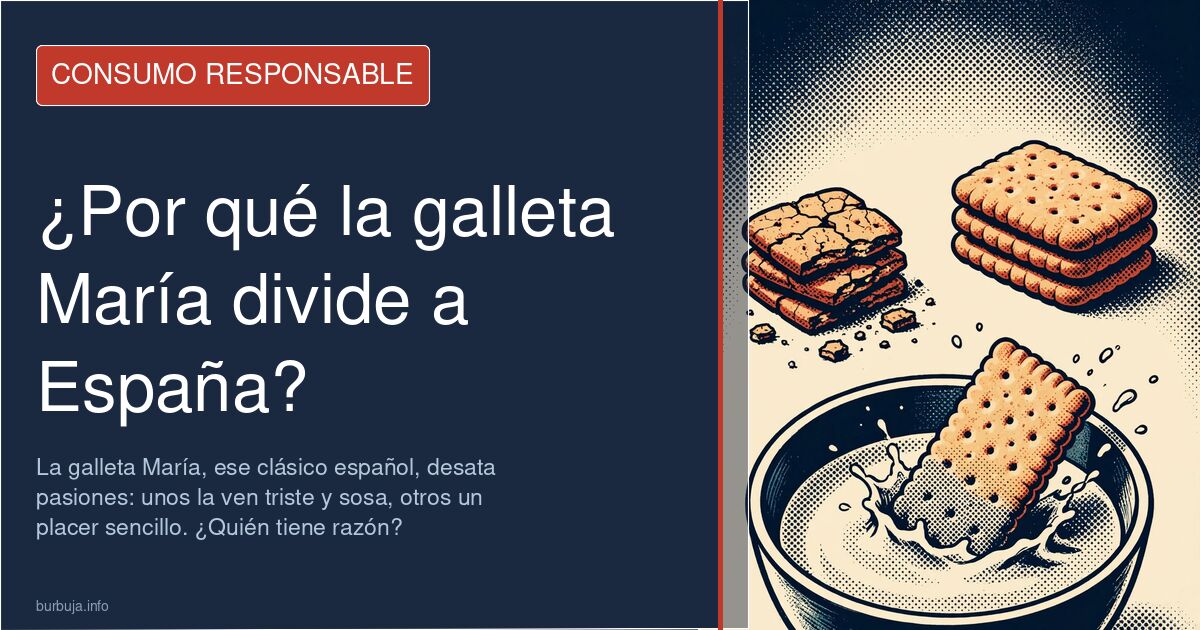
Maria Cookie: The Sweet That Splits Spain Between Nostalgia and Disgust
Is there anything sadder or blander than a Maria cookie? This question, raised during a debate on responsible consumption, sparked a trench war between those who defend it as a simple pleasure and those who compare it to a handful of dirt. It is not a trivial matter: behind the debate over its taste lies a discussion about Spanish culinary identity, food industry quality, and the nostalgia for an era of scarcity.
An English Invention That Became Spanish
The Maria cookie was born in England in the 19th century, but its true home is the Iberian Peninsula. After the Spanish Civil War, it became the go-to sweet due to its low cost and ease of production. Today it is consumed mainly in Spain and Portugal, while in France it barely appears as an imported product. Its success lies in being cheap, hard, and filling: a perfect combination for times of scarcity. As one analyst puts it, it is the most productive cookie in terms of value for money.
Does It Taste Like Dirt or Pleasure?
Opinions are divided. Some argue it tastes like dirt, like vomit, and that it is the fruit of an era without innovation. Others, however, defend it dipped in milk, spread with butter, or even with chorizo. The fact that you have to add a thousand things to make it taste good is, for critics, proof that it has no flavor on its own. For its defenders, that simplicity is precisely its virtue: a simple pleasure that needs no artifices. Comparisons with other sweets, such as the sequillo –flour with suet coated in sugar– only add fuel to the fire. Some recall eating them as children with butter, making a kind of giant Oreo, or with margarine and jam. Others, more daring, spread them with chorizo. Creativity has no limits, but the original flavor remains questioned.
Declining Quality
Since the pandemic, the quality of industrial cookies has dropped. Manufacturers, to maintain prices, have reduced ingredients like egg or honey and increased sugar. The result is that any cookie tastes like sweetness without nuance, and diabetes continues to rise. The Maria cookie is no exception: what was once a simple product is now an impoverished one. It is also mentioned that napolitanas and campurrianas have suffered the same fate, with less egg and less honey.
The Regional War: Meseta vs Levante
The debate transcends taste. For some, the Maria cookie embodies the spirit of the meseta (the central plateau): sober, austere, almost caveman-like. In the Levante (eastern coast), however, bollitos de toña and churritos are preferred, being more varied and colorful. It is also mentioned that the magdalena, so criticized, is actually a French invention that arrived in Spain via the Camino de Santiago. And in comparison with sweets from other cultures, it is argued that Castilian sobriety is a virtue, not a defect. Meanwhile, in Vienna, Naples, or Marrakech, pastry shops offer an infinity of sweets that have nothing to do with the austere cookie. Some defend that Castilian sobriety is a matter of character, not lack of resources, and that with garlic soup, a piece of bread, and some cookies, one can live like royalty.
Perhaps the Maria cookie is nothing more than a mirror of an austere Spain that survives with little. But while some dip it in milk and others spread it with butter, the debate remains open. And that, at least, is not bland.
Is there anything sadder or blander than a Maria cookie? This question, raised during a debate on responsible consumption, sparked a trench war between those who defend it as a simple pleasure and those who compare it to a handful of dirt. It is not a trivial matter: behind the debate over its taste lies a discussion about Spanish culinary identity, food industry quality, and the nostalgia for an era of scarcity.
An English Invention That Became Spanish
The Maria cookie was born in England in the 19th century, but its true home is the Iberian Peninsula. After the Spanish Civil War, it became the go-to sweet due to its low cost and ease of production. Today it is consumed mainly in Spain and Portugal, while in France it barely appears as an imported product. Its success lies in being cheap, hard, and filling: a perfect combination for times of scarcity. As one analyst puts it, it is the most productive cookie in terms of value for money.
Does It Taste Like Dirt or Pleasure?
Opinions are divided. Some argue it tastes like dirt, like vomit, and that it is the fruit of an era without innovation. Others, however, defend it dipped in milk, spread with butter, or even with chorizo. The fact that you have to add a thousand things to make it taste good is, for critics, proof that it has no flavor on its own. For its defenders, that simplicity is precisely its virtue: a simple pleasure that needs no artifices. Comparisons with other sweets, such as the sequillo –flour with suet coated in sugar– only add fuel to the fire. Some recall eating them as children with butter, making a kind of giant Oreo, or with margarine and jam. Others, more daring, spread them with chorizo. Creativity has no limits, but the original flavor remains questioned.
Declining Quality
Since the pandemic, the quality of industrial cookies has dropped. Manufacturers, to maintain prices, have reduced ingredients like egg or honey and increased sugar. The result is that any cookie tastes like sweetness without nuance, and diabetes continues to rise. The Maria cookie is no exception: what was once a simple product is now an impoverished one. It is also mentioned that napolitanas and campurrianas have suffered the same fate, with less egg and less honey.
The Regional War: Meseta vs Levante
The debate transcends taste. For some, the Maria cookie embodies the spirit of the meseta (the central plateau): sober, austere, almost caveman-like. In the Levante (eastern coast), however, bollitos de toña and churritos are preferred, being more varied and colorful. It is also mentioned that the magdalena, so criticized, is actually a French invention that arrived in Spain via the Camino de Santiago. And in comparison with sweets from other cultures, it is argued that Castilian sobriety is a virtue, not a defect. Meanwhile, in Vienna, Naples, or Marrakech, pastry shops offer an infinity of sweets that have nothing to do with the austere cookie. Some defend that Castilian sobriety is a matter of character, not lack of resources, and that with garlic soup, a piece of bread, and some cookies, one can live like royalty.
Perhaps the Maria cookie is nothing more than a mirror of an austere Spain that survives with little. But while some dip it in milk and others spread it with butter, the debate remains open. And that, at least, is not bland.
Summary of a discussion on Burbuja.info - Foro de economía, actualidad y política., translated from Spanish and reviewed before publication. Read the full discussion (161 replies).
More summaries
-
60 Hz Is Enough: The Monitor Refresh Rate War
A 240 Hz monitor cannot fix a graphics card running at 30 fps. The pursuit of high refresh rates shows that 60 Hz is still sufficient for most users.
-
Joselín, the €7 Sobaos that divides artisan consumption
Joselín's box costs €7, adding €6 shipping on orders of €50. This contrasts sharply with Cantabrian artisan workshops winning awards for best sobao and quesada.
-
Garage sends you to scrapyard for part: fair or rip-off?
A 2003 car, a discontinued part, and a garage sending the customer to a scrapyard. This is how repair works when official spares are gone.
-
Combustion cars decline: European gas stations lose 2.5 million customers
European gas stations lost 2.5 million customers in a year as Brent stays at $60. EVs grow, but the used market and subsidies remain key factors.
-
Fedora vs. Beret: Hats for Bald Men That Avoid Gangster Vibes
From wide-brimmed fedoras to grandpa's berets, discover which hat covers baldness without looking like a movie gangster.
-
Homemade Soap from Used Oil: Savings or Safety Risk?
Making natural soap with used cooking oil sparks debate on Burbuja.info. Is the cost saving worth the chemical risks?