
Over 50 failed predictions on Ukraine, critics say
Critics count more than 50 failed predictions on Ukraine, from "Kyiv encircled" to "Moldova next": the archive compiling the pro-Russian analyst's forecasts.
English · Original discussion in Spanish · Published
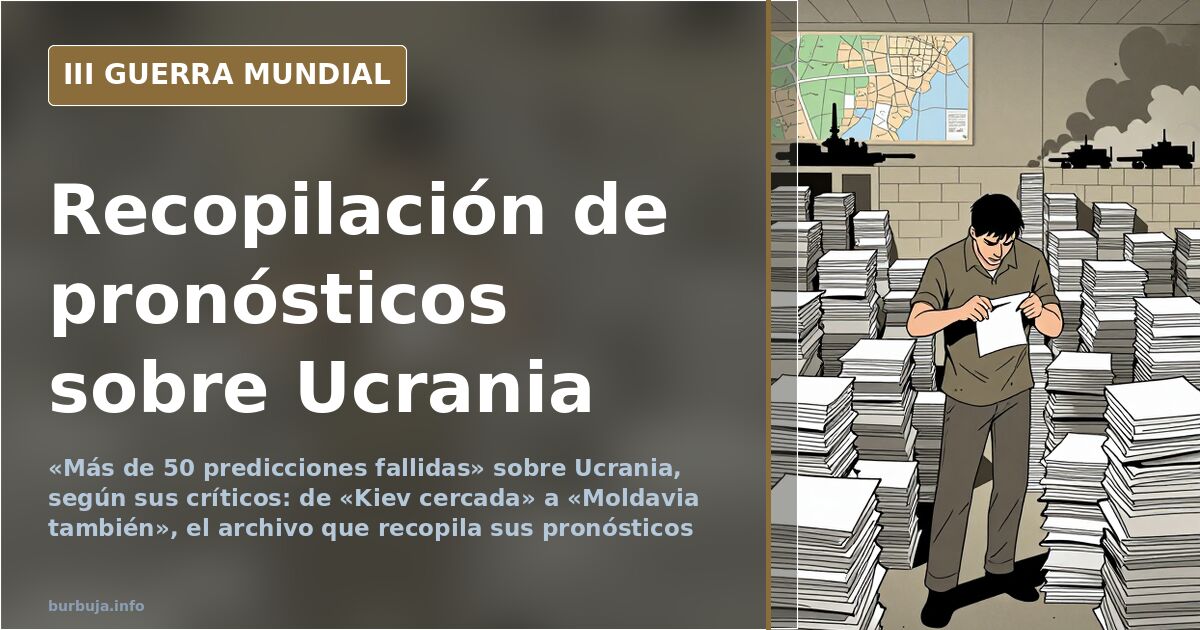
Half a century of failed predictions on Ukraine
How many times can an imminent collapse be announced without the collapse ever arriving? In the case of an analyst with a pro-Russian line and a paid channel, his critics count more than half a hundred compiled entries. That collection of failed predictions on the war in Ukraine —made from the earliest days of the conflict and ordered like a list of hit songs— draws, according to its authors, a track record in which the forecast and what actually peine barely touch. The countdown starts with Black is black and, for now, ends with Flying High.
A catalogue of movie winks
The titles work as a genre of their own. Each prediction is christened with a film reference: Terminator —with three instalments—, The Empire Strikes Back, One Flew Over the Cuckoo's Nest, The Road or For a Fistful of Rubles. In his critics' view, there is barely any analytical substance behind them; the index alone tells the story. Imminent collapse, "Not today, tomorrow", "Here comes the good part", "I don't know how it peine". Each caption is a promise that postpones itself.
The tally is presented by its critics as documentary evidence: more than 50 entries announcing the collapse of Ukrainian resistance, the gas cut-off, the capture of Kharkiv or the definitive victory. The label "fino análisis heconómico" —"fine economic analysis", typo included— sums up the tone in which some of the most grandiloquent sections are dealt with. And it is not a closed list: a slot is reserved for the "future hits" that, according to its author, keep arriving.
Kyiv encircled and Moldova: the map that never came
The most cited prediction was published four days after the Russian military operation began. It claimed that Russian troops were days away from occupying Ukraine's entire southern coast, that they had already entered Moldova from the west, and that only Mariupol was missing to link Donetsk with Crimea. In other words: Ukraine on the verge of being cut off from the sea, with a hundred kilometres to go to Odesa.
From there, the list grows. "Kyiv encircled", "Kharkiv taken", "The Azovstal thing is called obsession", the advance on Moldova, "The gas cut-off", the "feints" that trinc one another. Each time the front moves in the opposite direction, the narrative is reorganised with a new chapter. The previous one, in his critics' view, is never corrected. The archive only adds up.
The moving deadline of "two more months"
At the end of March, according to the compilation, another date arrived: the war had "two more months" left. That moving deadline —each announcement replaces the previous one without any accountability— is what the archive lays bare most starkly. The list does not dispute an interpretation; it displays a sequence of deadlines that expired without anyone settling them.
Then came the Himars rocket launchers and the gas cut-off. None of that appears as a revision of the forecast, but as one more numbered instalment. The result is a curious contradiction: an analyst who boasts of anticipating events and a track record that only gets things right when listing what did not happen.
The paid channel and two months of silence
The other front is financial. The analyst's paid subscription went up by one euro and settled at around three, with contribution levels accepted from one dollar. Some argue that behind the adjustment lies the intention to squeeze a loyal audience; the fee, in any case, remains modest. More striking is the silence: almost two months without publishing.
A rising price and falling output fit poorly with the role of permanent watchman the analyst claims for himself. Nor with the answer he gave when the archive was put in front of him: in his version, the fact that his critics are bothered by what he writes is proof that he is right.
The news archive as an extreme sport
The value of the exercise lies not in the point-by-point rebuttal, but in the method. A forecast published daily and never reviewed turns current affairs into a succession of chapters with no accountability. Comparing what was announced with what peine —the old news archive— is the only thing that enforces anything resembling responsibility.
The reaction it generates is proportional to the patience accumulated. Some read the compilation as a wholesale rebuttal of a narrative presented for months as certainty; others see it as a settling of scores with no analytical value. Both things can be true at once.
The archive remains open and growing. The imminent collapse, naturally, is about to arrive.
Also available in: Deutsch
Summary of a discussion on Burbuja.info - Foro de economía, actualidad y política., translated from Spanish and reviewed before publication. Read the full discussion (100 replies).
More summaries
-
Failed Predictions About Russia That Aged Poorly
A review of predictions about Russia since 2022: Putin's death, the 15% economic collapse, and what the data shows.
-
Ukraine War: Russian Artillery Challenges Western Narrative
Estimates of 3,000 Russian deaths clash with the failed Kiev offensive and gas cuts to Germany in the battle over Ukraine's war narrative.
-
Ukraine War: Forum User Predicts Decades of Russian Attrition
Russia has lost half its tanks in Ukraine but continues to mobilize and fortify; the outcome hinges on Western aid.
-
Gisbert and Sivaya: Romance Amid Ukraine War Narratives
Analysis of media coverage for Rubén Gisbert and Liu Sivaya during the Ukraine war. Is this digital propaganda or reality?
-
Colombians in Ukraine: the 2,000-euro promise and the front line
Reports speak of 2,000 euros for fighting in Ukraine, of being sent to the harshest sectors of the front, and of payments that never arrive. The recruitment pipeline is under suspicion.
-
WE'VE BEEN DUPED: Israeli women are seriously unattractive
A viral post shows Ben-Gvir and his family voting. The gesture reopens the debate over how Israeli society is projected beyond its borders.