
Colombians in Ukraine: the 2,000-euro promise and the front line
Reports speak of 2,000 euros for fighting in Ukraine, of being sent to the harshest sectors of the front, and of payments that never arrive. The recruitment pipeline is under suspicion.
English · Original discussion in Spanish · Published
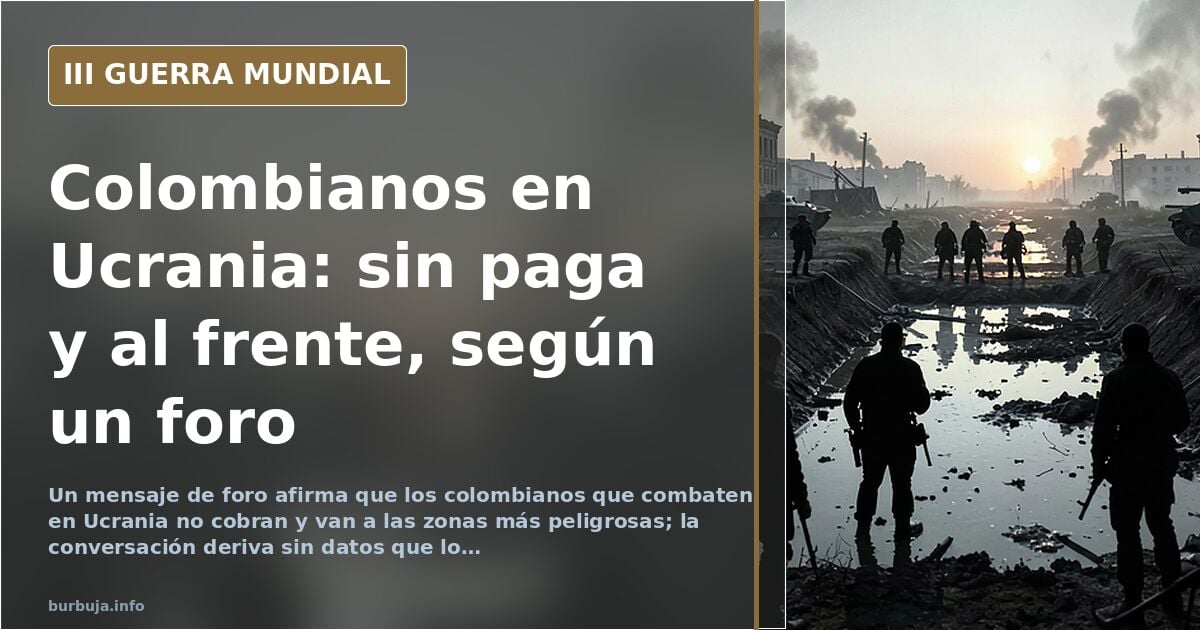
Colombians in Ukraine: 2,000 euros and the harshest front
What do we know about the Colombians fighting in Ukraine? That they are sent to the most battered points of the front, that some speak of payments of 2,000 euros, and that, according to the accounts circulating, many end up unpaid or with no one answering for them. The discussion begins with a specific accusation: foreign fighters are treated as cannon fodder and, when they fall, the official response is silence.
The financial lure and the fine print
The figure that keeps coming up is 2,000 euros. It appears in videos and serves as bait for recruiting foreigners. The problem is what comes after: some claim that money never arrives, that payments are delayed or vanish, and that the family of the fallen receives nothing. The promise works as a shop window; reality, as the fine print.
Added to this is the operational destination. The accounts agree that foreigners are sent to the most exposed sectors, where artillery and drones do the work quickly. It is not an isolated impression: it is described as a pattern. And yet the flow of recruits does not stop, something that baffles even those who trinc the issue closely.
Why do they keep going if the treatment is so bad?
The paradox is the core of the matter. I don't understand anything, one of the participants essentially says: if conditions are like that, why isn't the flow of recruits falling? The hypotheses range from a lack of economic alternatives back home to the pull effect of the first accounts, to plain misinformation about what awaits them on arrival.
The parallel drawn is uncomfortable: it is claimed that the same is done with wounded Ukrainian soldiers of their own side, leaving them behind. If that were true, the foreigner would not be the exception, but the norm taken to its extreme.
From Colombia to Poland: the same migration pipeline
The topic then shifts to a broader phenomenon. It describes the arrival of Colombian workers in Poland since 2025, recruited for the meat industry, and the arc that runs from initial enthusiasm to the shock of low wages, language and treatment many describe as slave-like. The war in Ukraine would be the extreme version of that same pipeline: recruitment abroad, harsh conditions once in.
The conversation later gets tangled in disputes over demographics, immigration and customs that add little to the substance. The useful fact remains the same: a recruitment market that operates on economic promises with little accountability.
In the end, the question is not how many Colombians are in Ukraine, but how many of those who went for 2,000 euros ever got paid. And for now, nobody has that answer.
Also available in: Deutsch
Summary of a discussion on Burbuja.info - Foro de economía, actualidad y política., translated from Spanish and reviewed before publication. Read the full discussion (35 replies).
More summaries
-
European youth won't fight Russia, forum thesis argues
Dodging conscription in Ukraine reportedly costs 20,000-25,000 dollars. With no European homeland and no future, the discontent running through young Europeans runs deep.
-
Wagner recruits African inmates from prisons to fight in Ukraine
A Zambian student died on the Ukrainian front. The case is linked to Wagner's recruitment of African prisoners for the war.
-
Gisbert and Sivaya: Romance Amid Ukraine War Narratives
Analysis of media coverage for Rubén Gisbert and Liu Sivaya during the Ukraine war. Is this digital propaganda or reality?
-
WE'VE BEEN DUPED: Israeli women are seriously unattractive
A viral post shows Ben-Gvir and his family voting. The gesture reopens the debate over how Israeli society is projected beyond its borders.
-
Brussels buries Nord Stream even if the war ends
The European Commission rules out Nord Stream's return even after the war, as concern grows over the cost of American gas and the resulting bill.
-
Spanish password manager Passwork shares tech ties with Russian counterpart
The Russian company linked to Passwork was certified by an agency of the Russian Ministry of Defense that reviews source code. The Spanish firm denies any relationship.