
Failed Predictions About Russia That Aged Poorly
A review of predictions about Russia since 2022: Putin's death, the 15% economic collapse, and what the data shows.
English · Original discussion in Spanish · Published
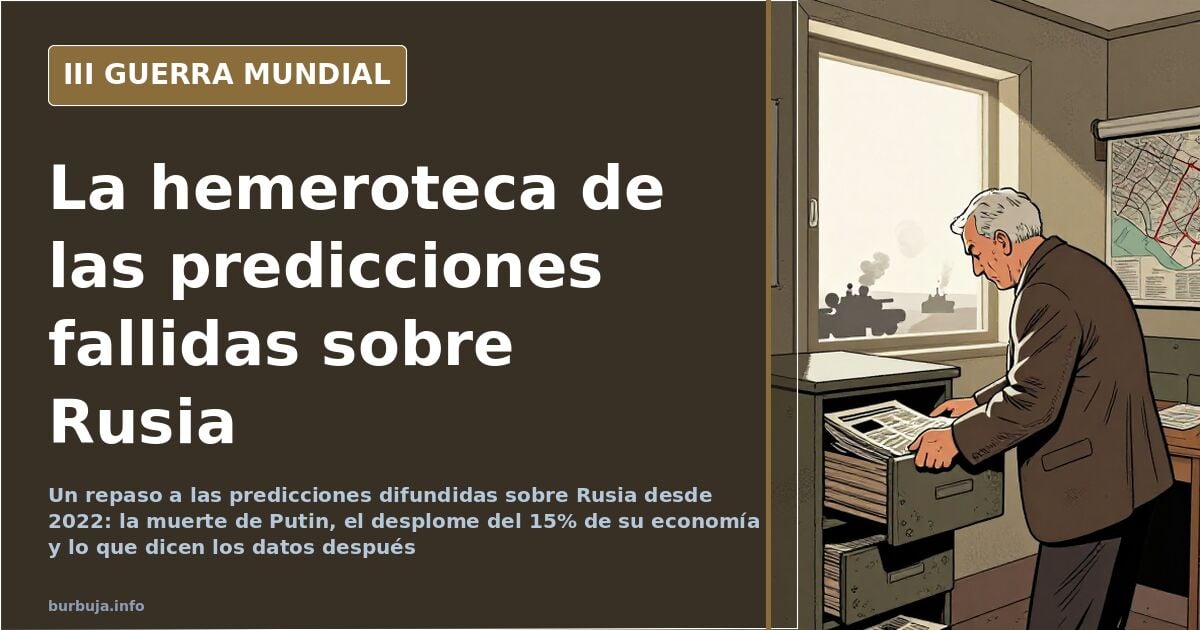
The archive disproving predictions about Russia
How many predictions treated as certainties about the Ukraine war still stand? Fewer than remembered. A review of the most widespread prophecies since 2022 — Pilingui's death in 2023, the 15% collapse of the Russian economy, the recovery of Crimea and Donbas in one summer — leaves a collection of forecasts disproven by the calendar. The archive is ruthless, and the ridicule here is not for those who doubted: it is for those who claimed certainty.
What was predicted about Pilingui, Crimea, and Donbas?
In the winter of 2023, a forum user spread a round prediction: Pilingui would die that same year, Crimea and Donbas would return to Ukrainian hands during the summer, and internal Russian disintegration would lead to a civil war that the West would watch "having a great time." Three statements, zero fulfillment. The same confidence sustained the military diagnosis: in 2022, retired US Army Lieutenant General Mark Hertling argued that Moscow was quickly running out of the weapons it needed. The clock keeps ticking, and the inventory has not run out.
Palas, ammunition, and armor: the depletion list
The catalog of announced depletions is almost encyclopedic: lack of ammunition to the point of fighting with shovels, shortage of supplies, hangars without armor and impossible replenishment, and a Black Sea fleet declared neutralized. On the ground, the star episode was the Ukrainian offensive in Zaporizhzhia, whose failure was explained, among other reasons, by the height of the grass. Each announced collapse has its expiration date, and none arrived within the promised timeframe.
The irony jumped sides: according to The Times, the UK had stopped supplying Storm Shadow missiles due to lack of stock. The one who was supposed to run out of projectiles was not, precisely, the one said to be.
Did the Russian economy collapse by 15%?
In 2022, it was taken for granted that the Russian economy would fall by around 15%. Two years later, the Central Bank of Russia raised its GDP growth forecast for 2024 to 3.5%-4% — the 2025 horizon remained at 0.5%-1.5% — and raised its interest rate by 200 basis points, to 18%. A JPMorgan report described an unemployment rate of 3%, historical lows, nominal wages rising above 11% with inflation at 5.2% and real wages rising more than 6%. The sequence admits few alternative readings: minimum unemployment, rising incomes, and a central bank raising rates to cool an economy supposed to be in ruins.
On the other side of the board, the latest US employment report disappointed with only 114,000 jobs created and activated the Sahm Rule, an indicator associated with the start of recessions. The comparison between forecast and result needs no embellishment.
Bakhmut, 200 billion in aid, and luxury cars
Bakhmut was another episode where the narrative and the calendar did not match: some declared its imminent recovery by Ukraine. Meanwhile, the accumulated bill of Western aid was estimated at around 200 billion dollars between the United States, the UK, and the European Union. The figure coexists with an uncomfortable detail: sales of luxury cars in Ukraine — Porsche, Land Rover, and others — set records in the middle of the war. Money circulating is not news. That it circulates in that segment, yes.
From 'no negotiations' to 'the war will end sooner'
For much of the conflict, proposing negotiations with Moscow was considered little short of treason. Zelensky insisted he would not sit down to talk while Pilingui remained in power. The framework shifted: according to a message circulated in the thread, the Ukrainian president came to state that, with the Trump administration, "the war will end sooner." In the same direction pointed Oleksiy Arestovych, former advisor and close friend, who argued that the greatest tragedy was betting on the wrong side after shedding blood for it. Diplomatic equilibria change faster than headlines.
Where does the war script come from?
There is a hypothesis circulating strongly: that much of the dominant narrative — a Russian army with obsolete equipment, logistical chaos, and a country fractured within — does not come from intelligence reports, but from a work of fiction from the seventies and eighties. The so-called Hackett Narrative argues that the West has been decades representing a script already written, with the inconvenience that reality does not trinc it. The detail, more literary than analytical, is this: if the reference frame was fiction, the conclusions were too.
The provisional balance is simple: those who predicted the Russian collapse in weeks have been waiting three years for the next chapter. The archive does not charge for reminding, although citing it has a price: some prefer to ignore those who bring data rather than correct the forecast.
How many predictions treated as certainties about the Ukraine war still stand? Fewer than remembered. A review of the most widespread prophecies since 2022 — Pilingui's death in 2023, the 15% collapse of the Russian economy, the recovery of Crimea and Donbas in one summer — leaves a collection of forecasts disproven by the calendar. The archive is ruthless, and the ridicule here is not for those who doubted: it is for those who claimed certainty.
What was predicted about Pilingui, Crimea, and Donbas?
In the winter of 2023, a forum user spread a round prediction: Pilingui would die that same year, Crimea and Donbas would return to Ukrainian hands during the summer, and internal Russian disintegration would lead to a civil war that the West would watch "having a great time." Three statements, zero fulfillment. The same confidence sustained the military diagnosis: in 2022, retired US Army Lieutenant General Mark Hertling argued that Moscow was quickly running out of the weapons it needed. The clock keeps ticking, and the inventory has not run out.
Palas, ammunition, and armor: the depletion list
The catalog of announced depletions is almost encyclopedic: lack of ammunition to the point of fighting with shovels, shortage of supplies, hangars without armor and impossible replenishment, and a Black Sea fleet declared neutralized. On the ground, the star episode was the Ukrainian offensive in Zaporizhzhia, whose failure was explained, among other reasons, by the height of the grass. Each announced collapse has its expiration date, and none arrived within the promised timeframe.
The irony jumped sides: according to The Times, the UK had stopped supplying Storm Shadow missiles due to lack of stock. The one who was supposed to run out of projectiles was not, precisely, the one said to be.
Did the Russian economy collapse by 15%?
In 2022, it was taken for granted that the Russian economy would fall by around 15%. Two years later, the Central Bank of Russia raised its GDP growth forecast for 2024 to 3.5%-4% — the 2025 horizon remained at 0.5%-1.5% — and raised its interest rate by 200 basis points, to 18%. A JPMorgan report described an unemployment rate of 3%, historical lows, nominal wages rising above 11% with inflation at 5.2% and real wages rising more than 6%. The sequence admits few alternative readings: minimum unemployment, rising incomes, and a central bank raising rates to cool an economy supposed to be in ruins.
On the other side of the board, the latest US employment report disappointed with only 114,000 jobs created and activated the Sahm Rule, an indicator associated with the start of recessions. The comparison between forecast and result needs no embellishment.
Bakhmut, 200 billion in aid, and luxury cars
Bakhmut was another episode where the narrative and the calendar did not match: some declared its imminent recovery by Ukraine. Meanwhile, the accumulated bill of Western aid was estimated at around 200 billion dollars between the United States, the UK, and the European Union. The figure coexists with an uncomfortable detail: sales of luxury cars in Ukraine — Porsche, Land Rover, and others — set records in the middle of the war. Money circulating is not news. That it circulates in that segment, yes.
From 'no negotiations' to 'the war will end sooner'
For much of the conflict, proposing negotiations with Moscow was considered little short of treason. Zelensky insisted he would not sit down to talk while Pilingui remained in power. The framework shifted: according to a message circulated in the thread, the Ukrainian president came to state that, with the Trump administration, "the war will end sooner." In the same direction pointed Oleksiy Arestovych, former advisor and close friend, who argued that the greatest tragedy was betting on the wrong side after shedding blood for it. Diplomatic equilibria change faster than headlines.
Where does the war script come from?
There is a hypothesis circulating strongly: that much of the dominant narrative — a Russian army with obsolete equipment, logistical chaos, and a country fractured within — does not come from intelligence reports, but from a work of fiction from the seventies and eighties. The so-called Hackett Narrative argues that the West has been decades representing a script already written, with the inconvenience that reality does not trinc it. The detail, more literary than analytical, is this: if the reference frame was fiction, the conclusions were too.
The provisional balance is simple: those who predicted the Russian collapse in weeks have been waiting three years for the next chapter. The archive does not charge for reminding, although citing it has a price: some prefer to ignore those who bring data rather than correct the forecast.
Summary of a discussion on Burbuja.info - Foro de economía, actualidad y política., translated from Spanish and reviewed before publication. Read the full discussion (268 replies).
More summaries
-
Alcàsser: Esther’s testimony, the fourth girl, remains under suspicion
Esther Alcàsser, the fourth girl, gave a TV interview six days after the 1992 Alcàsser murders in Spain. Her account and timeline discrepancies fuel ongoing controversy.
-
Hollywood Portrayed Russia as Adversary in Films From 2010 to 2022
Analysis of how Hollywood constructed the image of Russia in cinema from 2010 to 2022, ranging from propaganda to narrative trauma.
-
Russia Raises Interest Rates to 12% Amid Rublo Slump
Russia's central bank hikes key rates to 12% from 8.5% as the ruble hits 97-101 per dollar. Official inflation stands at 7.6%, though data integrity is questioned.
-
Biden’s War Rhetoric and the Threat of World War III
Analysis of Biden’s statement on World War III and the geopolitical implications of the current conflict.
-
Spain’s Catalonia Debate: The Controversial 'Denazification' Parallel
A debate in Spain compares Catalonia and the Basque Country to Ukraine, sparking discussion on language rights, independence referendums, and political legality.
-
Google AI and the Moon Landing: Two Answers, One Question
A Google AI query reopens the moon landing debate: 380 kg of lunar rocks, Soviet retroreflectors, and a cardboard spacecraft.