
Out-of-context video reignites debate over childcare
A video shows a woman failing to watch a child in a kitchen with a knife within reach. The case reignites the debate over childcare and maternal instinct.
English · Original discussion in Spanish · Published
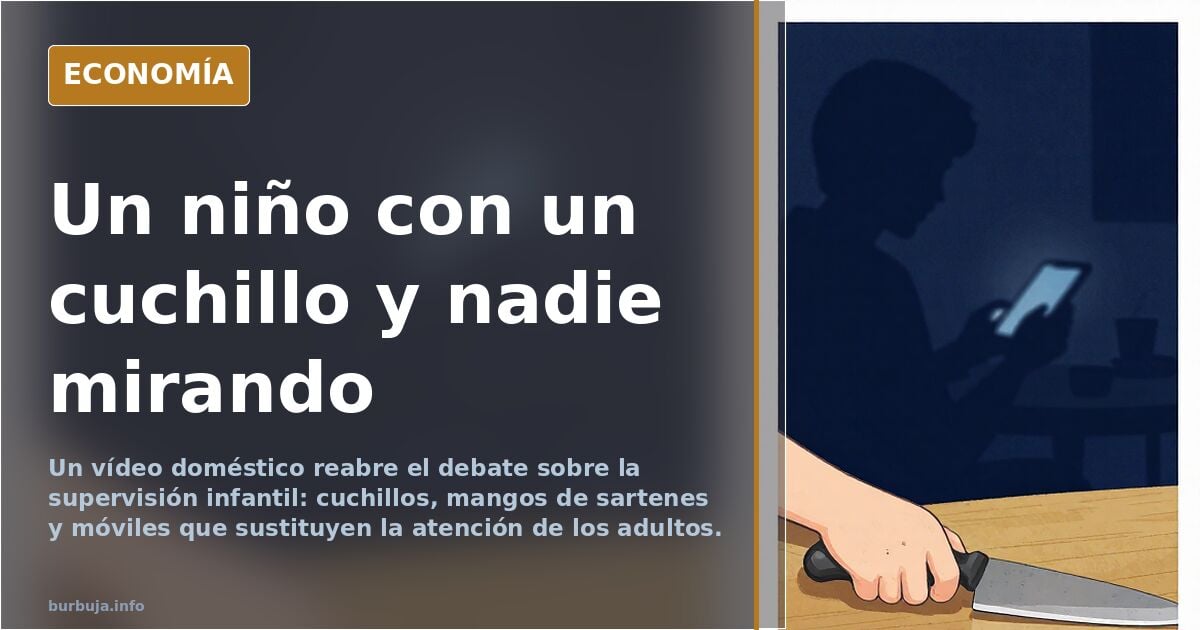
Out-of-context video reignites debate over childcare
Is maternal instinct a biological fact or a convenient story? A video circulating these days shows a woman who, allegedly, is watching a child in a kitchen while the boy handles a knife and she keeps her eyes on something else. The scene, hard to watch, has peine a discussion that seemed buried: whether childcare is an innate competence of women or simply a task society has assigned them by habit.
The video nobody wants to watch twice
The scene is simple, and that is precisely what makes it uncomfortable. A woman in a kitchen, a small child, a knife within arm's reach and a pot on the stove. The person filming does not intervene. Neither does the one who should be supervising. The video circulates without verified context: no date, place or identity of those involved is known, and that absence of data is exactly what makes it a perfect artifact for projecting prejudices.
Some argue the scene is impossible and can only be a fake generated with artificial intelligence. It is the most comfortable way out: if it is false, it requires no thought. Others point to something more prosaic and more serious: the pot handles turned outward, a mistake any home cook makes and which, with a child nearby, multiplies the risk of burns. It is not a one-off slip, they argue, it is a habit.
Why is childcare still associated with women?
The video has served as the trigger for a broader discussion. Part of the commentary argues that the absolute priority of many modern women is themselves, and that this trait, if it exists, is found in a much smaller proportion among men. Others reply that the education and employment system has spent two decades training people to compete and get ahead, and that it then seems incoherent to ask them to give that up as soon as they have a child.
The discussion drifts into more uncomfortable territory: the comparison between the educated woman and the uneducated one. Some put forward the hypothesis that the latter, seemingly more "rough," is often more loyal and a better mother than the flawless professional. It is a hunch without data, but it circulates widely because it taps into a widespread suspicion: that academic training guarantees nothing in the realm of emotional responsibility.
The phone as scapegoat and the real neglect
The mobile phone appears in almost every version of the story. Parents —not fathers, some point out— are described with small children sitting in strollers, entertained with screens from the age of two or three. The device serves a function: keeping the child from being a nuisance. And when Monday comes, daycare or school takes care of the rest.
In the case of the video, the detail is that neither he nor she was using a phone. Far from excusing them, that makes the scene worse for those commenting on it: there is no technological distraction to explain the lack of attention. The discussion about screens is thus displaced by a more basic question: what makes an adult stop watching a child in a kitchen?
What the video doesn't say and what the debate doesn't resolve
There is no possible verification. It is not established that the video is authentic, that the woman is the mother, or that the child suffered any harm. The discussion therefore moves in the realm of suspicion and anecdote, not proven facts. That does not stop the issue from touching on a real concern: the feeling that childcare has been delegated to institutions and screens while adults look the other way.
The most honest conclusion is that nobody has proven anything. Not that women are worse caregivers, not that maternal instinct is a myth, not that academic training protects or harms. There is only an out-of-context video and a conversation that, every time it opens, ends up talking about everything except the child.
Also available in: Deutsch
Summary of a discussion on Burbuja.info - Foro de economía, actualidad y política., translated from Spanish and reviewed before publication. Read the full discussion (15 replies).
More summaries
-
AI as an economic engine: bubble or structural shift?
Economic analysis of AI: Is it the growth engine or a speculative bubble? Energy costs and business adoption are examined.
-
Humans lack maternal instinct, unlike other species
Debate claims humans are the only species unable to raise offspring without social structures, questioning if we are a design error.
-
Trump Proposes Renaming AI to 'Superintelligence'
Trump suggests renaming AI to 'Superintelligence' and labels current term users as enemies, per a viral tweet.
-
Putin's plane forced to circle Moscow amid drone attack
Reports indicate Putin's aircraft could not land in Moscow during a Ukrainian drone strike, with three official Russian planes circling the airport.
-
Spain's University Statute gives students power over what is taught
Spain's University Statute will give students a say over what is taught. The key detail: it does not clarify which students, or with what checks and balances.
-
Unemployed mother of two in Ceuta, Spain: the maze of benefits that never arrives
A 25-year-old single mother, former self-employed worker and unemployed since December: the case that reopens the debate in Ceuta, Spain, over who actually receives social benefits