
Spain's University Statute gives students power over what is taught
Spain's University Statute will give students a say over what is taught. The key detail: it does not clarify which students, or with what checks and balances.
English · Original discussion in Spanish · Published
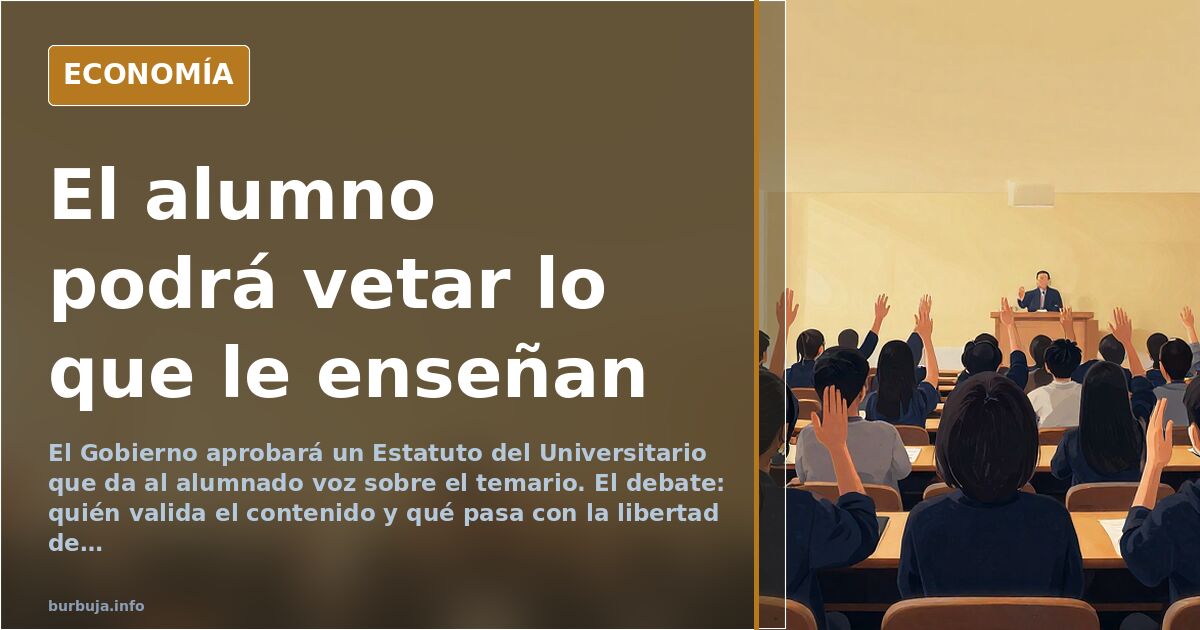
The University Statute that puts students in charge of approving teaching
A headline and a paradox. The Spanish Government will approve the University Statute under which students must give the green light to what they are taught, according to the report that opens this discussion. The news, dated at the time of this analysis, describes a mechanism whereby students stop being passive recipients and gain a formal voice over course content and, in practice, over who teaches it. The detail that sets off every alarm: it does not specify which "students" it refers to.
Who is the "student" that approves the syllabus
The most common criticism does not attack the underlying idea, but its fine print. Some argue that behind the generic label of "the students" lie student associations and unions, structures that in practice act as recruiting grounds for political parties and that dominate the representative bodies, the subsidies and the use of premises. The student who just attends class and works — the majority profile — has neither the time nor the desire to get involved in those circles. The consequence, according to this analysis, is that the approval would come from organised and disciplined minorities, not from real students.
The argument has legs. Anyone who has been through a public university recognises the mechanism: representative elections are held with absurdly small turnouts, and non-partisan candidates struggle to compete for resources. If the filter on course content passes through those hands, ideological control stops being a suspicion and becomes design.
Academic freedom, up in the air
The second front is academic. The law directly touches academic freedom, the principle that allows professors to teach without anyone dictating their script. Several contributions point to the obvious risk: if a student can veto content they consider "politically incorrect", the lecturer who teaches an uncomfortable subject — from history to economics — is exposed to pressure from organised classrooms. The predictable result is not a richer debate, but a syllabus watered down for antiestéticar of conflict.
Some go further and read it as a tool for purging staff: sidelining full professors who do not toe the official line and replacing them with like-minded profiles. It is the classic conspiratorial reading, but it fits the timeline being discussed.
The jurisdictional clash nobody clarifies
The discussion soon shifts to the distribution of power. For days it has been repeated that education falls exclusively under the competence of Spain's autonomous regions and that the central Government has no say. Now a university statute approved from Madrid appears that directly affects higher education. The contradiction, they point out, is textbook: either the regions legislate or they do not. And along the way, the double standard with which the autonomous State is invoked whenever convenient is laid bare.
The underlying doubt remains, the one nobody fully answers: if the student validates what they learn, what happens when the student is wrong? Who corrects the one who corrects the teacher?
Summary of a discussion on Burbuja.info - Foro de economía, actualidad y política., translated from Spanish and reviewed before publication. Read the full discussion (21 replies).
More summaries
-
Female Names by Decade and Autonomous Community
The most popular female names in Spain, analyzed by decade and Autonomous Community, from the 1930s to 2024. Discover the trends.
-
Foreign tenants: over half in Spain, 70% in three regions
More than 5.2 million tenants in Spain were born abroad. In Madrid, Valencia and Murcia the share reaches 70%. Data and analysis of...
-
The cost of wrecking a sunflower field: viral video and farm subsidies
A young man films himself destroying a sunflower field and the video goes viral. The destruction of 3 sunflowers exposes the reality of EU farm subsidies.
-
Two children killed in drug clan feud in Spain
A settling of scores between drug trafficking clans in Spain has claimed the lives of two minors, one unborn, fulfilling a threat made two years ago. The images...
-
The boredom of plenty: why rich societies grow restless
The case for boredom as a driver of discontent in the age of abundance: Ortega y Gasset, debt and nostalgia for the pre-9/11 world.
-
Sánchez opens door to private guardianship of migrant minors in Spain
The Spanish government is preparing a plan for NGOs to take on the legal guardianship of migrant minors in Ceuta. Privatisation, civil liability and profit: controversy is guaranteed.