
Unemployed mother of two in Ceuta, Spain: the maze of benefits that never arrives
A 25-year-old single mother, former self-employed worker and unemployed since December: the case that reopens the debate in Ceuta, Spain, over who actually receives social benefits
English · Original discussion in Spanish · Published
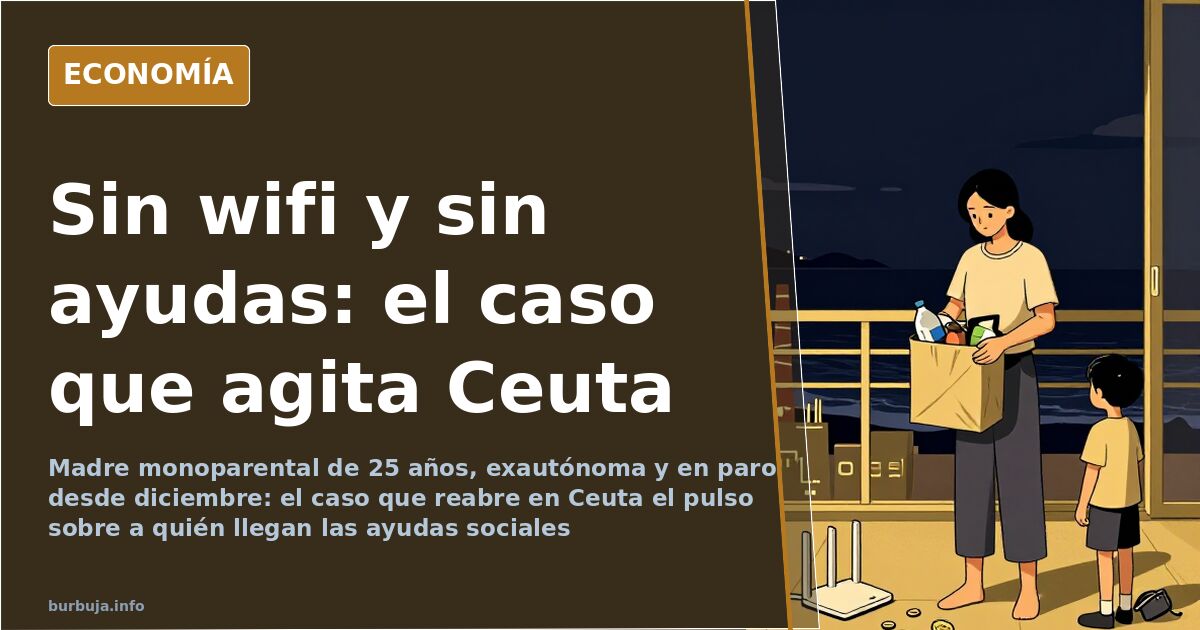
Unemployed, self-employed and with two daughters: the benefit that never arrives in Ceuta
A 25-year-old woman, a former self-employed worker who has been unemployed since December, says she has not received "a penny" from any public administration. A single mother of two girls, her testimony —shared with the remark that she cannot even afford wifi and hot water— has become the trigger for a far more uncomfortable debate: who in Ceuta actually receives social benefits, and who falls through the cracks along the way.
The case lands in a territory where pressure on public services has been at the heart of social discontent for years. And it lands with an emotional charge that makes analysis difficult: when someone says they cannot afford to heat water, the instinct is to argue, not to count.
What benefits exist and which ones fail to arrive
The catalogue available to a single-parent family with no income is longer than the complaint suggests:
The other side of the balance sheet is less photogenic: being on the municipal register is not the same as getting paid. Income thresholds, household composition, processing deadlines and the obligation to prove one's situation over and over leave out people who, on paper, meet the requirements. Nobody publishes how many applications fall into that gap.
The hole in the self-employed scheme
There is a detail that does not fit the story of universal support: being self-employed changes the rules. Unemployment cover under this scheme is the cessation-of-activity benefit, which requires prior contributions, a justified cause and a level of bureaucracy that many short careers do not survive. At 25, with a business just closed, the odds of falling into no man's land are high.
On top of that, the IMV calculation looks at the income of the entire household, not the individual's declaration. A single-parent family sharing a roof with grandparents or another household unit can see its benefit cut without an extra euro actually arriving at home.
What remains unresolved
The case will keep being fought over two checkboxes: whether the benefit was applied for and whether the decision arrived in time. Until coverage data are published broken down by city and family type, the debate will be settled by shouting rather than by case files. In a few months, most people will probably have forgotten the name of this Ceuta resident, but the same complaint will resurface with a new face and the same unaudited figures.
A 25-year-old woman, a former self-employed worker who has been unemployed since December, says she has not received "a penny" from any public administration. A single mother of two girls, her testimony —shared with the remark that she cannot even afford wifi and hot water— has become the trigger for a far more uncomfortable debate: who in Ceuta actually receives social benefits, and who falls through the cracks along the way.
The case lands in a territory where pressure on public services has been at the heart of social discontent for years. And it lands with an emotional charge that makes analysis difficult: when someone says they cannot afford to heat water, the instinct is to argue, not to count.
What benefits exist and which ones fail to arrive
The catalogue available to a single-parent family with no income is longer than the complaint suggests:
- Minimum Vital Income (Spain's means-tested minimum income scheme) calculated for a three-person household
- The child support supplement, around 115 euros per minor
- The minimum social insertion income, with a 22% top-up for single-parent families
- Complementary benefits to the IMV deployed by the autonomous city itself
- Unemployment subsidies, housing allowances, school grants, social vouchers and food banks
The other side of the balance sheet is less photogenic: being on the municipal register is not the same as getting paid. Income thresholds, household composition, processing deadlines and the obligation to prove one's situation over and over leave out people who, on paper, meet the requirements. Nobody publishes how many applications fall into that gap.
The hole in the self-employed scheme
There is a detail that does not fit the story of universal support: being self-employed changes the rules. Unemployment cover under this scheme is the cessation-of-activity benefit, which requires prior contributions, a justified cause and a level of bureaucracy that many short careers do not survive. At 25, with a business just closed, the odds of falling into no man's land are high.
On top of that, the IMV calculation looks at the income of the entire household, not the individual's declaration. A single-parent family sharing a roof with grandparents or another household unit can see its benefit cut without an extra euro actually arriving at home.
What remains unresolved
The case will keep being fought over two checkboxes: whether the benefit was applied for and whether the decision arrived in time. Until coverage data are published broken down by city and family type, the debate will be settled by shouting rather than by case files. In a few months, most people will probably have forgotten the name of this Ceuta resident, but the same complaint will resurface with a new face and the same unaudited figures.
Summary of a discussion on Burbuja.info - Foro de economía, actualidad y política., translated from Spanish and reviewed before publication. Read the full discussion (15 replies).
More summaries
-
Málaga mayor who won 88% of the vote quits Spain's PSOE
A mayor of a small town in Málaga province leaves the PSOE after winning with 88.13% of the vote, according to the tweet breaking the news.
-
Schwarzenegger's property empire before Hollywood made him a star
Arnold Schwarzenegger built a $300M fortune investing in apartments before becoming an actor. His 'bleed the tenants' strategy reopens the debate over rentier…
-
Zapatero in court: the trial that brings back Ketty Garat's sparkle
The trial of former Spanish PM Zapatero over rumours from his time in office triggers an unexpected effect: Ketty Garat regains her sparkle and dominates the headlines again.
-
Spain creates paid menopause sick leave from day one, no contributions needed
Spain's Government creates a menopause-related sick leave paid from the first day with no prior contribution record. The employer pays day one and Congress must…
-
Spain's Grandchildren Law: 1.3 million votes for the PSOE?
An estimate claims the Grandchildren Law could deliver 1.3 million votes to Spain's PSOE. We examine the figures and the accusations of electoral manipulation.
-
The economic cost of insecurity in Madrid
A stabbing in Madrid renews the debate over the link between insecurity and the economy: the impact on tourism, retail and how residents perceive the city.