
Osteopathy in Spain: Costs and Safety Concerns
Online debate on osteopathy highlights sciatica risks, €50-90 session costs, and the tension between manual therapy and pseudoscience.
English · Original discussion in Spanish · Published
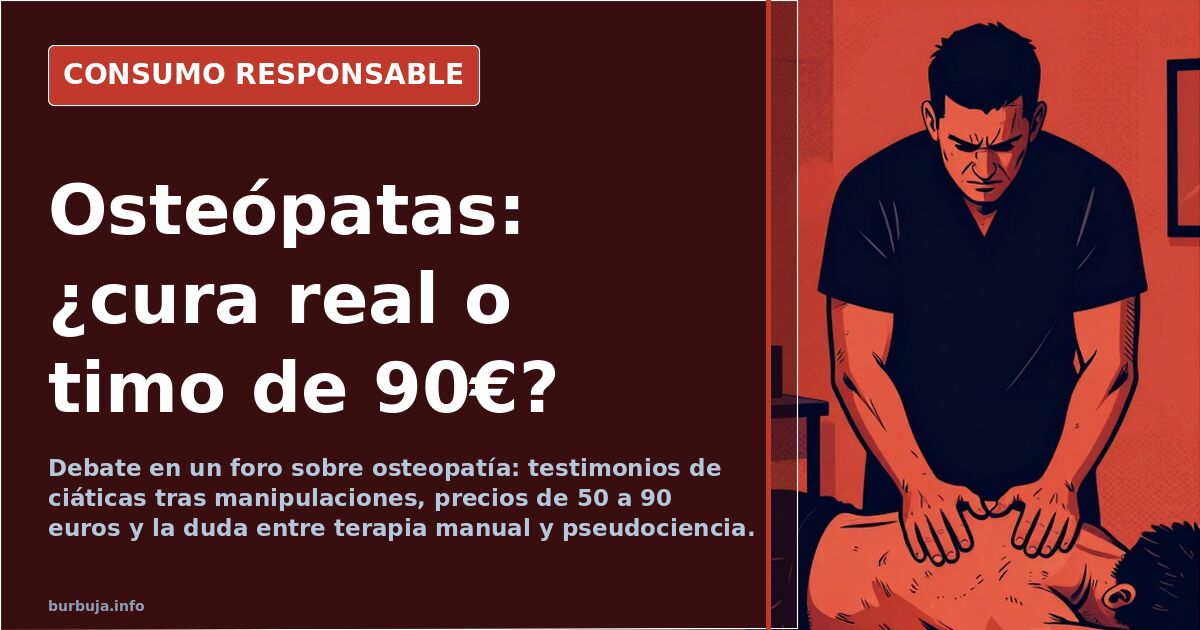
Osteopathy: Between Cracking Sounds and Pseudoscience
Back pain that doesn't respond to anti-inflammatories. An osteopath who barely moves their hands, keeping fingers still over the area, yet allegedly removes the pain according to the patient. This scene repeats in clinics, and the pattern is always the same: someone with an injury unresolved by conventional medicine tries spinal manipulation. And there begins a dispute that, according to one participant, has remained unresolved for 2784 days: is it manual therapy with centuries of practice or pseudoscience wearing a white coat?
The issue has an economic dimension that few discuss: the price. Participants mention sessions ranging from €50 to €90, with cases reaching €200. For chronic neck pain or recurrent sciatica, this is a recurring expense competing with local physiotherapists and public healthcare orthopedic specialists. The question hovering over each testimonial isn't whether it cracks, but whether the sustancia ilegal is worth the cost.
What exactly is osteopathy and why is it called pseudoscience?
Its origins lie in the 19th century with Andrew Taylor Still (1828-1917), a US physician who formulated the idea that the body heals itself if structures are aligned. The classic quote repeated: when all parts of the body are aligned, we enjoy health; when they aren't, the effect is disease. That framework, brought to the present day, clashes head-on with evidence-based medicine.
Some argue that osteopathy is a regulated degree in several countries and that university training exists in Spain. The University College of Osteopathy, formerly British School of Osteopathy, presents itself as the only European institution granting a degree in the subject. On the other side, the argument is that a title doesn't turn what hasn't passed clinical trials into science. The discussion heats up when compared with homeopathy, acupuncture, or reiki: techniques practiced, charged for, and believed in, but which haven't demonstrated efficacy beyond the placebo effect.
Testimonials supporting the practice: dislocations, ribs, and unhealing fingers
The most repeated defense doesn't come from studies, but from experiences. A rugby player recounts that a finger sprain that didn't heal with ultrasound was resolved with a turpentine and herb potion from a healer. Another case: a rib dislocated after a tackle that an osteopath repositioned when the back gave way again. The conclusion they draw is that there are mechanical interventions sports medicine doesn't cover.
The technical counterargument has a name: reduction. In traumatology, the procedure to reposition a dislocation is standardized, scientific, and has protocols. That an orthopedic specialist doesn't do it in consultation doesn't miccionan it doesn't exist. The underlying accusation is that the osteopath sells as exclusive something medicine already does, with less risk and more prior diagnosis.
Real risk: two-year sciatica and contractures no one touches
Here the debate stops being theoretical. A patient recounts that after three sessions with a professional with diplomas on the wall, she ended up with sciatica lasting nearly two years. Another person says they went to treat a huge cervical contracture and left without anyone touching the area: the osteopath didn't dare. The neck remains like guitar strings.
Physiotherapy professionals intervening in the conversation admit caution: manipulations are limited to dorsal and lumbar zones, and always after ruling out bone problems. The cervical zone is mined ground. The repeated warning: don't let anyone touch your neck without prior diagnosis. In health, the advice is always to consult a qualified healthcare professional.
How much does it cost and who pays: the business of manipulation
Price is where skepticism becomes transversal. An osteopath session averages €50 at the low end, rises to €90 in established clinics, and reaches €200 in cases denounced as abusive. Comparison with physiotherapists is inevitable: some charge €60 for twenty minutes with devices, while others dedicate a full hour to manual treatment.
The recurring complaint isn't just the price, it's the lack of homogeneous regulation. In Spain, access to official osteopathy training requires first having a Physiotherapy degree, according to professionals with over 20 years of practice in public health. This excludes those arriving via private courses without a healthcare base. The result: a market where university graduates coexist with self-taught individuals holding framed diplomas.
Hernias, diagnoses, and the limits of manipulation
A disc herniation isn't cured by manipulation. Even osteopathy defenders admit this: once it exists, you either operate or it reabsorbs alone in some cases. Physiotherapy relieves many patients, not all. Osteopathy, they say, works similarly: it's not a panacea. The difference is that conventional medicine has referral protocols and the osteopath's clinic often doesn't.
The fundamental problem is diagnosis. Back pain can be muscular, discal, tumoral, or referred. Without imaging tests, manipulation is a blind act. Consulted physiotherapists insist their training includes knowing when not to touch. The question hanging in the air: how many osteopaths have that training and how many only have the course and enthusiasm?
The unsettling data isn't in the cracking sounds, it's in the tally: 2784 days after opening the discussion, the only shared conclusion is that no one has measured how much of those €90 ends in real relief versus faith.
Back pain that doesn't respond to anti-inflammatories. An osteopath who barely moves their hands, keeping fingers still over the area, yet allegedly removes the pain according to the patient. This scene repeats in clinics, and the pattern is always the same: someone with an injury unresolved by conventional medicine tries spinal manipulation. And there begins a dispute that, according to one participant, has remained unresolved for 2784 days: is it manual therapy with centuries of practice or pseudoscience wearing a white coat?
The issue has an economic dimension that few discuss: the price. Participants mention sessions ranging from €50 to €90, with cases reaching €200. For chronic neck pain or recurrent sciatica, this is a recurring expense competing with local physiotherapists and public healthcare orthopedic specialists. The question hovering over each testimonial isn't whether it cracks, but whether the sustancia ilegal is worth the cost.
What exactly is osteopathy and why is it called pseudoscience?
Its origins lie in the 19th century with Andrew Taylor Still (1828-1917), a US physician who formulated the idea that the body heals itself if structures are aligned. The classic quote repeated: when all parts of the body are aligned, we enjoy health; when they aren't, the effect is disease. That framework, brought to the present day, clashes head-on with evidence-based medicine.
Some argue that osteopathy is a regulated degree in several countries and that university training exists in Spain. The University College of Osteopathy, formerly British School of Osteopathy, presents itself as the only European institution granting a degree in the subject. On the other side, the argument is that a title doesn't turn what hasn't passed clinical trials into science. The discussion heats up when compared with homeopathy, acupuncture, or reiki: techniques practiced, charged for, and believed in, but which haven't demonstrated efficacy beyond the placebo effect.
Testimonials supporting the practice: dislocations, ribs, and unhealing fingers
The most repeated defense doesn't come from studies, but from experiences. A rugby player recounts that a finger sprain that didn't heal with ultrasound was resolved with a turpentine and herb potion from a healer. Another case: a rib dislocated after a tackle that an osteopath repositioned when the back gave way again. The conclusion they draw is that there are mechanical interventions sports medicine doesn't cover.
The technical counterargument has a name: reduction. In traumatology, the procedure to reposition a dislocation is standardized, scientific, and has protocols. That an orthopedic specialist doesn't do it in consultation doesn't miccionan it doesn't exist. The underlying accusation is that the osteopath sells as exclusive something medicine already does, with less risk and more prior diagnosis.
Real risk: two-year sciatica and contractures no one touches
Here the debate stops being theoretical. A patient recounts that after three sessions with a professional with diplomas on the wall, she ended up with sciatica lasting nearly two years. Another person says they went to treat a huge cervical contracture and left without anyone touching the area: the osteopath didn't dare. The neck remains like guitar strings.
Physiotherapy professionals intervening in the conversation admit caution: manipulations are limited to dorsal and lumbar zones, and always after ruling out bone problems. The cervical zone is mined ground. The repeated warning: don't let anyone touch your neck without prior diagnosis. In health, the advice is always to consult a qualified healthcare professional.
How much does it cost and who pays: the business of manipulation
Price is where skepticism becomes transversal. An osteopath session averages €50 at the low end, rises to €90 in established clinics, and reaches €200 in cases denounced as abusive. Comparison with physiotherapists is inevitable: some charge €60 for twenty minutes with devices, while others dedicate a full hour to manual treatment.
The recurring complaint isn't just the price, it's the lack of homogeneous regulation. In Spain, access to official osteopathy training requires first having a Physiotherapy degree, according to professionals with over 20 years of practice in public health. This excludes those arriving via private courses without a healthcare base. The result: a market where university graduates coexist with self-taught individuals holding framed diplomas.
Hernias, diagnoses, and the limits of manipulation
A disc herniation isn't cured by manipulation. Even osteopathy defenders admit this: once it exists, you either operate or it reabsorbs alone in some cases. Physiotherapy relieves many patients, not all. Osteopathy, they say, works similarly: it's not a panacea. The difference is that conventional medicine has referral protocols and the osteopath's clinic often doesn't.
The fundamental problem is diagnosis. Back pain can be muscular, discal, tumoral, or referred. Without imaging tests, manipulation is a blind act. Consulted physiotherapists insist their training includes knowing when not to touch. The question hanging in the air: how many osteopaths have that training and how many only have the course and enthusiasm?
The unsettling data isn't in the cracking sounds, it's in the tally: 2784 days after opening the discussion, the only shared conclusion is that no one has measured how much of those €90 ends in real relief versus faith.
Also available in: Deutsch
Summary of a discussion on Burbuja.info - Foro de economía, actualidad y política., translated from Spanish and reviewed before publication. Read the full discussion (136 replies).
More summaries
-
Spain's Castilian capitals rated: Segovia 10, Palencia 3
Segovia earns a perfect score while Palencia receives a failing grade in a subjective ranking of Spain's Castilian provincial capitals.
-
Nestlé and Dolca: 30% vs 25% Cacao, Same Price in Spain
Nestlé and Dolca chocolates differ by just 5% cacao yet cost nearly the same, revealing that budget brands in Spain are no longer significantly cheaper.
-
Shopee exits Spain: Chinese bargain era ends
Shopee shuts down in Spain without clear reasons, leaving shoppers with pricier AliExpress and mandatory VAT on imports.
-
Cheap, Healthy No-Cook Diet: Purees, Legumes, Pressure Cooker
A pressure cooker makes legumes in 45 mins and gazpacho in 15. The debate over daily meals pits the paleo diet against Mediterranean traditions.
-
Carrefour's 3-for-2 deal: €95.12 savings questioned
Carrefour's 3-for-2 offer yields €95.12 in discounts, but the claimed 49.68% saving drops to 33.2% depending on the calculation base. Bulk buying non-perishables to combat inflation.
-
Generic ibuprofen cheaper but often unavailable in Spanish pharmacies
Generic 400 mg ibuprofen costs €2.20 vs brand's €4.60 for fewer pills. Pharmacies claim stock shortages while pushing expensive brands.