
Cheap, Healthy No-Cook Diet: Purees, Legumes, Pressure Cooker
A pressure cooker makes legumes in 45 mins and gazpacho in 15. The debate over daily meals pits the paleo diet against Mediterranean traditions.
English · Original discussion in Spanish · Published
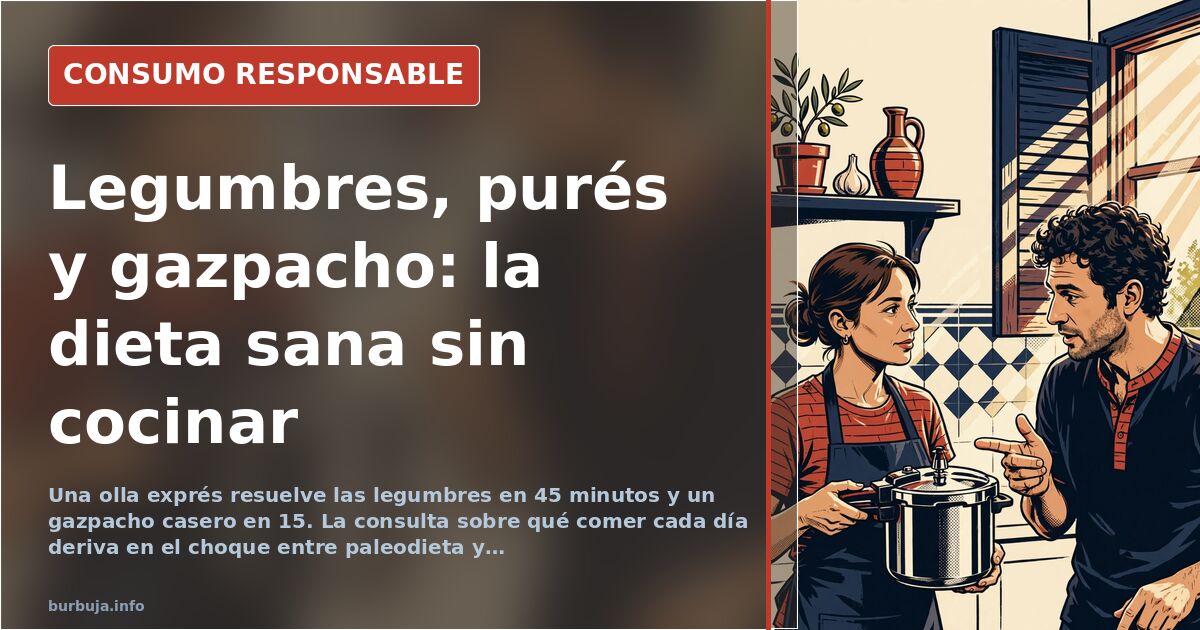
Purees, Gazpacho, and Pressure Cookers: A Healthy Diet That Requires Little Cooking
Fast food, sweets, sodas, and a liter of beer more often than desired. This is how someone describes their eating habits when asking for advice: only lunch is decent, the rest is "free choice" with bags of snacks in between. They request a healthy, simple, and filling diet, even if monotonous. And they drop the key fact that dictates everything else: they have about 8 kilos to lose and do no exercise.
This profile is not exotic. It is typical of anyone who has turned dinner into a grazing session. The response received offers little miracle but plenty of practical home management: cook less, cook cheaply, freeze in portions, and avoid buying what isn't needed.
Gazpacho, Purees, and Stews: The Repeated Recipes
If there is one dish that appears again and again, it is spoon food. Homemade gazpacho made with a blender takes about 15 minutes, is cheap, filling, and allows adjustments with pepper until finding your own formula. It works equally well in summer or winter, as many argue.
The second group of answers points to the pressure cooker, the tool that turns cooking into logistics. The proposed sequence is almost industrial: legumes, chicken carcass, and some meat are cooked for 45 minutes; the pot cools, opens, and vegetables—celery, leek, carrot, turnip—are added for another 45 minutes. Then, everything goes into containers and the freezer. Every day, open a portion and lunch is solved. "For the same price, you get a rich puree and a magnificent broth," summarizes one message.
There are variants for those who don't want to keep the fire on for long. A pisto (vegetable stew) made without adding a drop of water: pepper, tomato, carrot, onion, and leek in a covered pot for fifteen minutes, then blend. For dinner, frozen soups, creams, and purees by portion. The rule closing this section is so simple it's frustrating: don't eat anything your grandmother wouldn't recognize as food.
Is the Paleo Diet Better Than the Mediterranean?
Here the consultation splits in two. One current defends the paleo diet—meat, fish, fruit, and vegetables, nothing else—with an adaptation argument: for two million years the human body only knew these foods, hence intolerances to cereals, legumes, and dairy.
The rebuttal comes from several fronts. It is recalled that legumes and grains existed in the Neolithic, though without pressure cookers; that milk is assimilable for populations consuming it for millennia; and that reducing the diet to what was eaten 10,000 years ago ignores that life expectancy was minimal due to predators, infections, and wounds, not the menu. The summary of one repeated stance: the important thing is not living like ancestors, but accepting evolution has made us more tolerant of some foods than others.
In the middle remains a consensus resembling the textbook Mediterranean diet: seasonal fruit and vegetables, legumes, homemade stews with garlic and onion, more fish than meat, whole grains, and avoiding fried foods and refined sugar. A general practitioner cited in the conversation settles it with the obvious: eat everything, without exaggeration. A chocolate bun does not replace a steak with salad.
The Shopping List Matters More Than the Recipe
Apart from the dietary war, almost everyone agrees on one point: the problem is not information. Everyone knows what is superfluous in the cart. It is attitude. The proposal is disarmingly simple: make a closed list before leaving home and buy nothing not on paper. Distributing food into several daily meals—up to five—is discussed—to avoid arriving hungry at night, when snacking wins.
The original poster admits quitting alcohol entirely is difficult, though commits to cutting down liters consumed at home. No one promises miracles there. Among less-cooked solutions appear seed sprouts, cheap and requiring no fire, or canned fish in tomato sauce as a quick protein and omega-3 dinner. Eating healthy, most say, is not complicated; eating poorly is even easier.
Chlorella, Alkaline Diet, and Other Trendy Promises
Star remedies also emerge. Someone claims chlorella and artichokes "cleaned them inside" and improved blood tests in two months. It is a personal testimony, not proof: no trial supports that algae purifies blood, and remember the stomach is acidic by definition. Another voice recommends researching the alkaline diet as the most balanced, with no backing other than intuition.
Seed sprouts, however, have a more earthly defense: produced at home, stored easily, and require no cooking. Can be dressed with sauce and wrapped in a tortilla, or steamed for three minutes. It is the quintessential cheap food for those who don't want to depend on the supermarket every two days.
With this, the consultation ends where these things usually do. There is a clear, cheap, repeatable menu; a shopping list admitting no negotiation; and a liter of beer still ownerless. No one has yet decided if the problem was the plate or the hand filling it.
Fast food, sweets, sodas, and a liter of beer more often than desired. This is how someone describes their eating habits when asking for advice: only lunch is decent, the rest is "free choice" with bags of snacks in between. They request a healthy, simple, and filling diet, even if monotonous. And they drop the key fact that dictates everything else: they have about 8 kilos to lose and do no exercise.
This profile is not exotic. It is typical of anyone who has turned dinner into a grazing session. The response received offers little miracle but plenty of practical home management: cook less, cook cheaply, freeze in portions, and avoid buying what isn't needed.
Gazpacho, Purees, and Stews: The Repeated Recipes
If there is one dish that appears again and again, it is spoon food. Homemade gazpacho made with a blender takes about 15 minutes, is cheap, filling, and allows adjustments with pepper until finding your own formula. It works equally well in summer or winter, as many argue.
The second group of answers points to the pressure cooker, the tool that turns cooking into logistics. The proposed sequence is almost industrial: legumes, chicken carcass, and some meat are cooked for 45 minutes; the pot cools, opens, and vegetables—celery, leek, carrot, turnip—are added for another 45 minutes. Then, everything goes into containers and the freezer. Every day, open a portion and lunch is solved. "For the same price, you get a rich puree and a magnificent broth," summarizes one message.
There are variants for those who don't want to keep the fire on for long. A pisto (vegetable stew) made without adding a drop of water: pepper, tomato, carrot, onion, and leek in a covered pot for fifteen minutes, then blend. For dinner, frozen soups, creams, and purees by portion. The rule closing this section is so simple it's frustrating: don't eat anything your grandmother wouldn't recognize as food.
Is the Paleo Diet Better Than the Mediterranean?
Here the consultation splits in two. One current defends the paleo diet—meat, fish, fruit, and vegetables, nothing else—with an adaptation argument: for two million years the human body only knew these foods, hence intolerances to cereals, legumes, and dairy.
The rebuttal comes from several fronts. It is recalled that legumes and grains existed in the Neolithic, though without pressure cookers; that milk is assimilable for populations consuming it for millennia; and that reducing the diet to what was eaten 10,000 years ago ignores that life expectancy was minimal due to predators, infections, and wounds, not the menu. The summary of one repeated stance: the important thing is not living like ancestors, but accepting evolution has made us more tolerant of some foods than others.
In the middle remains a consensus resembling the textbook Mediterranean diet: seasonal fruit and vegetables, legumes, homemade stews with garlic and onion, more fish than meat, whole grains, and avoiding fried foods and refined sugar. A general practitioner cited in the conversation settles it with the obvious: eat everything, without exaggeration. A chocolate bun does not replace a steak with salad.
The Shopping List Matters More Than the Recipe
Apart from the dietary war, almost everyone agrees on one point: the problem is not information. Everyone knows what is superfluous in the cart. It is attitude. The proposal is disarmingly simple: make a closed list before leaving home and buy nothing not on paper. Distributing food into several daily meals—up to five—is discussed—to avoid arriving hungry at night, when snacking wins.
The original poster admits quitting alcohol entirely is difficult, though commits to cutting down liters consumed at home. No one promises miracles there. Among less-cooked solutions appear seed sprouts, cheap and requiring no fire, or canned fish in tomato sauce as a quick protein and omega-3 dinner. Eating healthy, most say, is not complicated; eating poorly is even easier.
Chlorella, Alkaline Diet, and Other Trendy Promises
Star remedies also emerge. Someone claims chlorella and artichokes "cleaned them inside" and improved blood tests in two months. It is a personal testimony, not proof: no trial supports that algae purifies blood, and remember the stomach is acidic by definition. Another voice recommends researching the alkaline diet as the most balanced, with no backing other than intuition.
Seed sprouts, however, have a more earthly defense: produced at home, stored easily, and require no cooking. Can be dressed with sauce and wrapped in a tortilla, or steamed for three minutes. It is the quintessential cheap food for those who don't want to depend on the supermarket every two days.
With this, the consultation ends where these things usually do. There is a clear, cheap, repeatable menu; a shopping list admitting no negotiation; and a liter of beer still ownerless. No one has yet decided if the problem was the plate or the hand filling it.
Also available in: Deutsch
Summary of a discussion on Burbuja.info - Foro de economía, actualidad y política., translated from Spanish and reviewed before publication. Read the full discussion (134 replies).
More summaries
-
Long-term Omeprazole Use: Risks of Suppressing Stomach Acid
Omeprazole is often prescribed indefinitely, but long-term acid suppression carries risks. This article explores side effects, alternatives, and the role of surgery.
-
Hypertension: Patients Question Lifelong Medication
Patients with hypertension share experiences on medication, keto diets, and arm asymmetry after diagnoses of spikes up to 190.
-
Spain: Fridge dies in a year, boots last eleven
In Spain, product durability varies wildly regardless of price. From fridges failing early to boots lasting over a decade, quality control remains inconsistent.
-
Fuel Efficiency: Drive at 105 km/h and 2,000 RPM
Driving at 105 km/h, increasing tire pressure, or using sixth gear at 2,000 RPM are key tips for saving fuel, though they have limits.
-
BM discounts branded tuna: 70% off with two cans
Branded tuna drops 50% at BM supermarkets and 70% for two cans, but the chain is concentrated in northwest Spain.
-
Shopee exits Spain: Chinese bargain era ends
Shopee shuts down in Spain without clear reasons, leaving shoppers with pricier AliExpress and mandatory VAT on imports.