
Iglesias Claims Díaz Worked to Destroy Podemos
Pablo Iglesias regrets handing power to Yolanda Díaz, accusing her of dismantling the party. The debate centers on internal appointments and leadership failures.
English · Original discussion in Spanish · Published
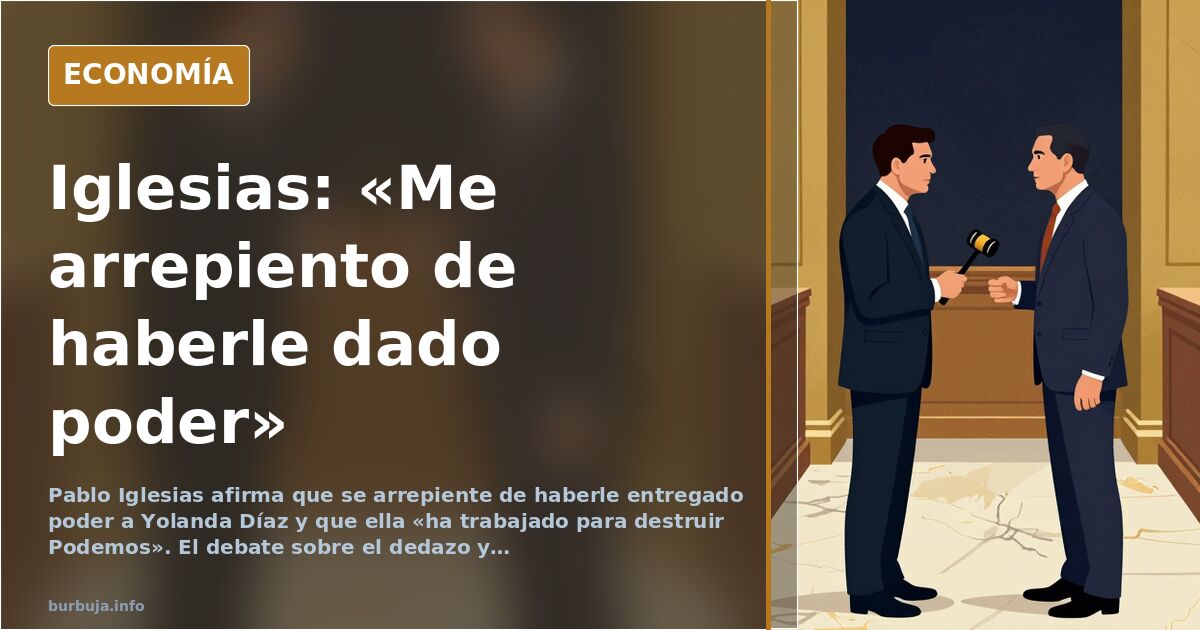
Iglesias Claims Díaz Worked to Destroy Podemos
Pablo Iglesias spoke bluntly: "I regret giving her so much power. She worked to destroy Podemos." This statement, reported by electomanía, is not a late reflection from a retired former vice-president. It is an explicit acknowledgment that Yolanda Díaz, his former number two in the party, has ended up dynamiting the structure he himself built. Alongside this comes the confession of a method: power was not won in primaries; it was granted from above.
The reaction was immediate. The dominant interpretation in public discourse is that Iglesias does not regret concentrating power, but rather placing it in the hands of others. "How generous he was with sharing power," summarizes an irony repeated in countless variations. The underlying accusation is more uncomfortable: if the party collapsed, it was because its architect designed an organization based on personal loyalties, not internal checks and balances.
Where Yolanda Díaz Came From and Why She Was Given Command
Díaz did not reach the vice-presidency through a primary process. She arrived because Iglesias placed her there. That is the data point underpinning the entire discussion. The person now demanding that Podemos return to being "an autonomous electoral option" was the one who designed the mechanism by which the party ceased to be so. The paradox is obvious to everyone: the same figure denouncing the destruction of the project was its main engineer.
Some argue the mistake was not choosing Díaz, but believing she could be controlled. "He thought he could manage her like his other majorettes, but Don Guapo picked her up and made her dance as he wished," notes a line of analysis circulating persistently. The thesis is that real power is neither granted nor withdrawn by decree: once ceded, the recipient has their own plans.
The Chalet, Ice Axe Attacks, and Ego as Causes of Collapse
The most repeated diagnosis points not at Díaz, but at Iglesias. "A window frame killed Podemos, along with Pablo's ice axe attacks on anyone overshadowing him," argues a current attributing 90% of the collapse to the founder's ego and lack of sarracena. The image of the Galapagar chalet functions as a recurring symbol: the leader who denounced the elite ended up living within it.
The reconstructed sequence is relentless. Iglesias left the Vice-Presidency of the Government to run for Madrid and prevent Podemos' disappearance. He lost. And upon losing, he left a power vacuum that Díaz occupied without resistance. "When this clown crashes, a power vacuum is created," describes an analysis highlighting the contradiction between rupture rhetoric and the practice of top-down appointments.
Was Yolanda Díaz a Traitor or Simply a Better Strategist?
Here the conversation splits in two. One side claims Díaz is "expert in backstabbing," accumulating political corpses behind her, and that her rise is explained by quotas, not merit. The other side, less noisy but more lethal, responds that the problem is not Díaz: it is that Iglesias "hasn't won according to you, you know what trinc." In other words, if you purge the person you appointed, the fault lies with the system you designed.
The comparison with Darth Sidious and Darth Vader appears as a joke but accurately describes the relationship: the master who trains an apprentice and discovers too late that the apprentice no longer needs him. "He would have done the same if allowed, but he met someone infinitely better at strategy than himself," summarizes one of the most shared assessments.
Return to Square One: 'Podemos Must Be Autonomous Again'
Iglesias' request for Podemos to recover its electoral autonomy sounds, in this context, like a confession of failure. If the party needs to become autonomous again, it is because it ceased to be so under his own mandate. The phrase "it must become visible" implicitly admits it had been invisible for some time, diluted in a coalition it no longer controlled.
The problem, note the most skeptical readings, is that returning to autonomy does not resolve the cause of the collapse. If the party was built on personal loyalties, rebuilding it requires more than a tweet. It requires internal checks and balances that never existed. And it requires explaining why those who denounced top-down appointments practiced them enthusiastically.
What Remains of the Project and What No One Admits
The emerging balance sheet is that of a party that exploited general discontent with bipartisanship and a crisis to enter where the big players competed, and bled out from multiple wounds: Errejón's betrayal, cadre flight, conversion into a satellite of a larger coalition. But 90% of the cuts, they insist, are attributable to a single person.
The reserved prediction is this: Podemos may attempt to rebuild itself as an autonomous brand, but without resolving the contradiction between assembly-based discourse and top-down appointment practices, the attempt will fail. The problem was never who occupied the chair. It was that the chair was designed so only one person could occupy it.
Pablo Iglesias spoke bluntly: "I regret giving her so much power. She worked to destroy Podemos." This statement, reported by electomanía, is not a late reflection from a retired former vice-president. It is an explicit acknowledgment that Yolanda Díaz, his former number two in the party, has ended up dynamiting the structure he himself built. Alongside this comes the confession of a method: power was not won in primaries; it was granted from above.
The reaction was immediate. The dominant interpretation in public discourse is that Iglesias does not regret concentrating power, but rather placing it in the hands of others. "How generous he was with sharing power," summarizes an irony repeated in countless variations. The underlying accusation is more uncomfortable: if the party collapsed, it was because its architect designed an organization based on personal loyalties, not internal checks and balances.
Where Yolanda Díaz Came From and Why She Was Given Command
Díaz did not reach the vice-presidency through a primary process. She arrived because Iglesias placed her there. That is the data point underpinning the entire discussion. The person now demanding that Podemos return to being "an autonomous electoral option" was the one who designed the mechanism by which the party ceased to be so. The paradox is obvious to everyone: the same figure denouncing the destruction of the project was its main engineer.
Some argue the mistake was not choosing Díaz, but believing she could be controlled. "He thought he could manage her like his other majorettes, but Don Guapo picked her up and made her dance as he wished," notes a line of analysis circulating persistently. The thesis is that real power is neither granted nor withdrawn by decree: once ceded, the recipient has their own plans.
The Chalet, Ice Axe Attacks, and Ego as Causes of Collapse
The most repeated diagnosis points not at Díaz, but at Iglesias. "A window frame killed Podemos, along with Pablo's ice axe attacks on anyone overshadowing him," argues a current attributing 90% of the collapse to the founder's ego and lack of sarracena. The image of the Galapagar chalet functions as a recurring symbol: the leader who denounced the elite ended up living within it.
The reconstructed sequence is relentless. Iglesias left the Vice-Presidency of the Government to run for Madrid and prevent Podemos' disappearance. He lost. And upon losing, he left a power vacuum that Díaz occupied without resistance. "When this clown crashes, a power vacuum is created," describes an analysis highlighting the contradiction between rupture rhetoric and the practice of top-down appointments.
Was Yolanda Díaz a Traitor or Simply a Better Strategist?
Here the conversation splits in two. One side claims Díaz is "expert in backstabbing," accumulating political corpses behind her, and that her rise is explained by quotas, not merit. The other side, less noisy but more lethal, responds that the problem is not Díaz: it is that Iglesias "hasn't won according to you, you know what trinc." In other words, if you purge the person you appointed, the fault lies with the system you designed.
The comparison with Darth Sidious and Darth Vader appears as a joke but accurately describes the relationship: the master who trains an apprentice and discovers too late that the apprentice no longer needs him. "He would have done the same if allowed, but he met someone infinitely better at strategy than himself," summarizes one of the most shared assessments.
Return to Square One: 'Podemos Must Be Autonomous Again'
Iglesias' request for Podemos to recover its electoral autonomy sounds, in this context, like a confession of failure. If the party needs to become autonomous again, it is because it ceased to be so under his own mandate. The phrase "it must become visible" implicitly admits it had been invisible for some time, diluted in a coalition it no longer controlled.
The problem, note the most skeptical readings, is that returning to autonomy does not resolve the cause of the collapse. If the party was built on personal loyalties, rebuilding it requires more than a tweet. It requires internal checks and balances that never existed. And it requires explaining why those who denounced top-down appointments practiced them enthusiastically.
What Remains of the Project and What No One Admits
The emerging balance sheet is that of a party that exploited general discontent with bipartisanship and a crisis to enter where the big players competed, and bled out from multiple wounds: Errejón's betrayal, cadre flight, conversion into a satellite of a larger coalition. But 90% of the cuts, they insist, are attributable to a single person.
The reserved prediction is this: Podemos may attempt to rebuild itself as an autonomous brand, but without resolving the contradiction between assembly-based discourse and top-down appointment practices, the attempt will fail. The problem was never who occupied the chair. It was that the chair was designed so only one person could occupy it.
Also available in: Deutsch
Summary of a discussion on Burbuja.info - Foro de economía, actualidad y política., translated from Spanish and reviewed before publication. Read the full discussion (127 replies).
More summaries
-
Margallo claims 'Yes is Yes' law was Sánchez's plot against Podemos
Margallo argues before Calvo and Iglesias that Sánchez let the 'Yes is Yes' law fail to damage Podemos.
-
Iglesias Presses Díaz to Lift Veto on Montero Amid List Dispute
Pablo Iglesias urges Yolanda Díaz to reverse her ban on Irene Montero, escalating an internal power struggle over electoral lists.
-
La Vanguardia fires columnist over article accusing PSOE of seeking civil conflict
La Vanguardia suspends Lacasta for criticising the PSOE's drift. A reflection on the limits of journalism.
-
University degrees no longer guarantee independence in Spain
Qualified workers struggle to live independently in Spain, facing €2,000 salaries against €1,200 rents and unbalanced responsibilities.
-
Spanish breakfast sparks online debate on sugar and health
A Spanish forum post about a protein-rich breakfast triggers heated arguments over added sugars, animal fats, and national identity.
-
Spanish Liberalism Defined by Imported Flags and Public Pay
Noelia Núñez’s unfinished degree highlights contradictions in Spanish liberalism, mixing imported symbols with state-funded careers.