
UNICEF Spain Ad Sparks Backlash Over Inheritance Appeals
UNICEF Spain faces criticism for an ad featuring basketball legend Juanma López-Iturriaga urging viewers to leave their estates to the charity, sparking debate on forced heirship.
English · Original discussion in Spanish · Published
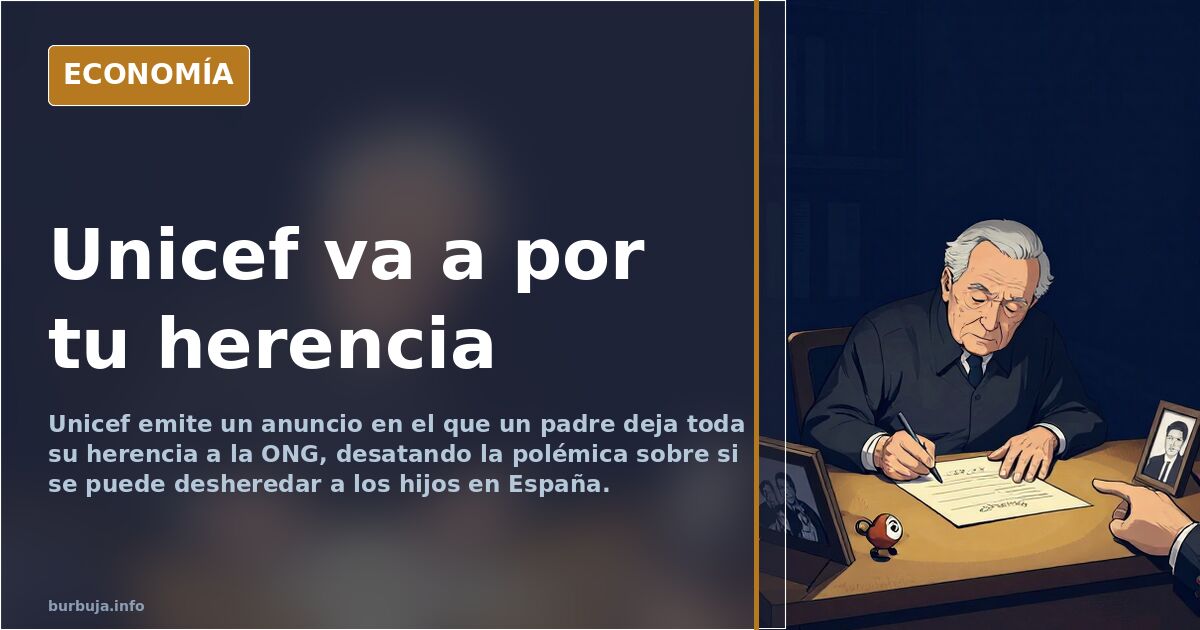
UNICEF Spain and the Ad That Asks for Your Estate
Can a non-profit take your parents' assets before you do? An UNICEF Spain commercial antiestéticaturing former basketball player Juanma López-Iturriaga, who tells his daughter he has left everything to the organization, has ignited a controversy far beyond advertising. In the spot, the former international appears with a young woman playing his daughter—reportedly his real child—discussing solidarity while she nods. The majority reaction has been outright rejection: the scene was interpreted as a message specifically targeting those with descendants, not single people without families.
What the Ad Says and Why It Is Seen as a Message to Heirs
The detail that triggered alarms is the presence of the daughter. If the goal were to attract bequests from people without descendants, the script would have been different. The dominant reading is that it seeks to encourage parents to consider leaving their wealth to the organization, which clashes with Spanish inheritance law. In most of the country, forced heirship protects children: one cannot freely disinherit them. In Navarre, where regional civil law applies, the situation differs, and freedom to testate is much greater.
Some argue the campaign is part of a broader strategy by major humanitarian organizations to capture bequests and recurring donations. Counterarguments note that UNICEF Spain is a national committee, not the UN fund itself, and its fundraising is legal. The full calculation of how much estate value remains outside heirs' reach in each autonomous community reveals surprising differences.
UNICEF Spain Is Not UNICEF: The Structure Few Know About
One of the most cited points in the analysis is the distinction between UNICEF as a UN fund financed by governments and UNICEF Spain as a national committee. The relationship between the two is comparable to that of a supporters' club and the sports team it backs. This structure allows fundraising in Spain to operate under its own rules and directs messages about inheritances and bequests to the general public.
The discussion shifted to the internal operations of NGOs. It is pointed out that a significant portion of funds goes to administrative structures, salaries, and subcontracting, with only a fraction reaching the field. While no audited figures are provided in the material, distrust of management is widespread: Cáritas, Red Cross, and Food Banks appear in the same list of suspicions.
The Debate on Wealth and Housing: Who Inherits and Who Doesn't
The thread connects the ad to a larger issue: housing. It is argued that there is a growing stock of apartments owned by elderly people without children, and that organizations seek to acquire these properties through bequests. The circulating thesis is that this wealth would end up swelling a social or rental housing park managed by entities, further hindering homeownership access for young people.
Against this interpretation, skeptics remind us that making a will is an individual decision and no one is obliged to leave anything to an NGO. The real controversy is cultural, not legal: what is considered legitimate to do with one's own wealth when there are descendants. And here, the ad struck a nerve.
Public Response: From Irony to Rejection
The majority reaction has been rejection, with a component of dark humor. Statements abound declaring intentions to leave assets to anything other than a humanitarian organization, including burning or spending them. Criticism also targets the ad's protagonist, reproaching his role in the campaign.
The most repeated friction point is the feeling that a financial sacrifice is being asked of those who already pay taxes to fund social policies. The lingering question is why a private organization should capture inheritances when a public redistribution system exists. There is no closed answer.
In the end, the ad achieved the opposite of its intent: instead of normalizing charitable bequests, it highlighted the fine print of inheritance laws and NGO structures. Meanwhile, the daughter continues to nod on screen.
Can a non-profit take your parents' assets before you do? An UNICEF Spain commercial antiestéticaturing former basketball player Juanma López-Iturriaga, who tells his daughter he has left everything to the organization, has ignited a controversy far beyond advertising. In the spot, the former international appears with a young woman playing his daughter—reportedly his real child—discussing solidarity while she nods. The majority reaction has been outright rejection: the scene was interpreted as a message specifically targeting those with descendants, not single people without families.
What the Ad Says and Why It Is Seen as a Message to Heirs
The detail that triggered alarms is the presence of the daughter. If the goal were to attract bequests from people without descendants, the script would have been different. The dominant reading is that it seeks to encourage parents to consider leaving their wealth to the organization, which clashes with Spanish inheritance law. In most of the country, forced heirship protects children: one cannot freely disinherit them. In Navarre, where regional civil law applies, the situation differs, and freedom to testate is much greater.
Some argue the campaign is part of a broader strategy by major humanitarian organizations to capture bequests and recurring donations. Counterarguments note that UNICEF Spain is a national committee, not the UN fund itself, and its fundraising is legal. The full calculation of how much estate value remains outside heirs' reach in each autonomous community reveals surprising differences.
UNICEF Spain Is Not UNICEF: The Structure Few Know About
One of the most cited points in the analysis is the distinction between UNICEF as a UN fund financed by governments and UNICEF Spain as a national committee. The relationship between the two is comparable to that of a supporters' club and the sports team it backs. This structure allows fundraising in Spain to operate under its own rules and directs messages about inheritances and bequests to the general public.
The discussion shifted to the internal operations of NGOs. It is pointed out that a significant portion of funds goes to administrative structures, salaries, and subcontracting, with only a fraction reaching the field. While no audited figures are provided in the material, distrust of management is widespread: Cáritas, Red Cross, and Food Banks appear in the same list of suspicions.
The Debate on Wealth and Housing: Who Inherits and Who Doesn't
The thread connects the ad to a larger issue: housing. It is argued that there is a growing stock of apartments owned by elderly people without children, and that organizations seek to acquire these properties through bequests. The circulating thesis is that this wealth would end up swelling a social or rental housing park managed by entities, further hindering homeownership access for young people.
Against this interpretation, skeptics remind us that making a will is an individual decision and no one is obliged to leave anything to an NGO. The real controversy is cultural, not legal: what is considered legitimate to do with one's own wealth when there are descendants. And here, the ad struck a nerve.
Public Response: From Irony to Rejection
The majority reaction has been rejection, with a component of dark humor. Statements abound declaring intentions to leave assets to anything other than a humanitarian organization, including burning or spending them. Criticism also targets the ad's protagonist, reproaching his role in the campaign.
The most repeated friction point is the feeling that a financial sacrifice is being asked of those who already pay taxes to fund social policies. The lingering question is why a private organization should capture inheritances when a public redistribution system exists. There is no closed answer.
In the end, the ad achieved the opposite of its intent: instead of normalizing charitable bequests, it highlighted the fine print of inheritance laws and NGO structures. Meanwhile, the daughter continues to nod on screen.
Also available in: Deutsch
Summary of a discussion on Burbuja.info - Foro de economía, actualidad y política., translated from Spanish and reviewed before publication. Read the full discussion (91 replies).
More summaries
-
Spain's Two-Year Citizenship Path for Ibero-Americans
Article 22 of Spain’s Civil Code grants citizenship after two years to nationals from Ibero-American countries, Andorra, Philippines, Equatorial Guinea, Portugal, and Sephardic Jews.
-
Leire Martínez: Weight and the Price of Image in Music
Leire Martínez, ex-LOVG, faces menopause and scrutiny over her weight. How much does appearance condition an artist? Analysis with data and real cases.
-
Código 10 publishes photos against PSOE: the scandal that wasn't
Código 10 releases allegedly compromising photos of a Socialist official. The expected political earthquake fizzles out as PSOE proves...
-
Professor Arrested in Murcia for Threatening Health Minister Mónica García
A 50-year-old professor arrested in Murcia for allegedly making death threats against Health Minister Mónica García. No prior convictions.
-
Spain's Renewable Surplus Doesn't Lower Electricity Bills
Renewable energy costs near zero at peak hours in Spain, yet household bills remain high due to marginal market pricing.
-
Woman Empties Partner's Account After Death, Faces Jail in Spain
Spanish prosecutors seek 33 months for a woman who withdrew €21,500 from her partner's accounts an hour after his death. Trial begins in Madrid.