
Oranges hit €6 per 3kg mesh; juice tops €2 in Spain
In Spain, a 3kg orange mesh costs €6 and juice exceeds €2, while farm-gate prices drop to €0.40/kg but supermarket prices rise to €2.75.
English · Original discussion in Spanish · Published
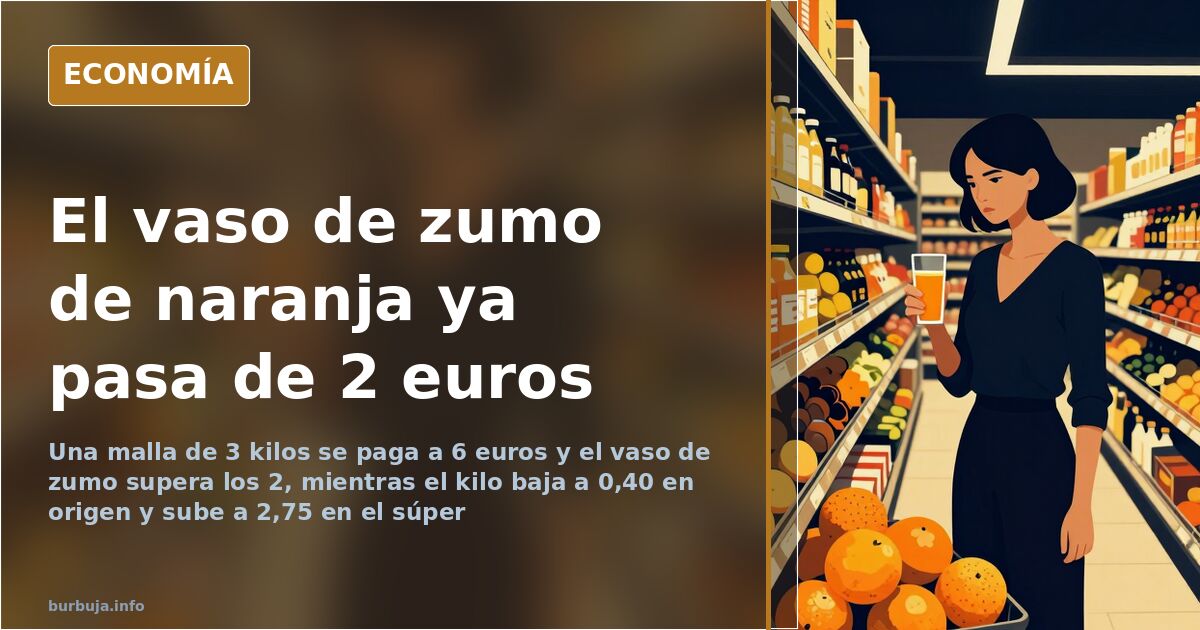
3kg of oranges for €6: A glass of juice exceeds €2
The math is simple and undeniable: a 3-kilo mesh of oranges costs €6. Counted individually, that’s about five pieces. From these comes a freshly squeezed glass of juice costing over two euros. The price of oranges has ceased to be a minor grocery anecdote and now competes on the same level as olive oil, another product turned into a thermometer for the shopping basket. In a competing hypermarket, table oranges were seen at €2.75 per kilo just weeks ago. In a local fruit shop, they cost €1.49.
The climate context doesn't help either. October 2023 was recorded as the warmest October ever, with a global average of 15.30 °C, 0.85 °C above the 1991-2020 average and 1.7 °C above the pre-industrial reference period. A silent disaster for harvests in both hemispheres. What reaches the shelves is the consequence.
From €0.40 per kilo at the farm to €2.75 on the shelf
Here lies the gap that no one fully explains. A five-kilo mesh sells for €3 in stores supplied directly by farmers from production zones, placing the origin price around €0.40 per kilo. A producer with more than 200,000 kilos of clementines details that top quality, in December, hovers around €0.50 per kilo at the farm, to which must be added a minimum of €0.20 for harvesting and transport. Late varieties from February and March that are indeed top quality can reach one euro at the farm gate.
Between that euro and the €2.75 on the shelf lie harvesting, transport, packaging, shrinkage, logistics, and the margin of each link. There is also an uncomfortable detail: the top quality paid at €0.50 at the farm, according to that same criterion, is rarely seen even in Spanish shops. What reaches the consumer is inferior quality at a higher price. And those who buy the 3-kilo mesh for €6 are paying, give or take, five times what it would cost at the source.
International comparisons leave the analysis without arguments. In Switzerland, two one-kilo bags of Spanish oranges — labeled as origin Spain — sell for two francs: one franc per kilo. Cheaper there than here, with transport already included.
Why juice rises more than whole fruit
The battle between table oranges and juicing oranges is, practically speaking, resolved against the former. The best table variety, the navel late, has been replaced by the navel lane late, which is more productive and better suited for squeezing. The result: you have to search hard to find an orange that peels well and has large segments. The shelves are filled with discard-quality pieces, looking as if they’ve passed through three cold rooms. For every orange eaten whole, ten or more go to juice. That is the business.
And it is not a cheap business for those squeezing at home. A liter of packaged pulp juice ranges between €2 and €3 in the supermarket. Homemade squeezing costs just as much or more, with the difference that at least you know what goes in.
There is a current reminding us that whole fruit and juice are not the same. Squeezing extracts free sugars and leaves out almost all fiber, causing a blood glucose spike that the whole piece does not trigger. The daily glass of juice as a healthy gesture is more of an advertising construct than evidence. Bell peppers, by the way, quadruple the vitamin C content of oranges and have been seen at €2 per kilo.
"Valencia" on the label, origin in the Southern Hemisphere
Labeling deserves its own section. A recent label in a discount supermarket announced "VALENCIA" in large letters. Below, in small print, it clarified that this referred to the variety, not the origin: the oranges came from South Africa. The same happens with other origins that have replaced Levante production, punished by farm-gate prices that do not cover costs.
Seasonality has broken. Throughout the year, imported fruits compete with local production, reducing the market share of domestic goods. And the calendar has stretched: farmers in production zones have delayed the harvest of early varieties, expected mid-month but pushed back fifteen days further. Little cold, slow ripening.
Fruit as a dispensable item
Amidst the escalation appears the most uncomfortable stance: that of those who argue fruit and vegetables are dispensable. Take a multivitamin and run; the money saved in the cart goes to animal protein, which is what truly yields returns. It is a solution that works in the checkout line but fails on the plate, yet it explains why consumers are stopping their fight over the fruit counter.
Opposite them are those who have two orange trees in their garden and have discovered that this year they are a gold mine. And those who buy from the corner farmer, without labels, waxes, or distributor shrinkage. Buying seasonal and direct from the source is today the only way to get below one euro per kilo. The problem is that it requires living in a production zone or paying for shipping.
This is where the analysis stalls. A producer with 200,000 kilos on the tree expects the industry to pay one euro for a 20-kilo crate — five cents per kilo — and assumes that more than 10,000 kilos of small-caliber Clemenules will remain unharvested. The consumer pays between one and three euros for what the farmer is offered at five cents. Both sides are right and both are losing. With these numbers, the six-euro mesh is not an anomaly: it is the fixed image of a chain where no one wants to take the ugly part.
The math is simple and undeniable: a 3-kilo mesh of oranges costs €6. Counted individually, that’s about five pieces. From these comes a freshly squeezed glass of juice costing over two euros. The price of oranges has ceased to be a minor grocery anecdote and now competes on the same level as olive oil, another product turned into a thermometer for the shopping basket. In a competing hypermarket, table oranges were seen at €2.75 per kilo just weeks ago. In a local fruit shop, they cost €1.49.
The climate context doesn't help either. October 2023 was recorded as the warmest October ever, with a global average of 15.30 °C, 0.85 °C above the 1991-2020 average and 1.7 °C above the pre-industrial reference period. A silent disaster for harvests in both hemispheres. What reaches the shelves is the consequence.
From €0.40 per kilo at the farm to €2.75 on the shelf
Here lies the gap that no one fully explains. A five-kilo mesh sells for €3 in stores supplied directly by farmers from production zones, placing the origin price around €0.40 per kilo. A producer with more than 200,000 kilos of clementines details that top quality, in December, hovers around €0.50 per kilo at the farm, to which must be added a minimum of €0.20 for harvesting and transport. Late varieties from February and March that are indeed top quality can reach one euro at the farm gate.
Between that euro and the €2.75 on the shelf lie harvesting, transport, packaging, shrinkage, logistics, and the margin of each link. There is also an uncomfortable detail: the top quality paid at €0.50 at the farm, according to that same criterion, is rarely seen even in Spanish shops. What reaches the consumer is inferior quality at a higher price. And those who buy the 3-kilo mesh for €6 are paying, give or take, five times what it would cost at the source.
International comparisons leave the analysis without arguments. In Switzerland, two one-kilo bags of Spanish oranges — labeled as origin Spain — sell for two francs: one franc per kilo. Cheaper there than here, with transport already included.
Why juice rises more than whole fruit
The battle between table oranges and juicing oranges is, practically speaking, resolved against the former. The best table variety, the navel late, has been replaced by the navel lane late, which is more productive and better suited for squeezing. The result: you have to search hard to find an orange that peels well and has large segments. The shelves are filled with discard-quality pieces, looking as if they’ve passed through three cold rooms. For every orange eaten whole, ten or more go to juice. That is the business.
And it is not a cheap business for those squeezing at home. A liter of packaged pulp juice ranges between €2 and €3 in the supermarket. Homemade squeezing costs just as much or more, with the difference that at least you know what goes in.
There is a current reminding us that whole fruit and juice are not the same. Squeezing extracts free sugars and leaves out almost all fiber, causing a blood glucose spike that the whole piece does not trigger. The daily glass of juice as a healthy gesture is more of an advertising construct than evidence. Bell peppers, by the way, quadruple the vitamin C content of oranges and have been seen at €2 per kilo.
"Valencia" on the label, origin in the Southern Hemisphere
Labeling deserves its own section. A recent label in a discount supermarket announced "VALENCIA" in large letters. Below, in small print, it clarified that this referred to the variety, not the origin: the oranges came from South Africa. The same happens with other origins that have replaced Levante production, punished by farm-gate prices that do not cover costs.
Seasonality has broken. Throughout the year, imported fruits compete with local production, reducing the market share of domestic goods. And the calendar has stretched: farmers in production zones have delayed the harvest of early varieties, expected mid-month but pushed back fifteen days further. Little cold, slow ripening.
Fruit as a dispensable item
Amidst the escalation appears the most uncomfortable stance: that of those who argue fruit and vegetables are dispensable. Take a multivitamin and run; the money saved in the cart goes to animal protein, which is what truly yields returns. It is a solution that works in the checkout line but fails on the plate, yet it explains why consumers are stopping their fight over the fruit counter.
Opposite them are those who have two orange trees in their garden and have discovered that this year they are a gold mine. And those who buy from the corner farmer, without labels, waxes, or distributor shrinkage. Buying seasonal and direct from the source is today the only way to get below one euro per kilo. The problem is that it requires living in a production zone or paying for shipping.
This is where the analysis stalls. A producer with 200,000 kilos on the tree expects the industry to pay one euro for a 20-kilo crate — five cents per kilo — and assumes that more than 10,000 kilos of small-caliber Clemenules will remain unharvested. The consumer pays between one and three euros for what the farmer is offered at five cents. Both sides are right and both are losing. With these numbers, the six-euro mesh is not an anomaly: it is the fixed image of a chain where no one wants to take the ugly part.
Also available in: Deutsch
Summary of a discussion on Burbuja.info - Foro de economía, actualidad y política., translated from Spanish and reviewed before publication. Read the full discussion (169 replies).
More summaries
-
Mercadona hits the brakes: customers are comparing prices
While comparing seven chains keeps many customers captive, Lidl and Aldi are gaining market share, and fresh produce is increasingly bought outside of Mercadona.
-
California's High Costs and Fentanyl Crisis Outpace Switzerland
With beer at $9 and fentanyl camps, California's living costs and social issues spark debate on the price of life.
-
Same ALDI cart costs less in Germany than in Spain
Frozen pizzas cost just 1 euro in Germany versus 1.80 euros in Spain, while German minimum wages are nearly double Spanish levels.
-
AI advises 40-year-old with €70,000 and €800 a month
AI therapy: €70,000, €800 a month and living with mum at 40. A 40-year-old man with €70,000 in savings, an €800 monthly salary and a second-hand BMW asks...
-
Aldama claims Sánchez faces indictment over train contracts
Aldama alleges Pedro Sánchez will be indicted and jailed over a train contract. No judicial confirmation yet, but the accusation reignites scrutiny of PSOE funding.
-
Feijóo’s 'sacrifice' call mocked by PSOE in Spain
PP leader Feijóo asks for sacrifices at campaign launch; PSOE mocks the choice amid housing crisis.