
Only 30 of 80,000 Greek vases depict homosexuality
A revisionist thesis claims only 30 of 80,000 Greek vases show homosexual themes. Debate continues over Athenian laws and classical texts.
English · Original discussion in Spanish · Published
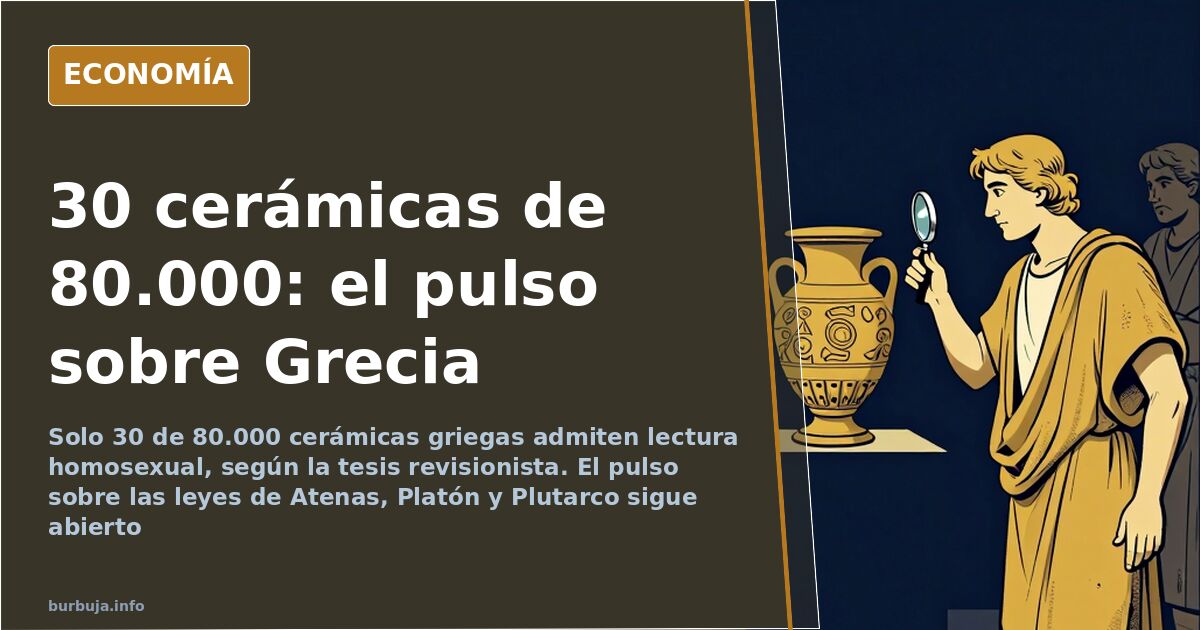
Only 30 of 80,000 Greek vases allude to gaiity
In a display case, a winged figure lifts a young man into the air. To the hurried visitor, it is an abduction. The catalog explains that Zephyr, the west wind, carries away Hyacinthus’s soul after accidentally killing him and turning him into a flower. This piece—and all others—has fueled one of the loudest historiographical disputes recently: did Ancient Greece tolerate or punish gaiity? There is no consensus. A recurring statistic suggests otherwise: of the 80,000 Greek ceramic representations found so far, only about 30 allow for a gai reading. Revisionists argue the rest are noise, mistranslations, or forced interpretations.
The zero-tolerance thesis and its supporting study
One analytical current argues that ancient Greeks applied a form of zero tolerance toward male relationships. It relies on Georgiades’ 2004 study, "Gaiity in Ancient Greece: The Myth Crumbles," which posits that the mentor-protégé bond was educational and paternal, similar to soldierly camaraderie, without sensual components. They insist the term used for this fraternal affection has nothing to do with sens.
Similarly, it is claimed that no literary source from Minoan, Mycenaean, Archaic, Classical, or Hellenistic periods explicitly defends gaiity, and many circulating images are manipulated or decontextualized. Some even allege modern forgeries created to support the narrative. This remains an accusation, not proven fact, and should be treated as an unverified suspicion.
What Athenian laws said according to Aeschines and Demosthenes
Legal arguments rely on two orators. Aeschines reportedly wrote that any Athenian associated with a gai was barred from priesthood, archonship, religious ceremonies, civil meetings, public office, or speeches. Demosthenes confirmed these norms. Abusa could carry the death penalty.
However, debate nuances this: some argue these laws didn’t physically punish citizens but excluded them from public roles, with capital punishment reserved for repeat offenders. The distinction matters. Marginalizing a society differs greatly from executing individuals, and precise legal interpretation shapes the diagnosis.
Did Plato call male relations unnatural?
The most cited thesis quotes Plato directly: union between man and woman for reproduction is natural, but joining another man or woman with another woman is unnatural, making participants responsible for their shame. This passage serves as central proof. Plato also viewed non-Greeks’ failure to use mentor-protégé bonds as weakness.
Yet, selective quoting cuts both ways. Aristophanes and Xenophon mocked gais with today-unpublishable insults. The Laius myth presents such relations as curses. Until now, the condemnation narrative seems solid. Then come contradictory pieces.
Plutarch, Xenophon, and Phaedrus say the opposite
Here the narrative breaks. Plutarch writes there is no error when ancient poets recount Apollo’s love for Phorbas, Hyacinthus, and Admetus. Xenophon praises comradeship among soldiers, though criticizing armies built solely on it. Phaedrus argues male bonds boost courage: no soldier is too cowardly to abandon his beloved. In the *Phaedrus*, Plato attributes these ties the power to overthrow tyrants in Athens.
This disrupts the issue. The same Ancient Greece that allegedly prohibited and executed produces texts celebrating these bonds with military and heroic language. The dispute isn’t whether they existed—they did—but whether society integrated them as marginal practice, blessed them as rites, or persecuted them depending on time and place.
What readers gain from this controversy
Behind vases and judicial speeches lies a contemporary fight: who has the right to claim the past. One side accuses historians of projecting modern categories onto a world that lacked them. The other replies that rewriting history is standard, and we always interpret the past through present interests. Testimonial selection in both camps is so careful that complete sets are rarely cited.
The disorienting data closes the circle: those claiming no favorable mention exists in all ancient Greek literature must explain Plutarch, Xenophon, Phaedrus, and Plato’s *Phaedrus*. Either they are marginalized exceptions, or the universal condemnation narrative collapses.
In a display case, a winged figure lifts a young man into the air. To the hurried visitor, it is an abduction. The catalog explains that Zephyr, the west wind, carries away Hyacinthus’s soul after accidentally killing him and turning him into a flower. This piece—and all others—has fueled one of the loudest historiographical disputes recently: did Ancient Greece tolerate or punish gaiity? There is no consensus. A recurring statistic suggests otherwise: of the 80,000 Greek ceramic representations found so far, only about 30 allow for a gai reading. Revisionists argue the rest are noise, mistranslations, or forced interpretations.
The zero-tolerance thesis and its supporting study
One analytical current argues that ancient Greeks applied a form of zero tolerance toward male relationships. It relies on Georgiades’ 2004 study, "Gaiity in Ancient Greece: The Myth Crumbles," which posits that the mentor-protégé bond was educational and paternal, similar to soldierly camaraderie, without sensual components. They insist the term used for this fraternal affection has nothing to do with sens.
Similarly, it is claimed that no literary source from Minoan, Mycenaean, Archaic, Classical, or Hellenistic periods explicitly defends gaiity, and many circulating images are manipulated or decontextualized. Some even allege modern forgeries created to support the narrative. This remains an accusation, not proven fact, and should be treated as an unverified suspicion.
What Athenian laws said according to Aeschines and Demosthenes
Legal arguments rely on two orators. Aeschines reportedly wrote that any Athenian associated with a gai was barred from priesthood, archonship, religious ceremonies, civil meetings, public office, or speeches. Demosthenes confirmed these norms. Abusa could carry the death penalty.
However, debate nuances this: some argue these laws didn’t physically punish citizens but excluded them from public roles, with capital punishment reserved for repeat offenders. The distinction matters. Marginalizing a society differs greatly from executing individuals, and precise legal interpretation shapes the diagnosis.
Did Plato call male relations unnatural?
The most cited thesis quotes Plato directly: union between man and woman for reproduction is natural, but joining another man or woman with another woman is unnatural, making participants responsible for their shame. This passage serves as central proof. Plato also viewed non-Greeks’ failure to use mentor-protégé bonds as weakness.
Yet, selective quoting cuts both ways. Aristophanes and Xenophon mocked gais with today-unpublishable insults. The Laius myth presents such relations as curses. Until now, the condemnation narrative seems solid. Then come contradictory pieces.
Plutarch, Xenophon, and Phaedrus say the opposite
Here the narrative breaks. Plutarch writes there is no error when ancient poets recount Apollo’s love for Phorbas, Hyacinthus, and Admetus. Xenophon praises comradeship among soldiers, though criticizing armies built solely on it. Phaedrus argues male bonds boost courage: no soldier is too cowardly to abandon his beloved. In the *Phaedrus*, Plato attributes these ties the power to overthrow tyrants in Athens.
This disrupts the issue. The same Ancient Greece that allegedly prohibited and executed produces texts celebrating these bonds with military and heroic language. The dispute isn’t whether they existed—they did—but whether society integrated them as marginal practice, blessed them as rites, or persecuted them depending on time and place.
What readers gain from this controversy
Behind vases and judicial speeches lies a contemporary fight: who has the right to claim the past. One side accuses historians of projecting modern categories onto a world that lacked them. The other replies that rewriting history is standard, and we always interpret the past through present interests. Testimonial selection in both camps is so careful that complete sets are rarely cited.
The disorienting data closes the circle: those claiming no favorable mention exists in all ancient Greek literature must explain Plutarch, Xenophon, Phaedrus, and Plato’s *Phaedrus*. Either they are marginalized exceptions, or the universal condemnation narrative collapses.
Summary of a discussion on Burbuja.info - Foro de economía, actualidad y política., translated from Spanish and reviewed before publication. Read the full discussion (168 replies).
More summaries
-
Salamanca Rent: €480 a month highlights the debate on old contracts
An 87-year-old tenant pays €480/month in Madrid's Salamanca district under an old rent contract. The clash between historical rights and property ownership reopens the debate on...
-
Spain's old rent deals: the €100 lease that refuses to die
Natalia, 24, lives with her mother in an old-rent flat in Moratalaz for about €100 a month. The battle over inheriting these contracts
-
Misinformation about Negu Gorriak sparks assault in Ceuta
The name of the Negu Gorriak aid campaign was confused with the Basque band, leading to a vehicle being attacked in the port of Ceuta.
-
Ceuta crisis boosts Vox to second place
Vox gains two points in voting intention amid the Ceuta border crisis, challenging its potential as Spain's second political force despite electoral system hurdles.
-
Pablo Iglesias' Diesel Drive Signals Podemos Decline
A photo of Pablo Iglesias driving a diesel family car highlights contradictions and a bleak electoral future for the Spanish party Podemos.
-
Spain's PM blocks public observatory for eclipse viewing
Pedro Sánchez’s exclusive use of a publicly funded observatory denied access to paying citizens, sparking debate on privilege.