
Only 0.5% of Spanish Employees Earn Over €92,000 Gross
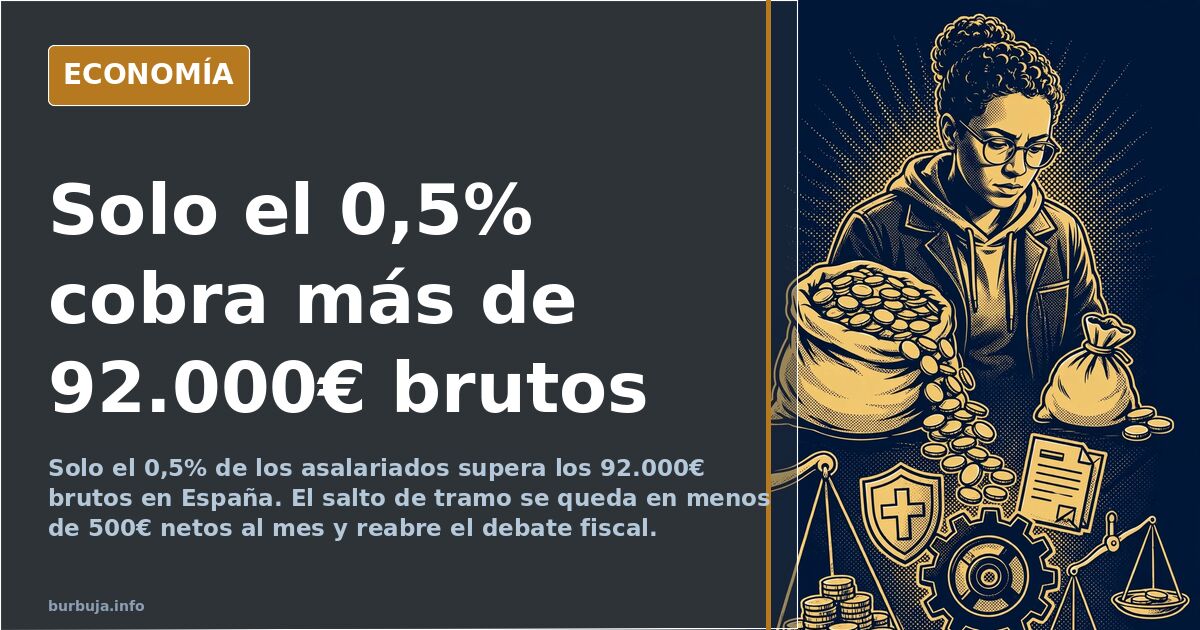
Just 0.5% of employees in Spain exceed €92,000 gross annually. The net gain for higher brackets is under €500/month, reigniting tax debates.
English · Original discussion in Spanish · Published
Only 0.5% of Spanish Employees Earn Over €92,000 Gross
A single figure summarizes the Spanish labor market better than any speech: barely 0.5% of employees reach €92,000 in annual gross salary, which equates to just over €4,500 net per month across fourteen payments. The next bracket, representing 0.2%, hovers around €104,000 gross but remains below €5,000 net monthly. An extra €12,000 in gross pay translates into less than a €500 monthly increase. The step up becomes a wall.
The debate starts with an AIREF report placing the tax and social security burden at around 70% of salary in certain brackets, according to one participant. From there, opinions split: those who argue the system discourages effort versus those who remind that most revenue goes to pensions via Social Security, not IRPF (personal income tax).
What Remains of Gross When Net Arrives
The calculation circulating in the debate is relentless. Starting from €20,000 gross, half the salary goes to taxes and contributions; at €40,000, the proportion approaches 60%. And on top of the net, one must still add VAT, fuel, ITP (transfer tax), or vehicle registration fees. The final tally leaves an uncomfortable result: the system does not reward moving up a bracket; it punishes it.
On the opposite end, a self-employed worker invoicing €120,000—excluding VAT—can be left with between €35,000 and €45,000 clean, according to figures discussed in the thread, in exchange for 60 to 80-hour workweeks and no real holidays. The comparison with a civil servant with a stable salary appears quickly, along with mutual accusations.
International Comparison That Breaks the Argument
Contrast with other markets is where the narrative cracks. A €100,000 salary in Spain would equate to about €160,000 in the US or UK with lower tax pressure, and €200,000 in Switzerland, according to calculations in the thread. The problem, even supporters of emigrating admit, is that housing in those countries is also much more expensive, and displacement has a price that doesn't show up on any payslip.
Some point out that qualified talent is already reacting: company cars, expense cards, private health insurance, and stock packages as ways to bypass marginal rates. It’s not evasion; it’s compensation design. And the State, this reading suggests, loses by failing to articulate a flat rate that captures at least part of that income.
The Self-Employed Who Invoices €120,000 and Still Struggles
The other side of the debate belongs to the self-employed. A plumber charging €200 for two and a half hours of work becomes the recurring example for those defending the existence of margins. The response comes fast: from those €200, you must deduct materials, tools, diesel, 21% VAT, 20% IRPF, self-employment quotas, circulation tax, and the risk of having no work tomorrow.
The result is a middle class squeezed from both sides. Those at the top watch every euro before spending it, as described in the conversation, while public discourse labels them as privileged. The social ladder, they say, has become a wall without rungs.
How Much Is Needed to Live in Madrid
The expense breakdown shared in the thread for a family of three in Madrid—a €1,000 mortgage, €200 community fees, €65 IBI (property tax), €25 insurance, €30 maintenance, €200 utilities, and €500 groceries—exceeds €2,000 before clothes, schools, car, or unforeseen events. With €3,100 between two people and two children, the math works, but barely, according to the debate.
The repeated conclusion: the problem isn’t just how much you earn, but what that earning is worth. With salaries considered standard in other European countries—€60,000 appears as a reference—and productivity that doesn’t keep pace, the diagnosis becomes circular.
How much would the net need to rise for the next bracket to be worthwhile?
A single figure summarizes the Spanish labor market better than any speech: barely 0.5% of employees reach €92,000 in annual gross salary, which equates to just over €4,500 net per month across fourteen payments. The next bracket, representing 0.2%, hovers around €104,000 gross but remains below €5,000 net monthly. An extra €12,000 in gross pay translates into less than a €500 monthly increase. The step up becomes a wall.
The debate starts with an AIREF report placing the tax and social security burden at around 70% of salary in certain brackets, according to one participant. From there, opinions split: those who argue the system discourages effort versus those who remind that most revenue goes to pensions via Social Security, not IRPF (personal income tax).
What Remains of Gross When Net Arrives
The calculation circulating in the debate is relentless. Starting from €20,000 gross, half the salary goes to taxes and contributions; at €40,000, the proportion approaches 60%. And on top of the net, one must still add VAT, fuel, ITP (transfer tax), or vehicle registration fees. The final tally leaves an uncomfortable result: the system does not reward moving up a bracket; it punishes it.
On the opposite end, a self-employed worker invoicing €120,000—excluding VAT—can be left with between €35,000 and €45,000 clean, according to figures discussed in the thread, in exchange for 60 to 80-hour workweeks and no real holidays. The comparison with a civil servant with a stable salary appears quickly, along with mutual accusations.
International Comparison That Breaks the Argument
Contrast with other markets is where the narrative cracks. A €100,000 salary in Spain would equate to about €160,000 in the US or UK with lower tax pressure, and €200,000 in Switzerland, according to calculations in the thread. The problem, even supporters of emigrating admit, is that housing in those countries is also much more expensive, and displacement has a price that doesn't show up on any payslip.
Some point out that qualified talent is already reacting: company cars, expense cards, private health insurance, and stock packages as ways to bypass marginal rates. It’s not evasion; it’s compensation design. And the State, this reading suggests, loses by failing to articulate a flat rate that captures at least part of that income.
The Self-Employed Who Invoices €120,000 and Still Struggles
The other side of the debate belongs to the self-employed. A plumber charging €200 for two and a half hours of work becomes the recurring example for those defending the existence of margins. The response comes fast: from those €200, you must deduct materials, tools, diesel, 21% VAT, 20% IRPF, self-employment quotas, circulation tax, and the risk of having no work tomorrow.
The result is a middle class squeezed from both sides. Those at the top watch every euro before spending it, as described in the conversation, while public discourse labels them as privileged. The social ladder, they say, has become a wall without rungs.
How Much Is Needed to Live in Madrid
The expense breakdown shared in the thread for a family of three in Madrid—a €1,000 mortgage, €200 community fees, €65 IBI (property tax), €25 insurance, €30 maintenance, €200 utilities, and €500 groceries—exceeds €2,000 before clothes, schools, car, or unforeseen events. With €3,100 between two people and two children, the math works, but barely, according to the debate.
The repeated conclusion: the problem isn’t just how much you earn, but what that earning is worth. With salaries considered standard in other European countries—€60,000 appears as a reference—and productivity that doesn’t keep pace, the diagnosis becomes circular.
How much would the net need to rise for the next bracket to be worthwhile?
Also available in: Deutsch
Summary of a discussion on Burbuja.info - Foro de economía, actualidad y política., translated from Spanish and reviewed before publication. Read the full discussion (116 replies).
More summaries
-
Swiss Wealth vs. American Wealth: Château vs. Mansion
Château on Lake Geneva vs. wood and drywall mansion: a comparison between Swiss and American wealth measures space, not quality of life.
-
Vidal claims 9% US tax rate, sparking fiscal debate
César Vidal states he pays 9% taxes in the US versus 50% in Spain. Federal brackets and living costs complicate this comparison.
-
Tenant Union of Sol: a network with €3.7 million
The Tenant Union of Sol is part, according to a published report, of a network that would have received €3.7 million from Socialist administrations.
-
Madrid school endorses student strike targeting PP and Ayuso
An internal email from a Madrid school supports a student strike aimed at disrupting the education system to protest against the PP and Isabel Díaz Ayuso.
-
Sánchez's new party: London lawyer and state control focus
The announcement of Pedro Sánchez's new political project has sparked criticism regarding Miriam González Durántez's profile and her stance on immigration.
-
China's housing prices drop significantly amid ongoing property crisis
A viral claim suggests China has solved its housing crisis with prices returning to 20-year lows, though official data shows a steady decline since 2021.