
Madrid school endorses student strike targeting PP and Ayuso
An internal email from a Madrid school supports a student strike aimed at disrupting the education system to protest against the PP and Isabel Díaz Ayuso.
English · Original discussion in Spanish · Published
Internal email calls to turn streets into a nightmare
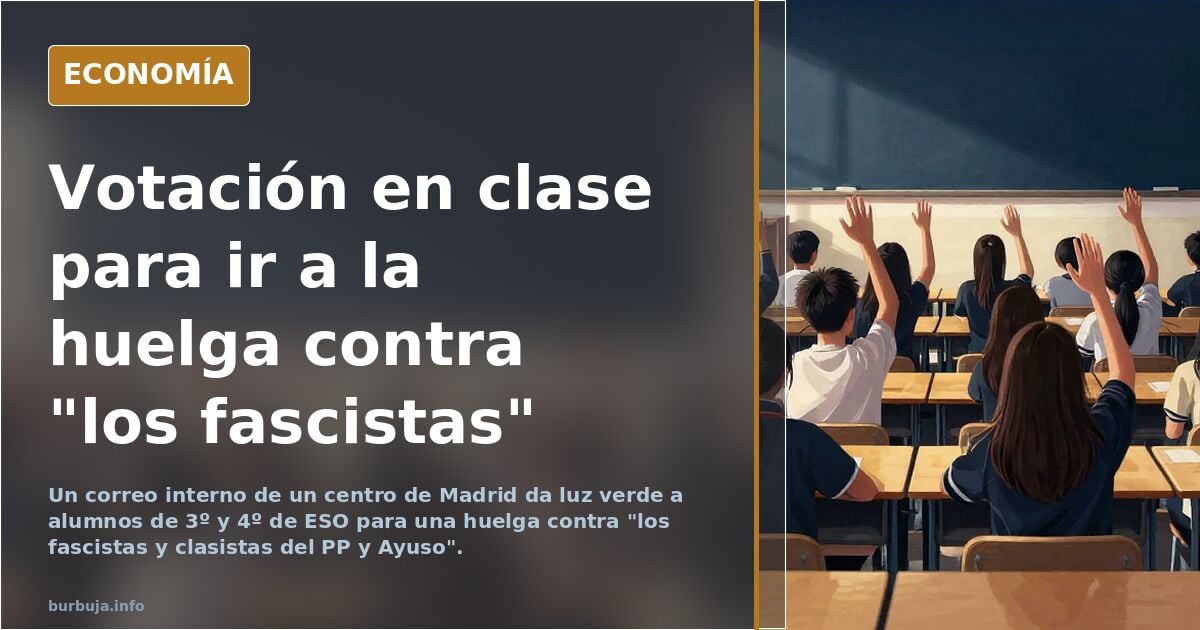
An internal email from an educational center in Madrid has given the green light to 3rd and 4th year ESO (compulsory secondary education) students to support a strike. According to the leaked text, the stated goal is to "completely stop the education system and turn the streets into a nightmare for the fascists and classists of the Partido Popular and Ayuso". The paradox is difficult to overcome: the call to strike is not signed by a union or a student assembly, but by the school's own administration, which informs the students that they have permission to skip class. The matter, uncovered by Vozpópuli, has ignited a debate that goes far beyond the classroom.
What the email says and who signed it
The message, sent by the school's administration to the students themselves, does not merely inform them of a vote: it endorses the result and presents it as a collective decision. The phrase that has spread like wildfire—"turn the streets into a nightmare for the fascists and classists"—appears in quotation marks in the text, raising the question of whether it is a literal quote from the organizers or a description by the school itself. In any case, the email comes from the school's official structure, not from a spontaneous group of students.
Some argue that the call abusa the legal framework. While students' rights to assembly and association are recognized, their legal purposes do not include "stopping the education system" or targeting a specific political party. The difference between a student strike and a political mobilization campaign within a public school is precisely what the email blurs.
Teachers under scrutiny
Suspicion that adults with their own agendas are behind the vote is common among the reactions. It is argued that using minors to justify a strike that defends the labor or ideological interests of the faculty is a way of using children as a shield. The criticism does not distinguish between teachers and management: the reproach is aimed at the public system as a whole, which is accused of being politicized and of turning classrooms into tools for political messaging.
Against this thesis, another current of thought reminds us that students have the right to organize and that civic education includes learning how to mobilize. The problem, even some defenders of the protest admit, is the framing: labeling voters of a party as a "nightmare" is not pedagogy, it is a political slogan. And a slogan signed by the school carries much more weight than a pamphlet handed out after class.
Family response: school vouchers and the move to private education
The episode has revived the argument of those who have been calling to dismantle the public teaching model for years. "The school voucher (cheque escolar) as a necessary measure to begin dismantling this inefficient and politicized public education," summarizes one of the most repeated stances, which sees cases like this as proof that public money finances indoctrination. Several personal accounts confirm the trend: parents who have already moved their children to private schools and describe it as "an excellent investment."
Not all criticisms go in the same direction. Some also point to the students and their families, speaking of "lazy children of absent parents" and ironically noting that the vote was decided during long weekends and holidays. Criticism is widespread, but the common denominator is distrust toward what is taught and who organizes it.
Political tension: Ayuso and the PP in the crosshairs
The email does not mention any party by chance. The explicit reference to the Partido Popular and Isabel Díaz Ayuso places the call in the realm of Madrid's political confrontation, rather than educational advocacy. This explains why the reaction has not been limited to the school environment: calls have been made for accountability, dismissal of those involved, and even incivil consequences for politicizing education.
The question left hanging is uncomfortable for everyone. If a public school can formally endorse a mobilization against a specific party, what happens to the neutrality required of schools? And what if the email had been signed by a school with the opposite slogan?
An internal email from an educational center in Madrid has given the green light to 3rd and 4th year ESO (compulsory secondary education) students to support a strike. According to the leaked text, the stated goal is to "completely stop the education system and turn the streets into a nightmare for the fascists and classists of the Partido Popular and Ayuso". The paradox is difficult to overcome: the call to strike is not signed by a union or a student assembly, but by the school's own administration, which informs the students that they have permission to skip class. The matter, uncovered by Vozpópuli, has ignited a debate that goes far beyond the classroom.
What the email says and who signed it
The message, sent by the school's administration to the students themselves, does not merely inform them of a vote: it endorses the result and presents it as a collective decision. The phrase that has spread like wildfire—"turn the streets into a nightmare for the fascists and classists"—appears in quotation marks in the text, raising the question of whether it is a literal quote from the organizers or a description by the school itself. In any case, the email comes from the school's official structure, not from a spontaneous group of students.
Some argue that the call abusa the legal framework. While students' rights to assembly and association are recognized, their legal purposes do not include "stopping the education system" or targeting a specific political party. The difference between a student strike and a political mobilization campaign within a public school is precisely what the email blurs.
Teachers under scrutiny
Suspicion that adults with their own agendas are behind the vote is common among the reactions. It is argued that using minors to justify a strike that defends the labor or ideological interests of the faculty is a way of using children as a shield. The criticism does not distinguish between teachers and management: the reproach is aimed at the public system as a whole, which is accused of being politicized and of turning classrooms into tools for political messaging.
Against this thesis, another current of thought reminds us that students have the right to organize and that civic education includes learning how to mobilize. The problem, even some defenders of the protest admit, is the framing: labeling voters of a party as a "nightmare" is not pedagogy, it is a political slogan. And a slogan signed by the school carries much more weight than a pamphlet handed out after class.
Family response: school vouchers and the move to private education
The episode has revived the argument of those who have been calling to dismantle the public teaching model for years. "The school voucher (cheque escolar) as a necessary measure to begin dismantling this inefficient and politicized public education," summarizes one of the most repeated stances, which sees cases like this as proof that public money finances indoctrination. Several personal accounts confirm the trend: parents who have already moved their children to private schools and describe it as "an excellent investment."
Not all criticisms go in the same direction. Some also point to the students and their families, speaking of "lazy children of absent parents" and ironically noting that the vote was decided during long weekends and holidays. Criticism is widespread, but the common denominator is distrust toward what is taught and who organizes it.
Political tension: Ayuso and the PP in the crosshairs
The email does not mention any party by chance. The explicit reference to the Partido Popular and Isabel Díaz Ayuso places the call in the realm of Madrid's political confrontation, rather than educational advocacy. This explains why the reaction has not been limited to the school environment: calls have been made for accountability, dismissal of those involved, and even incivil consequences for politicizing education.
The question left hanging is uncomfortable for everyone. If a public school can formally endorse a mobilization against a specific party, what happens to the neutrality required of schools? And what if the email had been signed by a school with the opposite slogan?
Also available in: Deutsch
Summary of a discussion on Burbuja.info - Foro de economía, actualidad y política., translated from Spanish and reviewed before publication. Read the full discussion (18 replies).
More summaries
-
School reprimand for racism in Madrid sparks discipline debate
A school disciplinary report over a racist comment at a Madrid high school reignites debates on teacher authority and double standards.
-
Norwegian IQ Test: The Flaw in Measuring Cognitive Ability
Analysis of Norwegian IQ test results: Is intelligence measurable with patterns or is it a statistical fallacy?
-
Llados vs. the World Cup: Mass distraction or pain marketing?
Influencer Llados labels World Cup fans as 'NPCs', claiming only millionaires profit from the tournament while others waste time.
-
La Sexta misrepresents hostile shouts against Pedro Sánchez as ovation
Spanish broadcaster La Sexta aired hostile shouts against Pedro Sánchez as an ovation, sparking controversy over media manipulation and postal voting.
-
Spain and Japan face decades of stagnant or falling real wages
Spanish real wages have fallen 4.2% compared to 2021, while Japan has seen a 4% decline since 1995, according to OECD data.
-
Top model demands €100,000 income, facing rejection from the dating market
A 50-year-old top model seeking partners with incomes over €100,000 faces market backlash as her perceived value declines.