
One tea bag per liter: where saving ends and weak tea begins
One tea bag per liter of water doesn't save money: it turns the brew into colored water. The real range is 200 to 400 cc per bag and 2-3 bags per liter.
English · Original discussion in Spanish · Published
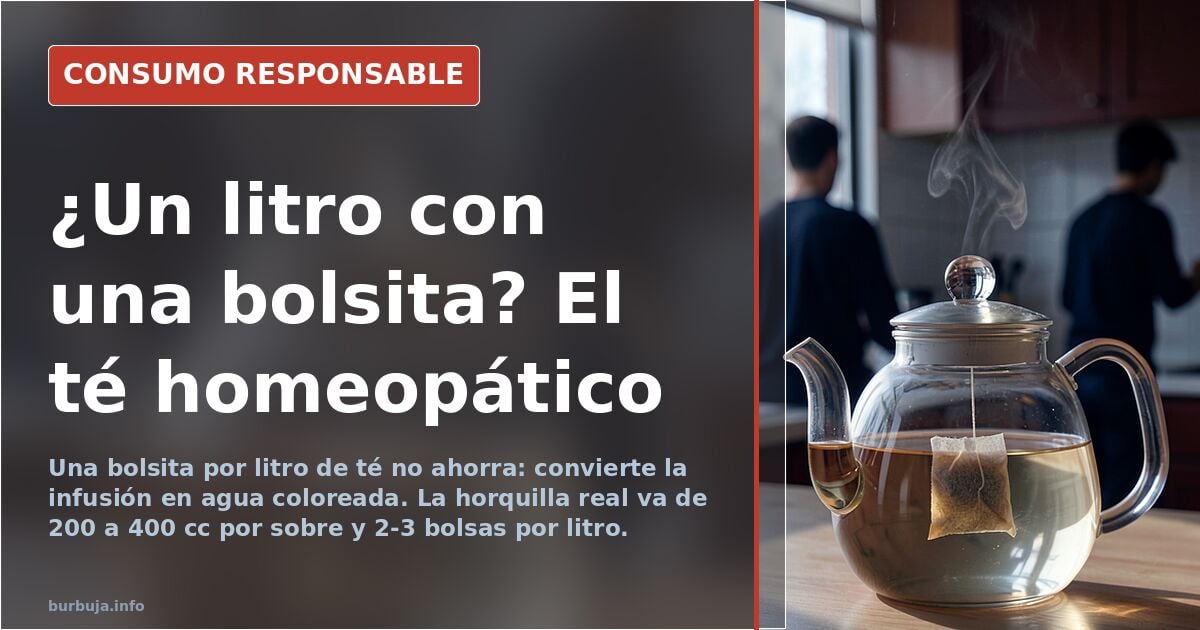
One tea bag per liter: where the saving ends and the colored water begins
A liter of water with a single tea bag. The question, raised as a practical pantry dilemma, opens a spectrum that runs from the stingiest household calculation to a debate about what on earth you're actually drinking. The most common answer leaves no room for interpretation: that's not tea, it's weak dishwater. And from there comes the comparison that sums up the consensus: they've just invented homeopathic tea.
The starting point is one bag per liter. The range most people work with is between 200 and 400 cubic centimeters per bag, in other words, one large cup. For a full liter, common practice goes up to two or three bags. The figure is no whim: below that, what ends up in the glass is water with a memory of tea leaf.
How many tea bags per liter of water
The rule that prevails in the conversation is two or three bags per liter, with one clear exception: those who drink tea as if it were water and prefer a mild flavor. That's where one bag per liter comes in, but with full awareness that you're drinking a decaffeinated-in-spirit infusion. For a single cup, one bag; for an afternoon snack with milk and biscuits, one or two cups per bag.
The economic calculation dismantles the premise of extreme saving. A pack of 25 bags costs around 45 cents. Stretching each bag to a full liter doesn't pay off: the cost per cup becomes irrelevant and the result, disappointing. Some call it outright penny-pinching, and not as a compliment.
Loose tea versus tea bags: price, flavor and reuse
The alternative gaining trinc is buying by weight. Tea in cake form, common in Chinese and Japanese shops, allows the same portion to be steeped three or four times without losing its properties or flavor. The cake costs more upfront, but brings down the cost per cup when you do the real math.
With loose tea, a tablespoon yields a full liter. Red tea holds up for two or three more reuses. Pure teas tolerate a second use; flavored ones, not so much. Chamomile, lemon verbena or mint picked in the fields or from pots only last one use, but four little flowers make a stronger infusion than any industrial tea bag.
Tea picked in the wild and tea dried in the sun
Against the industrial tea bag stands the option of foraging. In many parts of Castile, quality wild tea grows, and chamomile can be picked without middlemen. The caveat comes immediately: rock tea is not the tea being discussed here, and confusing the two betrays impatience.
The anecdote that best captures the culture of reuse dates from the mid-eighties. An elderly neighbor used to dry her used tea bags in the sun because the box said "10 uses". The scene, told with the distance of years, explains why badly understood thrift has a tradition in this country.
How to make tea with milk and why the order matters
Tea with milk allows for two schools. One puts the bag directly into hot milk; the other brews the tea in water first and then adds a splash of milk, as is done with coffee. The results are nothing alike. The second option is considered the standard, even if the first survives out of habit.
The debate ends where it usually does: in personal taste. Some prefer their tea very diluted, while others load the cup with two bags for a quarter of a liter. The surprising fact is that the Asian practice of refilling the cup over the same leaves, far from being an exception, is the norm. And there, one tea bag per liter stops being heresy and becomes a way of drinking.
Also available in: Deutsch
Summary of a discussion on Burbuja.info - Foro de economía, actualidad y política., translated from Spanish and reviewed before publication. Read the full discussion (14 replies).
More summaries
-
Expired herbal teas: what happens if you brew an old tea bag
A green tea two years past its date loses its properties and gains bitterness, according to one forum user. Virgin olive oil goes rancid, and insulin is no joke.
-
Supermarket Papayas Taste Like Nothing: Here's Why
Supermarket papayas are often harvested unripe and ripen poorly, resulting in a bland, cork-like taste. Papayas ripened on the tree in places like the Canary Islands offer a superior flavor.
-
Albo and frozen Louriño, the most recommended callos on the forum
Several forum members criticise Litoral and recommend Albo, La Nora and, above all, the frozen Louriño
-
Mattresses: from 150 to 1,512 euros for the same foam
A forum user compares a 150-euro mattress with a 1,512-euro one and argues they may contain the same foam. Heat, density and the Tempur trick.
-
Moviegoer pees into popcorn bucket rather than walk down the aisle
A moviegoer urinated into the popcorn bucket in the last row of a Spanish cinema to avoid walking down the stairs in front of the audience. The story and its aftermath.
-
Where to buy a placebo? A demand nobody meets
A forum user asks where to buy placebos for his father with dementia. The thread suggests homeopathy, sweets or empty capsules, with no medical backing.