
Mattresses: from 150 to 1,512 euros for the same foam
A forum user compares a 150-euro mattress with a 1,512-euro one and argues they may contain the same foam. Heat, density and the Tempur trick.
English · Original discussion in Spanish · Published
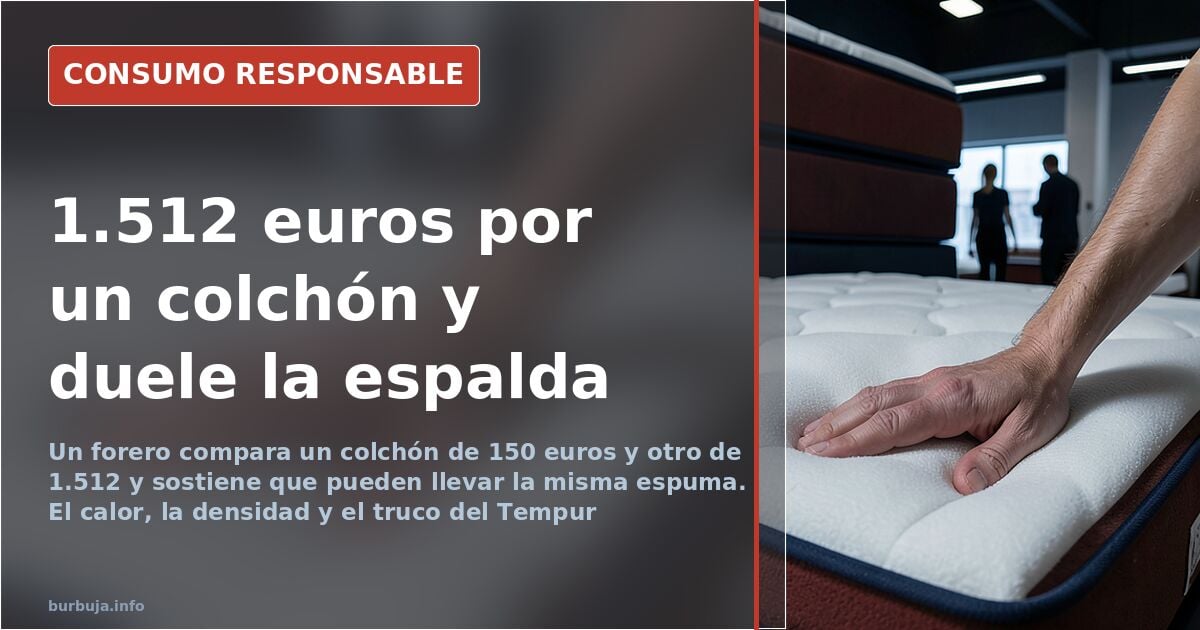
From the 150-euro mattress to the 1,512-euro Tempur: the sleep lottery
A forum user claims that a 150-euro mattress and a 1,512-euro one may contain the very same foam inside. The price gap is not always explained by the density or thickness of the memory foam layer, and that is where the problem starts: the buyer pays blindly for something they will only notice eight hours later, every night, for years. The Christmas bonus thus becomes a bet with your back as collateral.
The first finding along the way is that trying mattresses in a store helps you gauge firmness, and little else. Five minutes of a good impression are nothing like real sleep, and the person who tested it puts it bluntly: if the mattress already feels too hard or too soft when you lie down, it will only get worse over time. The purchase comes down to a choice between antiestéticar of the cheap stuff —the imitation memory foam that sags and holds moisture— and antiestéticar of the expensive one, that Tempur promising weightlessness that leaves you with a strange backache after the first week.
Memory foam, viscolatex or springs: what is really being debated
Memory foam wins fans for its adaptability and loses them because of heat. The complaint is always the same: it swallows you up, it is soft and it gets hot in summer. The gel version is presented as the fix, though there is no agreement on whether it is a real innovation or just a marketing label. Latex, meanwhile, is championed as a breathable material that keeps its shape: one forum user reports that a pure latex mattress, nine years old and carrying 83 kilos, still performs well with just a turn three times a year.
The good old spring mattress is not dead. Several buyers go back to it after trying foam, and the argument carries weight: all-foam mattresses for heavier people end up with a crater, while a spring mattress with a comfort layer holds up better. The spring-plus-memory-foam combination has become the middle ground for those unwilling to give up either firmness or padding.
The Tempur trick nobody explains in the store
The most revealing anecdote of the journey comes once the expensive mattress is already home. According to the buyer's account, the material needs warmth to activate, and an extra cotton cover between your body and the surface is enough to cancel it out. Between the pyjamas, the sheet, the added cover and the official one, the mattress never warms up and fails to deliver. The discovery came after five nights of pain and nearly returning it.
The conclusion of someone who has been through it: memory foam hardens in the cold and softens with heat, and that happens just the same in a 1,500-euro mattress as in a 300-euro one. The price difference, then, is not in the physics of the material but in the rest of the construction and the marketing.
How much you need to spend to avoid sleeping on the floor
The average budget being discussed is around 600 euros for a double bed, which is where Pikolín and Flex come in with frequent promotions. That figure gets you a decent, no-frills spring mattress. Below that, the advice is repeated: cheap memory foam is not memory foam, it is an imitation that deforms.
The DIY alternative comes up as a resource: buying a five-centimetre memory foam topper and custom-cut foam, gluing them together and fitting a cover comes to about 200 euros, according to a calculation circulating among forum users. It is the route for those who distrust the shop window and prefer to build their mattress piece by piece.
Where to try and what to check before signing
The tour of physical stores in Madrid ends in a bleak picture: shops closing down, others turned into furniture stores, one selling bedding with just two display mattresses. The crisis has ravaged the sector, according to the buyer's experience. Anyone who wants a proper test ends up in a department store, lying on fifteen beds for nearly three hours, without embarrassment.
And one warning about bed bases: the slatted base is still the best foundation, no need to replace it. What you should do is not stretch a mattress beyond ten or twelve years, however much the one at home is twenty and still holding up.
Is it worth paying four times more for the same material? The answer depends on a variable no spec sheet includes: how much you weigh and how much you sweat.
Also available in: Deutsch
Summary of a discussion on Burbuja.info - Foro de economía, actualidad y política., translated from Spanish and reviewed before publication. Read the full discussion (74 replies).
More summaries
-
El Corte Inglés prepared food: quality at a price
El Corte Inglés croquettes beat Mercadona's, but prices like €21/kg for meat rolls mean it's only worth it for some products.
-
Flex or Pikolin mattress: the real price of a 105x180 size
105x180 mattresses: Flex Crepúsculo (€376), Pikolin Giga (€396) or Eurocolchón Visco Arena (€250). The non-standard size drives up the final price.
-
Cheap clothes in physical stores: Primark, Kiabi and El Corte Inglés outlets
Primark, Kiabi, Lefties and El Corte Inglés outlets: a guide to buying cheap clothes in physical stores, and why cost per wear changes the calculation
-
How to fix a broken TV antenna input for under €30
Free app, Chromecast or €30 receiver: three ways to watch TV without fixing the broken coaxial input. The cheapest costs zero euros.
-
Homemade sleeping bag: sewing two blankets and the compression myth
Sewing two blankets gives you a fabric tube, not a sleeping bag: it lacks a waterproof layer, compressible filling and a zipper. The DIY version keeps you warm, but it won't fit in a backpack.
-
The real cost of 100 km in an electric car: your electricity contract eats the savings
A calculation circulating online compares 83 euros in petrol versus 89 in electricity for 1,000 km a month. The contracted power and fixed charge decide the outcome.