
One in three children in Spain at risk of poverty
One in three children in Spain is at risk of poverty, the highest rate in the EU, according to data from recent debates.
English · Original discussion in Spanish · Published
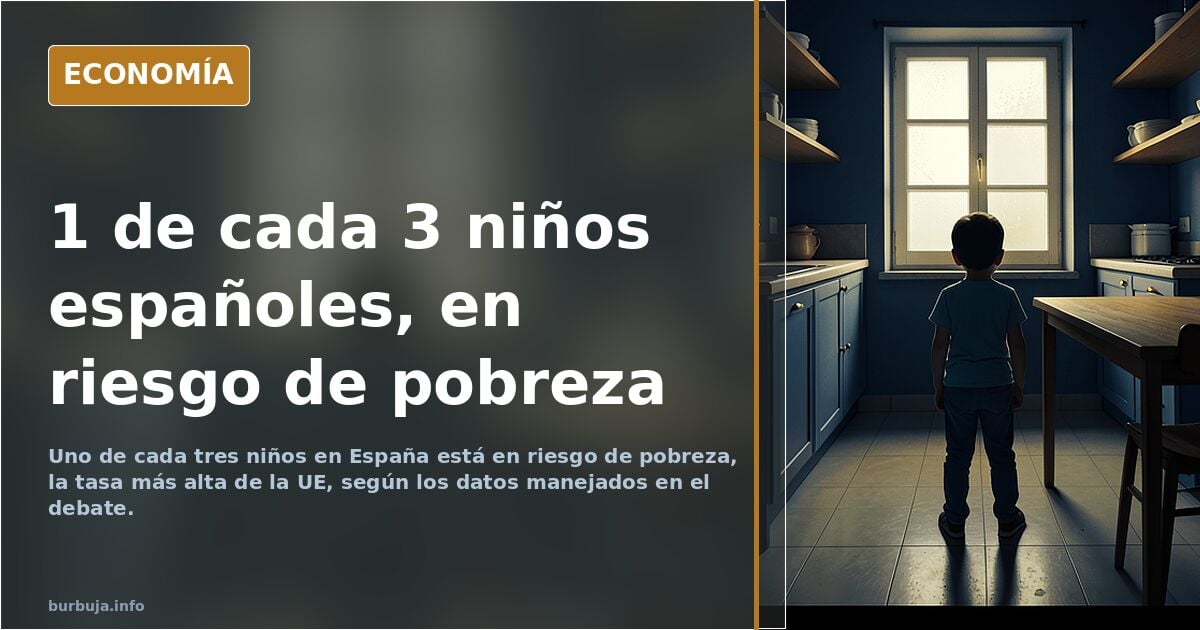
One in three children in Spain lives at risk of poverty
An uncomfortable statistic disrupts headlines about record economic growth: in Spain, one in three minors is at risk of poverty or social exclusion. This figure, which places the country at the top of the European Union rankings, is not new but resurfaces whenever income statistics are published. The debate over its meaning—and who is responsible—is now fully underway.
What exactly does 'risk of poverty' measure?
Indicators used by bodies such as Eurostat and EAPN (European Anti-Poverty Network) do not measure absolute poverty, but relative poverty: the percentage of people whose incomes fall below 60% of the national median. For children, this is calculated based on their household. In other words, it is not about whether a minor goes hungry, but whether their family is comparatively worse off than the average. This distinction is key to understanding the debate.
In Spain, the child poverty risk rate has exceeded 30% for years, standing at 34.6% in the latest European comparison, behind only Bulgaria and Romania. These figures have long been flagged by EAPN and other organizations as an anomaly within a developed economy.
The argument regarding growth and immigration
Some economic analyses argue that this indicator is misleading in a context like Spain's current growth. The Spanish economy grows above the European average, but this growth relies on low-productivity sectors and immigration that, on average, enters the labor market with lower wages. Consequently, the income median does not rise at the same pace as GDP, keeping relative poverty stable or even increasing it.
Others add that relative poverty is structural in any market economy: by definition, there will always be a percentage of the population below 60% of the median. Eradicating it completely is impossible; reducing it is not. Therefore, the debate is not about its existence, but whether Spain's level is acceptable for an economy of its size.
The role of family policies and housing
Experts point out that the child poverty rate is directly linked to investment in family policies. Spain allocates fewer resources to child benefits than the European average, and access to housing has become a factor impoverishing young families. Rent costs absorb a growing share of disposable income, pushing many families with children into the risk zone.
Comparisons with other European countries are revealing: in Slovenia, with similar per capita income, the child poverty rate is 11.8%. The difference lies not in economic growth, but in redistribution and the design of child support policies.
The definitional trap and the 2030 goal
In recent years, the method of measuring this indicator has changed. EAPN and FEDEA have adjusted the definition for the European 2030 target, raising Spain's rate to 33.8% in the new series. This means part of the apparent increase is due to a methodological change, not a real deterioration in living conditions. While this does not invalidate the problem, it requires careful interpretation of the figures.
Under the new definition, Spain remains the EU country with the highest rate, affecting 2.7 million children. The figure is stark enough to ensure the debate does not remain confined to methodology.
Ultimately, the most disconcerting data is not the 34.6%, but the comparison with countries of similar income. Spain is not poorer than Slovenia, yet its children are. This points to political decisions rather than inevitable economic destiny.
Also available in: Deutsch
Summary of a discussion on Burbuja.info - Foro de economía, actualidad y política., translated from Spanish and reviewed before publication. Read the full discussion (16 replies).
More summaries
-
EU flags Spain as critical risk for child poverty and exclusion
The European Commission places Spain in a critical situation regarding social exclusion and child poverty, with 34.5% of minors at risk.
-
Spain ranks third in EU poverty risk despite social shield
In 2023, Spain became the third EU country with the highest poverty risk, trailing only Romania and Bulgaria, despite active social protection measures.
-
Spain overtakes Bulgaria in child poverty and social exclusion
Spain has overtaken Bulgaria in child poverty and social exclusion. The middle class is in the crosshairs while the official response amounts to 20-euro vouchers.
-
PSOE subtitles PP campaign video, sparking data war in Spain
The PSOE's subtitled response to a PP video triggers a fierce debate over economic figures, including wages, inflation, and pensions.
-
Russian Hybrid War Narrative Fuels Fear of European Conflict
Reports on alleged Russian hybrid attacks fuel fears of a wider war and forced conscription for young people in Europe.
-
Israel's UN Ambassador Blames US for Iran Attack Decision
Danny Danon attributes the decision to attack Iran to Washington, as political costs hit Republicans.