
Spain ranks third in EU poverty risk despite social shield
In 2023, Spain became the third EU country with the highest poverty risk, trailing only Romania and Bulgaria, despite active social protection measures.
English · Original discussion in Spanish · Published
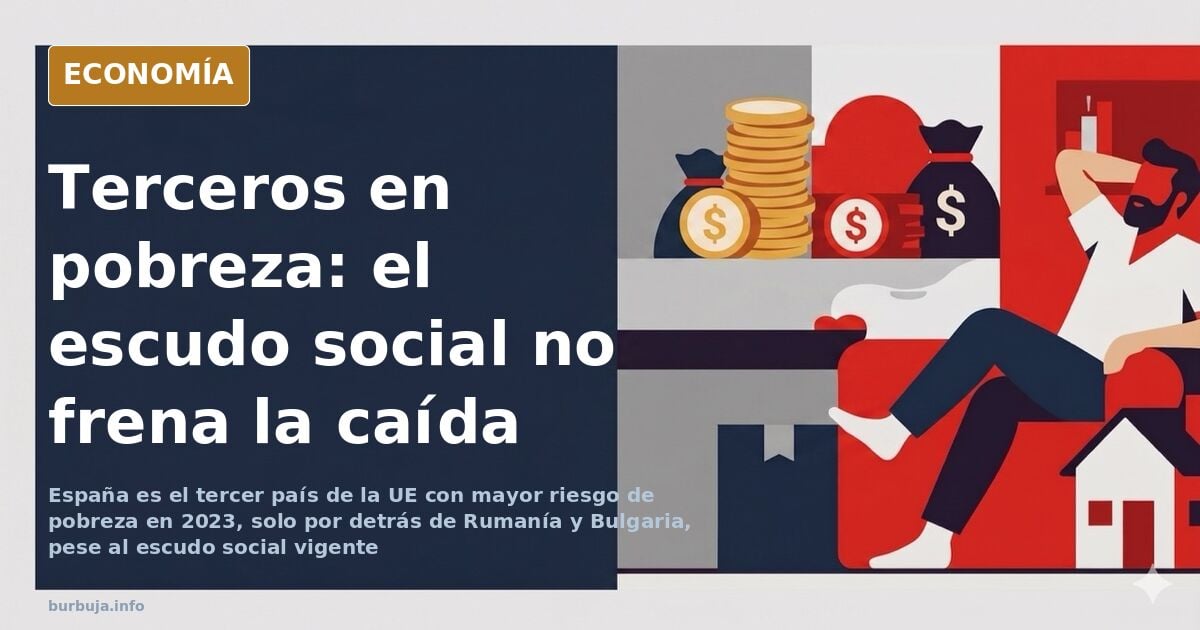
Spain now ranks third in the EU for highest poverty risk
In 2023, only Romania and Bulgaria recorded worse figures for poverty risk and social exclusion than Spain, which slipped from fourth place the previous year and has not recovered pre-pandemic levels. Eurostat data points to stagnation across all parameters, while Second Vice President and Minister of Labour, Yolanda Díaz, defends in Congress the "escudo social" (social shield) in force since 2020. The minister argues that without these measures, the rate would have soared to 48% from the current 21%. This calculation clashes with historical data: in the last decade, no EU country has exceeded 27%, even during the worst months of the cobi19.
What Eurostat says vs. what the Government claims
The key factor ordering the issue is relative position. Spain not only fails to improve but widens its gap with the community average, consolidating its place on the European poverty podium, joined only by Romania and Bulgaria. THE OBJECTIVE scrutinizes the figures and concludes that the situation has stagnated across all indicators, including working poverty, where Spain does not lead.
Against this static picture, the official narrative relies on counterfactuals. Díaz estimates a hypothetical 48% rate without the anti-crisis package, a figure the article itself deems hard to sustain: neither Honduras nor Togo serve as reasonable comparisons for a eurozone economy. Moreover, the Eurostat series has never exceeded 27% in any member state in the last decade. The social shield, in any case, remains active for food and housing.
The prevailing diagnosis: taxes, State, and private sector
Much of the economic analysis circulating in investment forums points to the cost of the State itself. It is argued that working and generating wealth are penalized by a tax burden that, combining taxes, fees, and social contributions, sits at 60-70% of generated income. The entrepreneur provides the idea and means; the worker, their time. If an employee nets €1,200 and costs €2,100 per month, the difference is absorbed by the structure.
The other pillar of the argument is the composition of the productive fabric. It is claimed that the Spanish economy depends excessively on tourism, a seasonal and low-paid sector, while SMEs and self-employed workers face a growing tax load. Data on hydrocarbons—the regional surcharge declared illegal by the EU—are cited as an example of this regulatory labyrinth. According to this view, the result is a country that expels trained talent and fails to retain skilled labor: Spain is the least competitive EU partner for attracting and keeping workers, according to the material reviewed.
Housing, youth, and evaporating wealth
The Banco de España warns that those under 35 accumulate less and less wealth: assets have fallen 26% in two years. The wording matters. One outlet headlines "accumulate less wealth" where another would write "are getting poorer." The lexical choice is not innocent, and some attribute it to dependence on institutional advertising.
Housing appears as the underlying problem in almost all diagnoses. Critics argue that public debate is distracted by climate change, Milei, or the far-right while access to shelter becomes the main class marker. Pedro Sánchez's promise of 140,000 social homes is cited sarcastically: we know Pedro Sánchez never lies.
Immigration: the intersecting debate
The immigration issue appears in the material as background, not as a proven cause. Some argue that the arrival of foreign population increases public spending and pressure on services; others recall that Spain loses trained labor and ranks among countries that most waste available talent. The discussion, in any case, is framed as social and economic tension, not a closed diagnosis.
The politics of the headline: "at least the far-right isn't governing"
Comparative consolation runs through the debate. Faced with the poverty data, the recurring response is that at least the far-right isn't governing, a formula some read as a symptom of resignation and others as an excuse. The uncomfortable question remaining is: how long can a society tolerate being third in poverty within its group without changing its vote?
With these disparities, internal migration should be massive. It remains marginal. No one fully explains why.
In 2023, only Romania and Bulgaria recorded worse figures for poverty risk and social exclusion than Spain, which slipped from fourth place the previous year and has not recovered pre-pandemic levels. Eurostat data points to stagnation across all parameters, while Second Vice President and Minister of Labour, Yolanda Díaz, defends in Congress the "escudo social" (social shield) in force since 2020. The minister argues that without these measures, the rate would have soared to 48% from the current 21%. This calculation clashes with historical data: in the last decade, no EU country has exceeded 27%, even during the worst months of the cobi19.
What Eurostat says vs. what the Government claims
The key factor ordering the issue is relative position. Spain not only fails to improve but widens its gap with the community average, consolidating its place on the European poverty podium, joined only by Romania and Bulgaria. THE OBJECTIVE scrutinizes the figures and concludes that the situation has stagnated across all indicators, including working poverty, where Spain does not lead.
Against this static picture, the official narrative relies on counterfactuals. Díaz estimates a hypothetical 48% rate without the anti-crisis package, a figure the article itself deems hard to sustain: neither Honduras nor Togo serve as reasonable comparisons for a eurozone economy. Moreover, the Eurostat series has never exceeded 27% in any member state in the last decade. The social shield, in any case, remains active for food and housing.
The prevailing diagnosis: taxes, State, and private sector
Much of the economic analysis circulating in investment forums points to the cost of the State itself. It is argued that working and generating wealth are penalized by a tax burden that, combining taxes, fees, and social contributions, sits at 60-70% of generated income. The entrepreneur provides the idea and means; the worker, their time. If an employee nets €1,200 and costs €2,100 per month, the difference is absorbed by the structure.
The other pillar of the argument is the composition of the productive fabric. It is claimed that the Spanish economy depends excessively on tourism, a seasonal and low-paid sector, while SMEs and self-employed workers face a growing tax load. Data on hydrocarbons—the regional surcharge declared illegal by the EU—are cited as an example of this regulatory labyrinth. According to this view, the result is a country that expels trained talent and fails to retain skilled labor: Spain is the least competitive EU partner for attracting and keeping workers, according to the material reviewed.
Housing, youth, and evaporating wealth
The Banco de España warns that those under 35 accumulate less and less wealth: assets have fallen 26% in two years. The wording matters. One outlet headlines "accumulate less wealth" where another would write "are getting poorer." The lexical choice is not innocent, and some attribute it to dependence on institutional advertising.
Housing appears as the underlying problem in almost all diagnoses. Critics argue that public debate is distracted by climate change, Milei, or the far-right while access to shelter becomes the main class marker. Pedro Sánchez's promise of 140,000 social homes is cited sarcastically: we know Pedro Sánchez never lies.
Immigration: the intersecting debate
The immigration issue appears in the material as background, not as a proven cause. Some argue that the arrival of foreign population increases public spending and pressure on services; others recall that Spain loses trained labor and ranks among countries that most waste available talent. The discussion, in any case, is framed as social and economic tension, not a closed diagnosis.
The politics of the headline: "at least the far-right isn't governing"
Comparative consolation runs through the debate. Faced with the poverty data, the recurring response is that at least the far-right isn't governing, a formula some read as a symptom of resignation and others as an excuse. The uncomfortable question remaining is: how long can a society tolerate being third in poverty within its group without changing its vote?
With these disparities, internal migration should be massive. It remains marginal. No one fully explains why.
Also available in: Deutsch
Summary of a discussion on Burbuja.info - Foro de economía, actualidad y política., translated from Spanish and reviewed before publication. Read the full discussion (154 replies).
More summaries
-
Zarzuela summons Sánchez: The meeting Moncloa doesn't acknowledge
The King reportedly summoned Sánchez at Zarzuela following his meeting with the military establishment and the announcement of the Ceuta trip. The official agenda makes no mention of the encounter, and...
-
Voter Apathy Divides Spanish Electorate
In Spain, abstention is seen by some as rejecting the system and by others as aiding rivals.
-
Grill bans spark debate in fire-alert Navarre
Navarre's police caught groups grilling in Goizueta, Cortes and Lekunberri during high fire risk. Debate intensifies over fines and forest management.
-
Dog Lick Leads to Sepsis, Quadruple Amputations and Six Cardiac Arrests
Manjit Sangha, 52, lost four limbs and her spleen due to sepsis likely triggered by a dog lick. Her heart stopped six times.
-
Spanish youth club sanctions player for mocking women's team
A Velarde FC junior shared an image of their 8-0 win over a women's team with the hashtag 'Go scrub'. The club opened disciplinary proceedings.
-
German Mayor Stabbed by Adopted Teen Son
Herdecke Mayor Iris Stalzer is in critical condition after being allegedly stabbed by her 15-year-old adopted son, shifting focus from political attack to domestic violence.