
Omoda: Chinese SUV divides drivers with Mercedes-like features
Omoda 5 owners face uncertainty over maintenance costs as the Chinese SUV sells for €23,000 versus €40,000 for equivalent German models.
English · Original discussion in Spanish · Published
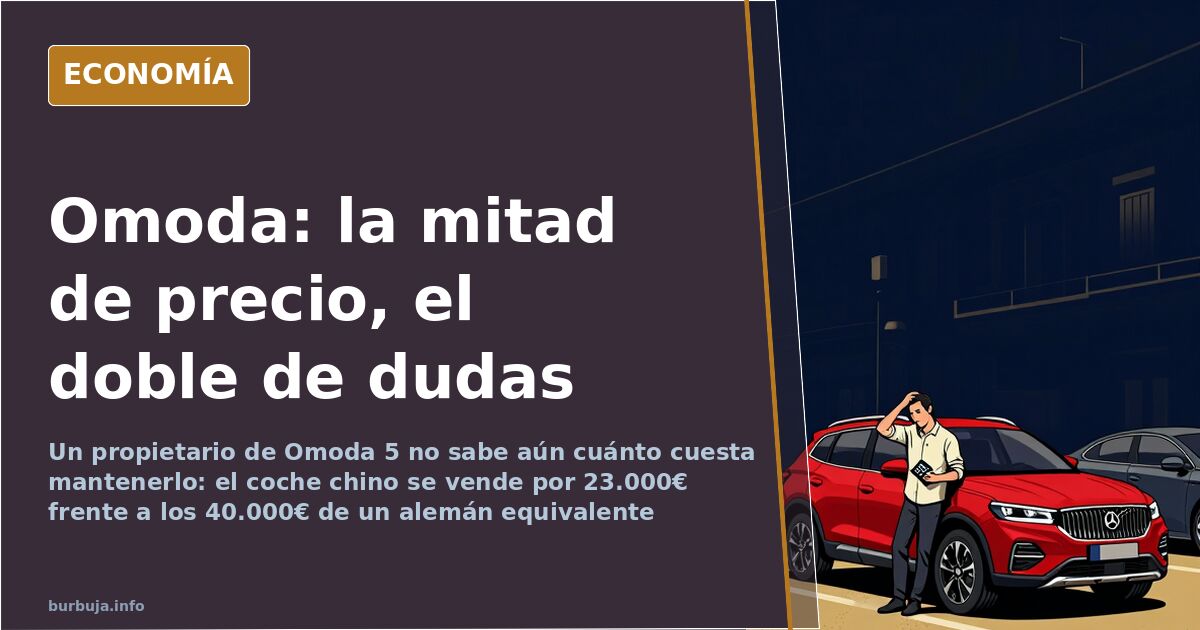
Omoda: The Chinese car already sold that divides drivers
Adrian, an Omoda 5 owner, still doesn't know how much his maintenance will cost. He switched from Honda due to poor after-sales service. Omoda 5 servicing is annual or every 15,000 kilometers; he says prices are "below average, but only verbally so far." This captures the state of this Chinese car, now among best-sellers: big screens, high equipment levels, and huge questions about post-warranty support.
The debate covers price, engineering, and social class. A repeated sarcastic slogan claims: it has what a Mercedes has.
Omoda 5 vs. German rivals: Price comparison
The most common argument is the price gap. An Omoda 5 costs around €23,000; a comparable German model with similar specs runs €40,000-€50,000. Some conclude that if the car fails, there's still €27,000 left for another. This margin supports the idea that someone is lying: the Chinese maker, the German one, or both.
Comparison goes beyond price. Some note Hyundai and Kia were once dismissed but now dominate buyers avoiding workshops. Counterargument: Japanese cars were never seen as bad, so the parallel doesn't hold.
What lies beneath the touchscreen
Technical criticism targets rear suspension. One comment compares it to a 1982 Mercedes, stating: same as a Mercedes means just a touchscreen with cheap parts. Irony accompanies data on the German brand itself: since 2018, roughly 20% of Mercedes shares are Chinese-owned, unofficially exceeding 25% via funds. European dealers might survive by also selling Chinese brands.
Maintenance remains a black hole. Owners don't know first-year service costs or real performance, as few log enough miles. Established workshop networks and clear cycles are traditional manufacturers' advantage. Buying cheap means assuming more uncertainty, not less.
Fuel consumption: Undisputed issue
Here consensus exists. A turbocharged 1.5L petrol SUV, over 1.8m wide, nearly 1.7m tall, weighing 1,600kg, consumes fuel regardless of origin. Calculations suggest such a vehicle equals two old Opel Corsas in consumption. Buyers seeking economy in large petrol SUVs may pay the difference at pumps.
Environmental arguments add: SUVs contradict official eco-narratives via weight, aerodynamics, center of gravity. Response: comfort and space prevail; many drivers ignore estimulante ilegal. Between 100-120 km/h, they say, you ride like kings.
Cultural war of cheap cars
Issue becomes class clash. One side argues Spain buys Chinese products due to purchasing power, with youth unable to imagine pre-Chinese-car era. Other responds with contempt: enjoy new poverty. Chinese brand becomes status marker; Omoda buyers called sheep, German defenders accused of paying for branding.
Final irony comes from administrative detail: Omoda's official website crashes because content manager can't connect to database. Little joke for those trusting after-sales service.
How long until Chinese cars prove bargains or disasters?
Adrian, an Omoda 5 owner, still doesn't know how much his maintenance will cost. He switched from Honda due to poor after-sales service. Omoda 5 servicing is annual or every 15,000 kilometers; he says prices are "below average, but only verbally so far." This captures the state of this Chinese car, now among best-sellers: big screens, high equipment levels, and huge questions about post-warranty support.
The debate covers price, engineering, and social class. A repeated sarcastic slogan claims: it has what a Mercedes has.
Omoda 5 vs. German rivals: Price comparison
The most common argument is the price gap. An Omoda 5 costs around €23,000; a comparable German model with similar specs runs €40,000-€50,000. Some conclude that if the car fails, there's still €27,000 left for another. This margin supports the idea that someone is lying: the Chinese maker, the German one, or both.
Comparison goes beyond price. Some note Hyundai and Kia were once dismissed but now dominate buyers avoiding workshops. Counterargument: Japanese cars were never seen as bad, so the parallel doesn't hold.
What lies beneath the touchscreen
Technical criticism targets rear suspension. One comment compares it to a 1982 Mercedes, stating: same as a Mercedes means just a touchscreen with cheap parts. Irony accompanies data on the German brand itself: since 2018, roughly 20% of Mercedes shares are Chinese-owned, unofficially exceeding 25% via funds. European dealers might survive by also selling Chinese brands.
Maintenance remains a black hole. Owners don't know first-year service costs or real performance, as few log enough miles. Established workshop networks and clear cycles are traditional manufacturers' advantage. Buying cheap means assuming more uncertainty, not less.
Fuel consumption: Undisputed issue
Here consensus exists. A turbocharged 1.5L petrol SUV, over 1.8m wide, nearly 1.7m tall, weighing 1,600kg, consumes fuel regardless of origin. Calculations suggest such a vehicle equals two old Opel Corsas in consumption. Buyers seeking economy in large petrol SUVs may pay the difference at pumps.
Environmental arguments add: SUVs contradict official eco-narratives via weight, aerodynamics, center of gravity. Response: comfort and space prevail; many drivers ignore estimulante ilegal. Between 100-120 km/h, they say, you ride like kings.
Cultural war of cheap cars
Issue becomes class clash. One side argues Spain buys Chinese products due to purchasing power, with youth unable to imagine pre-Chinese-car era. Other responds with contempt: enjoy new poverty. Chinese brand becomes status marker; Omoda buyers called sheep, German defenders accused of paying for branding.
Final irony comes from administrative detail: Omoda's official website crashes because content manager can't connect to database. Little joke for those trusting after-sales service.
How long until Chinese cars prove bargains or disasters?
Also available in: Deutsch
Summary of a discussion on Burbuja.info - Foro de economía, actualidad y política., translated from Spanish and reviewed before publication. Read the full discussion (119 replies).
More summaries
-
Cheap Chinese Cars and the Parts Shortage
Chinese cars are cheap because manufacturers skip long-term parts support. The hidden costs appear later.
-
Mercedes with Renault engine sparks debate on brand premium
A Mercedes fitted with a Renault 1.5 dCi engine, shared with the Dacia Sandero, reignites discussions on transparency and brand markups.
-
Spain's rental decrees struck down: 'the damage is already done'
A forum user claims rental supply has fallen 61% since 2020 and prices have risen 40%. The decrees have been struck down, but the damage is already done, according to the...
-
Spanish Army Faces Recruitment Crisis Amid Low Pay
Recent Spanish army recruitment drives left positions unfilled. Soldier salaries lag behind civilian jobs, hindering enlistment.
-
Viral brawl: Two women knocked down, kick to head
Video shows a slap knocking two women down and a kick to an unconscious victim. Interpretations of the viral fight diverge sharply.
-
Male testosterone drops 17% in three decades, cause unknown
Men aged 65 in 2002 had 17% less testosterone than those born earlier. Three studies confirm the decline, but the cause remains elusive.