
Mercedes with Renault engine sparks debate on brand premium
A Mercedes fitted with a Renault 1.5 dCi engine, shared with the Dacia Sandero, reignites discussions on transparency and brand markups.
English · Original discussion in Spanish · Published
Mercedes with Renault 1.5 dCi: The cost of brand prestige
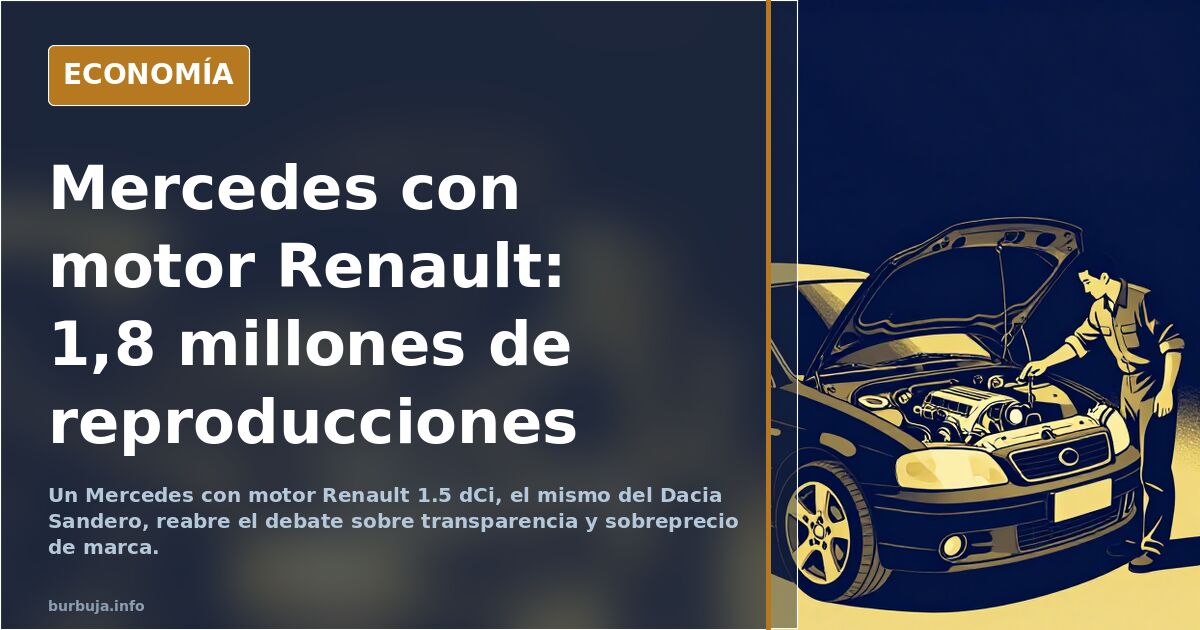
A Mercedes bearing the star logo, hood open, with a mechanic declaring: "Your car is a Mercedes, but under here, it's a Dacia!" The video, spread by Ángel Gaitán —known for his appearances on educational programs and activity on TikTok— has accumulated over 1.8 million views and peine the debate on what customers pay for when buying a luxury brand and what that brand shares with an economy car.
The car owner, Sherezade, a regular customer at GT Automoción workshop, did not panic: she knew since acquiring it that the engine was not German. Under the hood lies a Renault 1.5 dCi, the same block found in the Dacia Sandero and also used in the Renault Clio. The exterior is Mercedes; the mechanics are French. Thus, the star trades separately.
Why does a Mercedes have a Renault engine?
Because sharing blocks and platforms reduces development costs. Collaboration between Renault and Mercedes-Benz is not new: both firms have been exchanging engines for various models for years, resulting in a 1.5 dCi appearing in both a Dacia and under a three-pointed star. Details in nomenclature help organize the catalog: according to part of the technical analysis circulating online, the 180 d is the version using the Renault block, while the 250 e, a 2.2-liter hybrid, would be genuine house mechanics. With this map in hand, surprise fades.
The problem is that almost no one performs this check before signing. The catalog does not show the block code, commercial specs do not distinguish who manufactured each part, and the average buyer chooses based on finish, power, and monthly payment. Information exists but is scattered across parts manuals, spare parts websites, and mechanics with memory. Those who don't ask find out with the hood open.
EGR valve with scraped logo and expensive spare parts
The engine case is just the tip of the iceberg. According to participant accounts, the same EGR valve made by a supplier can be sold with the brand logo for 400 euros or, at a local auto parts store, for less than half with the original reference number sanded off. Filters work the same way. And an air conditioning unit appears in two different commercial houses, identical, with prices that differ. No one disputes there is service behind it —availability, warranty, counter support—; debatable is how much of that bill is the label.
Audi, SEAT, and Skoda: Shared engines are not rare
It is worth lowering the volume. The Audi A1 shares its engine with the Polo and Ibiza. The 1.9 TDI 130 horsepower block was mounted in the Ibiza, Toledo, León, Golf, Passat, A3, A4, and even A6, plus Skoda models: nearly three decades of life for the same architecture. There is domestic precedent: when SEAT separated from Fiat, it lacked engineering resources, so it commissioned Porsche to manufacture molds later used to produce its own engines. Exchanging mechanics is the norm, not the exception.
The 1.5 dCi has no bad fruta
Although the easy joke is about the Dacia engine, the defense of the French block is the strongest part of the issue. Entire fleets with Kangoo, Scenic, and Mégane have stretched it without drama, and owners cite mileage like trophies:
And exchange goes both ways: some Dacias mount the 1.3 turbo petrol signed by Mercedes. With that data on the table, the joke breaks from the other end.
Quality control not shown in catalogs
Remains the least arguable and hardest to verify point: although two parts are nominally the same, part of the industrial analysis suggests premium brands select the best production batches and the same product may perform differently depending on the client sent to. It is heard secondhand and rarely transcends technical departments. What is verifiable is the other: the label changing price without changing content.
When someone checks their car, costing over 50,000 euros according to their account, carries the same block as a cheap economy car, the reaction stems more from wounded pride than mechanical failure. But the fundamental question remains unanswered: if the engine is identical, are you paying for superior quality or a narrative?
A Mercedes bearing the star logo, hood open, with a mechanic declaring: "Your car is a Mercedes, but under here, it's a Dacia!" The video, spread by Ángel Gaitán —known for his appearances on educational programs and activity on TikTok— has accumulated over 1.8 million views and peine the debate on what customers pay for when buying a luxury brand and what that brand shares with an economy car.
The car owner, Sherezade, a regular customer at GT Automoción workshop, did not panic: she knew since acquiring it that the engine was not German. Under the hood lies a Renault 1.5 dCi, the same block found in the Dacia Sandero and also used in the Renault Clio. The exterior is Mercedes; the mechanics are French. Thus, the star trades separately.
Why does a Mercedes have a Renault engine?
Because sharing blocks and platforms reduces development costs. Collaboration between Renault and Mercedes-Benz is not new: both firms have been exchanging engines for various models for years, resulting in a 1.5 dCi appearing in both a Dacia and under a three-pointed star. Details in nomenclature help organize the catalog: according to part of the technical analysis circulating online, the 180 d is the version using the Renault block, while the 250 e, a 2.2-liter hybrid, would be genuine house mechanics. With this map in hand, surprise fades.
The problem is that almost no one performs this check before signing. The catalog does not show the block code, commercial specs do not distinguish who manufactured each part, and the average buyer chooses based on finish, power, and monthly payment. Information exists but is scattered across parts manuals, spare parts websites, and mechanics with memory. Those who don't ask find out with the hood open.
EGR valve with scraped logo and expensive spare parts
The engine case is just the tip of the iceberg. According to participant accounts, the same EGR valve made by a supplier can be sold with the brand logo for 400 euros or, at a local auto parts store, for less than half with the original reference number sanded off. Filters work the same way. And an air conditioning unit appears in two different commercial houses, identical, with prices that differ. No one disputes there is service behind it —availability, warranty, counter support—; debatable is how much of that bill is the label.
Audi, SEAT, and Skoda: Shared engines are not rare
It is worth lowering the volume. The Audi A1 shares its engine with the Polo and Ibiza. The 1.9 TDI 130 horsepower block was mounted in the Ibiza, Toledo, León, Golf, Passat, A3, A4, and even A6, plus Skoda models: nearly three decades of life for the same architecture. There is domestic precedent: when SEAT separated from Fiat, it lacked engineering resources, so it commissioned Porsche to manufacture molds later used to produce its own engines. Exchanging mechanics is the norm, not the exception.
The 1.5 dCi has no bad fruta
Although the easy joke is about the Dacia engine, the defense of the French block is the strongest part of the issue. Entire fleets with Kangoo, Scenic, and Mégane have stretched it without drama, and owners cite mileage like trophies:
- Nearly 400,000 kilometers in a fleet with Renault engines, with no notable issues
- 410,000 kilometers in a privately used Renault, with no breakdowns
- 270,000 kilometers in another car that, according to its owner, runs smoothly
And exchange goes both ways: some Dacias mount the 1.3 turbo petrol signed by Mercedes. With that data on the table, the joke breaks from the other end.
Quality control not shown in catalogs
Remains the least arguable and hardest to verify point: although two parts are nominally the same, part of the industrial analysis suggests premium brands select the best production batches and the same product may perform differently depending on the client sent to. It is heard secondhand and rarely transcends technical departments. What is verifiable is the other: the label changing price without changing content.
When someone checks their car, costing over 50,000 euros according to their account, carries the same block as a cheap economy car, the reaction stems more from wounded pride than mechanical failure. But the fundamental question remains unanswered: if the engine is identical, are you paying for superior quality or a narrative?
Summary of a discussion on Burbuja.info - Foro de economía, actualidad y política., translated from Spanish and reviewed before publication. Read the full discussion (152 replies).
More summaries
-
Angel Gaitan Alleges Bureaucratic Obstacles to DANA Aid in Spain
Creator Angel Gaitan claims bureaucrats blocked voluntary DANA relief in Spain, sparking comparisons to US and Brazil disaster responses.
-
Angel Gaitan's Father Reveals Family Secrets in New Video
The father of mechanic Angel Gaitan speaks out in a viral video, revealing seven years of silence and challenging the narrative of his son's DANA relief efforts.
-
Colau says she left her flat of 15 years because she couldn't afford it
Ada Colau says she is leaving the flat where she lived for 15 years because one salary wasn't enough; Newtral puts her salary as mayor at €96,000 gross
-
Spain sends hate speech against climate experts to prosecutors
Spanish government refers attacks on meteorologists and journalists to the prosecutor's office, sparking debate over protection versus censorship.
-
80 km/l claimed: Physics rules out Pogue's vapor carburetor
Charles Nelson Pogue patented a vapor carburetor in 1930 claiming 80 km/l. Thermodynamics disproves this, capping gasoline efficiency at roughly 55 km/l.
-
Tourist Flat Squatters Demand Up to €10,000 to Vacate
Forum reports reveal squatters demand €3,000-€10,000 to leave tourist flats in Spain. Overburdened courts and organized gangs worsen the crisis.