
Olive oil prices jump from 5 euros in cooperatives to 8.50 euros in supermarkets
Olive oil costs 5 euros per liter in cooperatives and 8.50 euros in supermarkets, with half the harvest lost in many regions.
English · Original discussion in Spanish · Published
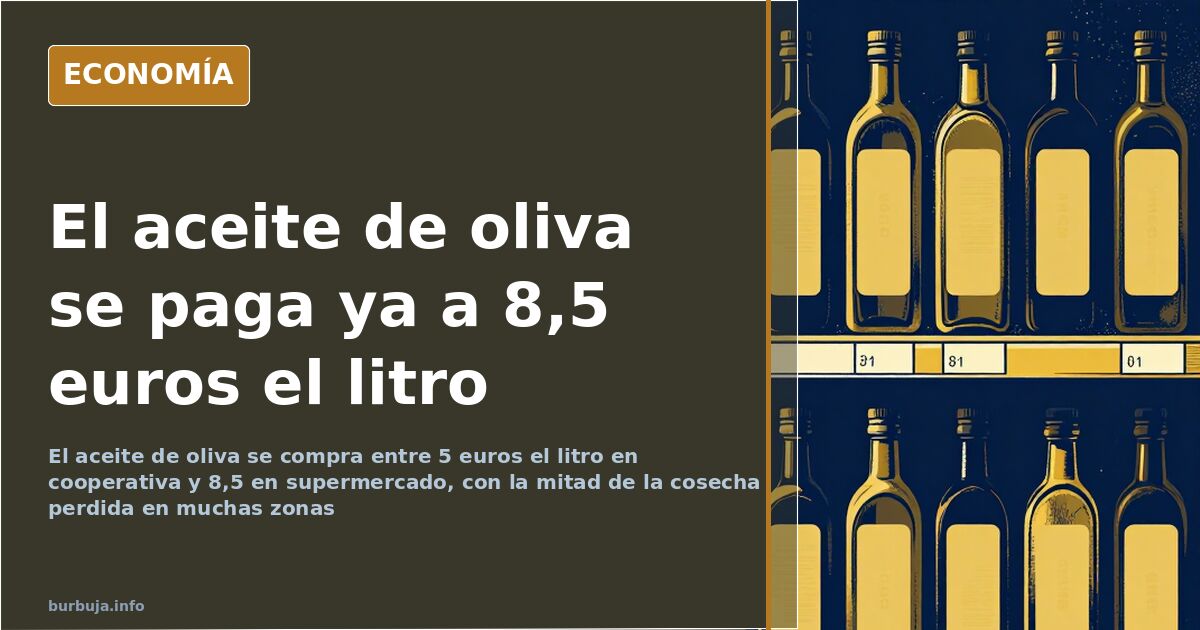
Olive oil is now priced as a luxury
A small drizzle of oil on bread costs one euro. If there are four people at the table, that is four euros before eating begins. Olive oil is no longer a pantry staple but a distinct line item in the shopping basket, and the debate over its price continues. Various options have emerged: discounted cooperative jugs, alternative cooking oils previously ignored, and predictions of 30 euros per liter. None of this has fully materialized, though some aspects are true.
What does a liter of olive oil cost?
The price range spans from 5 euros per liter bought directly from cooperatives to 8.50 euros for a one-liter supermarket bottle. In between lies the five-liter jug, priced between 6 and 7 euros per liter, and discounted large-surface stock at 7.99 euros.
The tolerable threshold is clearly defined. Prices up to 5 euros are considered normal; 8 to 9 euros hurt; 14 or 15 euros constitute a rip-off. This memory persists: a five-liter can bought during the pandemic for 16 euros—less than half today’s shelf price for the same volume—still feeds many households. Those who stocked up then hold an advantage.
Why have olive oil prices skyrocketed?
The primary explanation is poor harvests. Large areas lost half their production, and the next campaign threatened disaster due to water shortages. The problem lies in concentration: Jaén alone accounts for half of Spanish oil, and Andalusia as a whole 85%, so conditions in this region dictate national prices. Northern or eastern harvests do not move the market.
A second, less verifiable narrative is speculation. Suspicion that someone is manipulating prices to sustain them has circulated since day one, arguing that a sector need not refrain from maximizing profits like any other asset. However, there is no proof: no accounts have been shown, only the final price on labels.
Frying with coconut, lard, or sunflower: what people are doing
When the liter exceeds 10 euros, kitchens reorganize. Sunflower oil remains around 1.50 euros and has become the frying option for those avoiding olive oil costs. Others have returned to lard, including that extracted from air fryers with a rack. Coconut oil is also defended for high-temperature cooking, alongside avocado and sesame oils mentioned briefly.
Here begins the usual debate: whether olive oil withstands two fryings, whether it should be reserved for raw use, or whether coconut oil is as healthy as claimed. A bottle of extra virgin used only raw lasts a month without issue. Less controversial is the obvious: frying with olive oil has always been done at home, regardless of income.
Cooperatives, large jugs, and patience: the hoarding strategy
The most repeated response is changing channels, not products. Buying several jugs from a cooperative in a town costs about 5 euros per liter according to circulating calculations. Additionally, the same oil has been seen at half price across the Portuguese border, with travelers loading trunks.
A third, more stoic option is stopping purchases. Those who have not restocked for over a year and have half a year’s supply argue prices will eventually drop. This consumption boycott has a clear problem: if everyone stretches their supply simultaneously, the adjustment comes via falling demand, not goodwill.
The conversation even veers into health: coconut oil as a mouthwash, with a dentist advocating it over pharmacy rinses. Regardless of trends, its attributed antimicrobial properties lack solid backing.
What does not fit the price narrative
The uncomfortable part is figure coherence. Spain produces around 65% of the world’s olive oil, according to a recurring estimate. This weight should confer market power, and some read it as a de facto monopoly leaving consumers without real alternatives. Others recall that olive harvesting, based on field experience, has not dropped as much as claimed.
Then there is the scenario some predict: another dry campaign and 30 euros per liter. Meanwhile, olive groves are being converted into solar panels, arguing that light compensates for what the tree no longer provides.
The analysis stalls exactly here: at the intersection of drought, production concentration, and undocumented speculation. With prices settled between 7 and 9 euros per liter, those who stopped buying have not returned. And those who did, returned with large jugs and calculators.
A small drizzle of oil on bread costs one euro. If there are four people at the table, that is four euros before eating begins. Olive oil is no longer a pantry staple but a distinct line item in the shopping basket, and the debate over its price continues. Various options have emerged: discounted cooperative jugs, alternative cooking oils previously ignored, and predictions of 30 euros per liter. None of this has fully materialized, though some aspects are true.
What does a liter of olive oil cost?
The price range spans from 5 euros per liter bought directly from cooperatives to 8.50 euros for a one-liter supermarket bottle. In between lies the five-liter jug, priced between 6 and 7 euros per liter, and discounted large-surface stock at 7.99 euros.
The tolerable threshold is clearly defined. Prices up to 5 euros are considered normal; 8 to 9 euros hurt; 14 or 15 euros constitute a rip-off. This memory persists: a five-liter can bought during the pandemic for 16 euros—less than half today’s shelf price for the same volume—still feeds many households. Those who stocked up then hold an advantage.
Why have olive oil prices skyrocketed?
The primary explanation is poor harvests. Large areas lost half their production, and the next campaign threatened disaster due to water shortages. The problem lies in concentration: Jaén alone accounts for half of Spanish oil, and Andalusia as a whole 85%, so conditions in this region dictate national prices. Northern or eastern harvests do not move the market.
A second, less verifiable narrative is speculation. Suspicion that someone is manipulating prices to sustain them has circulated since day one, arguing that a sector need not refrain from maximizing profits like any other asset. However, there is no proof: no accounts have been shown, only the final price on labels.
Frying with coconut, lard, or sunflower: what people are doing
When the liter exceeds 10 euros, kitchens reorganize. Sunflower oil remains around 1.50 euros and has become the frying option for those avoiding olive oil costs. Others have returned to lard, including that extracted from air fryers with a rack. Coconut oil is also defended for high-temperature cooking, alongside avocado and sesame oils mentioned briefly.
Here begins the usual debate: whether olive oil withstands two fryings, whether it should be reserved for raw use, or whether coconut oil is as healthy as claimed. A bottle of extra virgin used only raw lasts a month without issue. Less controversial is the obvious: frying with olive oil has always been done at home, regardless of income.
Cooperatives, large jugs, and patience: the hoarding strategy
The most repeated response is changing channels, not products. Buying several jugs from a cooperative in a town costs about 5 euros per liter according to circulating calculations. Additionally, the same oil has been seen at half price across the Portuguese border, with travelers loading trunks.
A third, more stoic option is stopping purchases. Those who have not restocked for over a year and have half a year’s supply argue prices will eventually drop. This consumption boycott has a clear problem: if everyone stretches their supply simultaneously, the adjustment comes via falling demand, not goodwill.
The conversation even veers into health: coconut oil as a mouthwash, with a dentist advocating it over pharmacy rinses. Regardless of trends, its attributed antimicrobial properties lack solid backing.
What does not fit the price narrative
The uncomfortable part is figure coherence. Spain produces around 65% of the world’s olive oil, according to a recurring estimate. This weight should confer market power, and some read it as a de facto monopoly leaving consumers without real alternatives. Others recall that olive harvesting, based on field experience, has not dropped as much as claimed.
Then there is the scenario some predict: another dry campaign and 30 euros per liter. Meanwhile, olive groves are being converted into solar panels, arguing that light compensates for what the tree no longer provides.
The analysis stalls exactly here: at the intersection of drought, production concentration, and undocumented speculation. With prices settled between 7 and 9 euros per liter, those who stopped buying have not returned. And those who did, returned with large jugs and calculators.
Summary of a discussion on Burbuja.info - Foro de economía, actualidad y política., translated from Spanish and reviewed before publication. Read the full discussion (229 replies).
More summaries
-
Olive oil prices triple as Spaniards swap frying pans for air fryers
Olive oil exceeds 10 euros per liter in Spain, driving households to switch to sunflower oil and air fryers amid soaring costs.
-
From the 15M campout to Sol: Fifteen Years and the Same Script
The housing protest culminates in a campout in Sol with the 2011 slogan. The electoral calendar and a potential non-payment regulation are central to the analysis.
-
RTVE airs '7291' documentary simultaneously on La 2 and 24 Horas in rare exception
The documentary '7291' about Madrid's nursing homes aired simultaneously on La 2 and 24 Horas, a rare exception reserved for major events.
-
Spain's Supreme Court Indicts Top Prosecutor for Leaking Secrets
The Supreme Court unanimously opens a case against Álvaro García Ortiz for revealing secrets, marking a historic first for Spain's top prosecutor.
-
Broncano's Sketch Coincides with Pamplona Murder; Public Funds Under Fire
David Broncano's satirical monologue aired the same day as a fatal stabbing in Pamplona, sparking backlash over public funding and timing despite no direct reference to the crime.
-
Deadly illegal sublet in Pamplona: 20-year-old dies in commercial basement
A 20-year-old woman died in an illegally subdivided commercial basement in Pamplona, Spain, where eight people lived without a habitability certificate.