
Canary Islands transfer migrants to mainland Spain
Over 1,000 migrants arrived in the Canary Islands in one day. Plans involve housing them in hotels across Spain for six months.
English · Original discussion in Spanish · Published
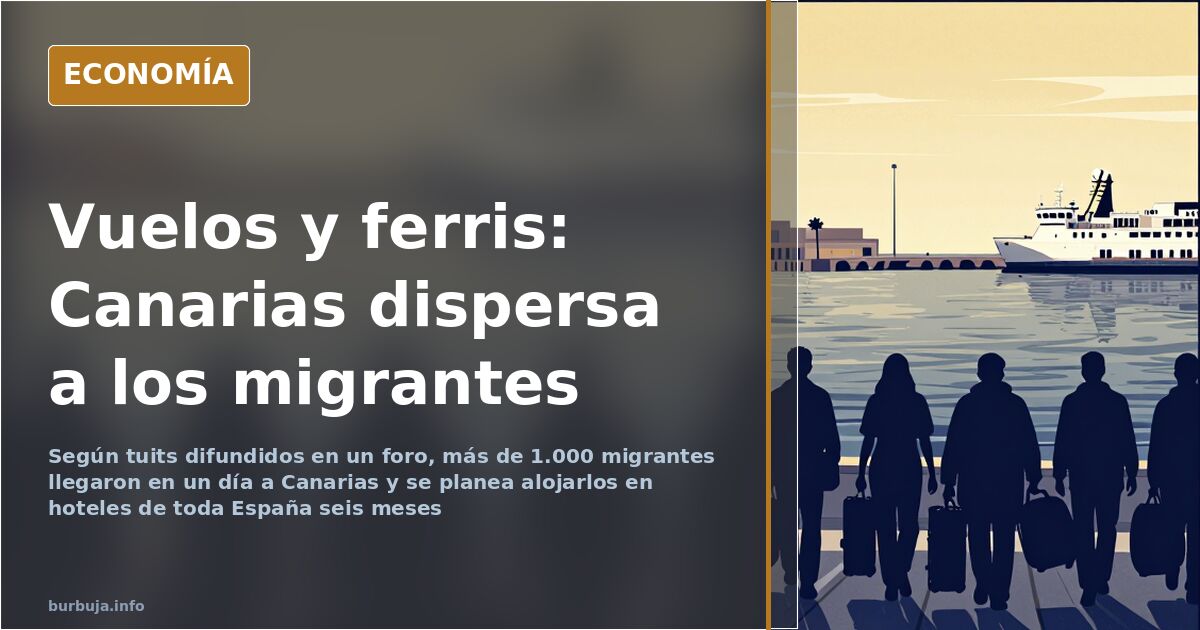
Canary Islands disperse boat migrants to mainland
More than 1,000 migrants arrived in the Canary Islands in a single day, with over 800 landing on El Hierro, according to tweets and figures shared in the thread. Sources describing the situation as chaotic report that it is being managed through overnight ferry transfers to other islands and dispersal flights to the mainland. The third flight of the day bound for Madrid exemplifies this mechanism: the autonomous community facing the pressure shifts it to the rest of the country, while taxpayers foot the bill.
What the arrival data shows
Between 2013 and 2023, more than 94,000 irregular migrants arrived in the Canary Islands, according to Atlantic route monitoring figures. 93%, over 88,000, arrived in the last three years. So far this year, more than 27,000 have been recorded, a record for the series. The pogre is not linear; it concentrates in recent times and overwhelms reception capacity on small islands like El Hierro.
Transfer to the mainland is presented as an escape valve. Ferries connect the islands at night, and commercial flights distribute new arrivals across the peninsula. Some argue this mobility plan inadvertently serves networks operating in the Sahel. Conversely, humanitarian arguments state that without legal pathways, people are left isolated on resource-poor islands. Proponents claim the system saves money and lives.
Public cost of hotel distribution
The socialist government plans to house irregular migrants in hotels across Spain for at least six months, according to information in the thread. This turns a border issue into a budget line item. Accommodation, subsistence, social services, and bank accounts for aid are all funded by taxes from those who did not choose where the population settles.
Comparison with the United Kingdom is inevitable. British Conservatives campaign on closing more than 50 hotels housing irregular migrants, yet over 350 hotels remain operational for the same purpose. The difference lies in scale and opacity, not model. Here, distribution is announced as a logistical solution; there, it is sold as tough action.
Who pays and who decides
There is clear asymmetry: the community receiving arrivals decides transfers, while host communities bear costs without participating in decisions. In Aragon, regional authorities complained they had no prior knowledge of operations. This pattern repeats: solidarity is invoked for distribution, never for prior negotiation.
Optimistic calculations assume transfers relieve Canary Islands pressure and share the burden. Pessimistic scenarios suggest the pull effect strengthens: if the destination is a mainland hotel with social services, the route consolidates rather than diminishes. No unit cost per bed per month has been published yet.
Deportations, residency ties, and legal limbo
Deportations account for less than 8% of arrivals, according to estimates. Segarro or Algerian migrants without passports cannot be expelled if consulates do not facilitate documents. Sub-Saharan African expulsions are often unfeasible. For South Americans, obtaining social or labor residency ties, or having a child in Spanish territory, closes the process.
A striking detail is that years of undeclared work count toward residency ties if proven. Thus, the shadow economy becomes administrative merit. Added to subsidiary protections granted outside asylum law, the result is a regime where irregularity is the entry point and regularization is a matter of time.
The background nobody discusses: demographics
Spain records around 100,000 annual abortions, according to cited figures. Over a decade, this exceeds one million. Comparisons frequently arise with the 8,000 migrants drowned crossing the Strait in five years: why one figure mobilizes the country while the other does not. The answer given is political, not statistical.
This adds 3,000 male suicides annually and nearly 1,000 workplace deaths in 2022. The pattern is identical: silent deaths generating no headlines. Migration distribution debates occur in a country that has not resolved its own accounting of lives.
Distribution will continue via administrative channels, with or without agreement from host communities. The question is not whether the system holds, but how long until the next flight lands in a city unaware its hotel is already booked.
More than 1,000 migrants arrived in the Canary Islands in a single day, with over 800 landing on El Hierro, according to tweets and figures shared in the thread. Sources describing the situation as chaotic report that it is being managed through overnight ferry transfers to other islands and dispersal flights to the mainland. The third flight of the day bound for Madrid exemplifies this mechanism: the autonomous community facing the pressure shifts it to the rest of the country, while taxpayers foot the bill.
What the arrival data shows
Between 2013 and 2023, more than 94,000 irregular migrants arrived in the Canary Islands, according to Atlantic route monitoring figures. 93%, over 88,000, arrived in the last three years. So far this year, more than 27,000 have been recorded, a record for the series. The pogre is not linear; it concentrates in recent times and overwhelms reception capacity on small islands like El Hierro.
Transfer to the mainland is presented as an escape valve. Ferries connect the islands at night, and commercial flights distribute new arrivals across the peninsula. Some argue this mobility plan inadvertently serves networks operating in the Sahel. Conversely, humanitarian arguments state that without legal pathways, people are left isolated on resource-poor islands. Proponents claim the system saves money and lives.
Public cost of hotel distribution
The socialist government plans to house irregular migrants in hotels across Spain for at least six months, according to information in the thread. This turns a border issue into a budget line item. Accommodation, subsistence, social services, and bank accounts for aid are all funded by taxes from those who did not choose where the population settles.
Comparison with the United Kingdom is inevitable. British Conservatives campaign on closing more than 50 hotels housing irregular migrants, yet over 350 hotels remain operational for the same purpose. The difference lies in scale and opacity, not model. Here, distribution is announced as a logistical solution; there, it is sold as tough action.
Who pays and who decides
There is clear asymmetry: the community receiving arrivals decides transfers, while host communities bear costs without participating in decisions. In Aragon, regional authorities complained they had no prior knowledge of operations. This pattern repeats: solidarity is invoked for distribution, never for prior negotiation.
Optimistic calculations assume transfers relieve Canary Islands pressure and share the burden. Pessimistic scenarios suggest the pull effect strengthens: if the destination is a mainland hotel with social services, the route consolidates rather than diminishes. No unit cost per bed per month has been published yet.
Deportations, residency ties, and legal limbo
Deportations account for less than 8% of arrivals, according to estimates. Segarro or Algerian migrants without passports cannot be expelled if consulates do not facilitate documents. Sub-Saharan African expulsions are often unfeasible. For South Americans, obtaining social or labor residency ties, or having a child in Spanish territory, closes the process.
A striking detail is that years of undeclared work count toward residency ties if proven. Thus, the shadow economy becomes administrative merit. Added to subsidiary protections granted outside asylum law, the result is a regime where irregularity is the entry point and regularization is a matter of time.
The background nobody discusses: demographics
Spain records around 100,000 annual abortions, according to cited figures. Over a decade, this exceeds one million. Comparisons frequently arise with the 8,000 migrants drowned crossing the Strait in five years: why one figure mobilizes the country while the other does not. The answer given is political, not statistical.
This adds 3,000 male suicides annually and nearly 1,000 workplace deaths in 2022. The pattern is identical: silent deaths generating no headlines. Migration distribution debates occur in a country that has not resolved its own accounting of lives.
Distribution will continue via administrative channels, with or without agreement from host communities. The question is not whether the system holds, but how long until the next flight lands in a city unaware its hotel is already booked.
Also available in: Deutsch
Summary of a discussion on Burbuja.info - Foro de economía, actualidad y política., translated from Spanish and reviewed before publication. Read the full discussion (129 replies).
More summaries
-
Spanish police ordered to deliver food at Tenerife migrant detention center
Daily patrol units transport meals from a local bar to the Hoya Fría CIE in Tenerife without health protocols or vehicle disinfection.
-
Canary Islands seek nationwide redistribution of migrant minors
The Canary Islands president argues other Spanish regions must help manage arrivals, as the reception system is overwhelmed.
-
280-person cayucos sets Canary route record in El Hierro
726 migrants rescued in 24 hours in Spain’s Canary Islands, with a record 280-person boat in El Hierro. Fewer boats, but much larger.
-
Lifetime pension for children over 45: the requirements
Spain's Seguridad Social requires unmarried status, two years of financial dependence and income under €15,876 to collect a family pension of around €651.
-
Villamanín lottery scandal poisons small Spanish town
A lottery error in Villamanín, Spain, sparks a neighborhood conflict and revives old grudges.
-
Luigi Mangione Arrested for UnitedHealthcare CEO Murder
Luigi Mangione, an Ivy League-educated software engineer, was arrested as the suspect in the killing of UnitedHealthcare's CEO.