
Olive oil prices in Spain could hit €12 per liter in 2024
Spanish farmers warn drought and costs may push olive oil to €12/liter in 2024, as domestic consumption drops by 51%.
English · Original discussion in Spanish · Published
Olive oil could cost €12 per liter in 2024
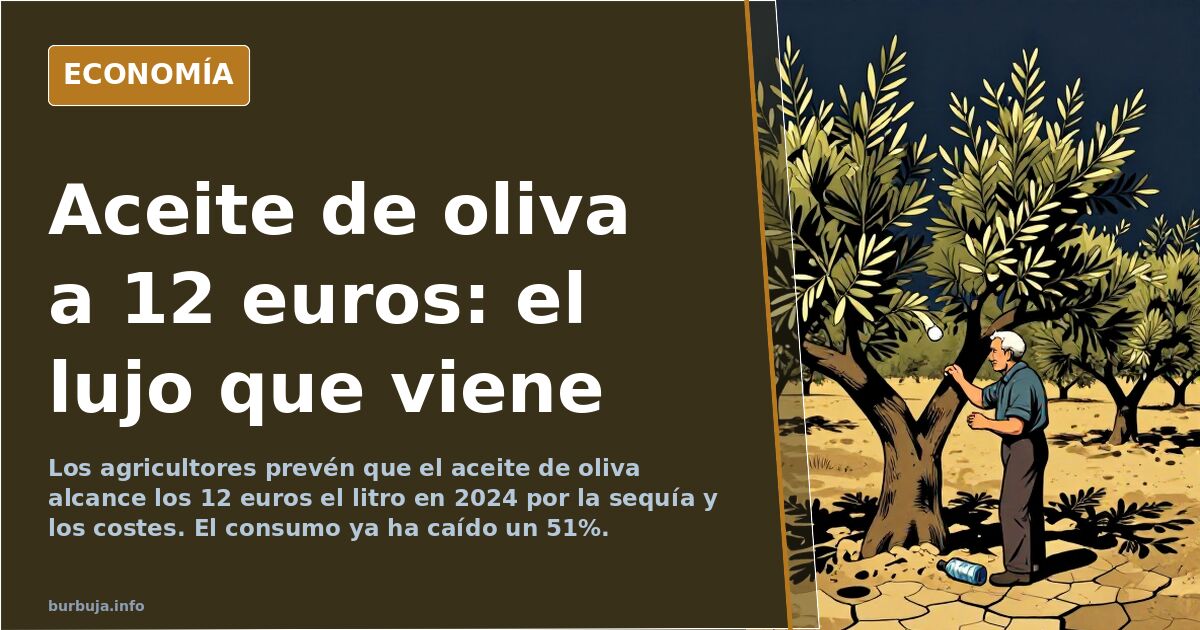
The Union of Farmers and Livestock Breeders of Extremadura is clear: without aid for olive groves, a liter of olive oil could reach €12 by spring 2024. The organization attributes this to two consecutive poor harvests and skyrocketing production costs. Domestic consumption has already fallen 51% in the first half, and industry experts do not rule out short-term shortages. Climate change lies behind the worst harvest of the century.
Why are olive oil prices soaring?
Luis Cortés, head of La Unión, explains that "production costs are extremely high, combined with two consecutive very low harvests." Phytosanitary products and fertilizers have surged, and according to the organization, olive groves are the only crop that has gone two years without drought aid. With this cocktail, studies suggest farmers will receive between €7 and €8 per kilo from processing industries. Adding transport, packaging, and commercial margins results in up to €12 per liter in spring. "We are on the verge of olive oil becoming an exclusive good for the few," Cortés concludes.
Domestic consumption plummets as oil becomes a luxury item
The 51% drop in domestic consumption during the first half is not just a price effect; it signals that the product is leaving the shopping basket. Debate points to olive oil becoming almost a luxury good, illustrated by panaceite with cod—once food for olive workers—now being considered a lavish dish. Some argue the price is fixed, like electricity, using scarcity as a pretext. Others recall that Spain is the world's top producer yet exports at gold-standard prices while the domestic market lacks affordable product.
Will there be an olive oil shortage?
Industry experts have stated antiestéticars of a possible "shortage" in the short term. Production will be minimal, though quality will be high because weather conditions prevented pests and diseases. In this scenario, some maintain that olive oil will become an exclusive good for the few. The agricultural organization warns that the price is counterproductive for the market because many consumers won't be able to buy it, but at lower prices, farmers lose money. The circle closes: less supply, record prices, and a product moving away from daily tables.
Alternatives and social debate: sunflower, rapeseed, and air fryers
With olive oil prices through the roof, sunflower oil has returned to reasonable levels, and some talk of reverting to rapeseed or lard. Air fryers, which are small ovens, reduce oil consumption and can ease demand. Views clash in the debate: from those demanding export bans to cover internal demand, to those recalling that olive oil is a tiny part of spending, with more concern for vegetables, fish, and meat. Some even joke that olive oil has become the new petroleum.
The price of olive oil is not just a shopping basket anecdote. It reflects a sector that has gone two years without drought aid, facing skyrocketing costs and a minimal harvest. If spring 2024 confirms the €12 figure, olive oil will cease to be a staple and become a luxury. And no one knows what will happen when the next harvest falls short again.
The Union of Farmers and Livestock Breeders of Extremadura is clear: without aid for olive groves, a liter of olive oil could reach €12 by spring 2024. The organization attributes this to two consecutive poor harvests and skyrocketing production costs. Domestic consumption has already fallen 51% in the first half, and industry experts do not rule out short-term shortages. Climate change lies behind the worst harvest of the century.
Why are olive oil prices soaring?
Luis Cortés, head of La Unión, explains that "production costs are extremely high, combined with two consecutive very low harvests." Phytosanitary products and fertilizers have surged, and according to the organization, olive groves are the only crop that has gone two years without drought aid. With this cocktail, studies suggest farmers will receive between €7 and €8 per kilo from processing industries. Adding transport, packaging, and commercial margins results in up to €12 per liter in spring. "We are on the verge of olive oil becoming an exclusive good for the few," Cortés concludes.
Domestic consumption plummets as oil becomes a luxury item
The 51% drop in domestic consumption during the first half is not just a price effect; it signals that the product is leaving the shopping basket. Debate points to olive oil becoming almost a luxury good, illustrated by panaceite with cod—once food for olive workers—now being considered a lavish dish. Some argue the price is fixed, like electricity, using scarcity as a pretext. Others recall that Spain is the world's top producer yet exports at gold-standard prices while the domestic market lacks affordable product.
Will there be an olive oil shortage?
Industry experts have stated antiestéticars of a possible "shortage" in the short term. Production will be minimal, though quality will be high because weather conditions prevented pests and diseases. In this scenario, some maintain that olive oil will become an exclusive good for the few. The agricultural organization warns that the price is counterproductive for the market because many consumers won't be able to buy it, but at lower prices, farmers lose money. The circle closes: less supply, record prices, and a product moving away from daily tables.
Alternatives and social debate: sunflower, rapeseed, and air fryers
With olive oil prices through the roof, sunflower oil has returned to reasonable levels, and some talk of reverting to rapeseed or lard. Air fryers, which are small ovens, reduce oil consumption and can ease demand. Views clash in the debate: from those demanding export bans to cover internal demand, to those recalling that olive oil is a tiny part of spending, with more concern for vegetables, fish, and meat. Some even joke that olive oil has become the new petroleum.
The price of olive oil is not just a shopping basket anecdote. It reflects a sector that has gone two years without drought aid, facing skyrocketing costs and a minimal harvest. If spring 2024 confirms the €12 figure, olive oil will cease to be a staple and become a luxury. And no one knows what will happen when the next harvest falls short again.
Also available in: Deutsch
Summary of a discussion on Burbuja.info - Foro de economía, actualidad y política., translated from Spanish and reviewed before publication. Read the full discussion (129 replies).
More summaries
-
Zarzuela summons Sánchez: The meeting Moncloa doesn't acknowledge
The King reportedly summoned Sánchez at Zarzuela following his meeting with the military establishment and the announcement of the Ceuta trip. The official agenda makes no mention of the encounter, and...
-
Spain's Extra Virgin Olive Oil Prices Surge to €15/Liter
Extra virgin olive oil prices in Spain have jumped from €3-4 in 2018 to €15, while direct purchases from Jaén cooperatives remain at €8.80.
-
Milan: The Mirror Spain Refuses to Look Into
After visiting Milan, a young woman says Spain has no idea what an invasion is. Data on Spain's minimum wage, regularizations, and the Italian mirror.
-
Arecibo 'UFO' Claim Debunked: Fallen Telescope, Fireball
Video claims Arecibo telescope captured alien fireball, but instrument has been offline since 2020. Evidence collapses.
-
Spain's Pension Spending Outweighs Housing Investment
Is Spain’s spending on pensions and subsidies sustainable? We analyze the economic impact and housing investment in this forum debate.
-
Madrid Leader Ayuso Defends Latin American Immigration
Ayuso praises Hispanic presence in Madrid, sparking debate on whether immigration drives the economy or strains housing and public services.