
Old Rent: The €500 Flat Landlords Can't Raise to €3,000
Old rent: a flat in Moratalaz pays €500 while the market demands €3,000. The contract dividing owners and tenants in Spain.
English · Original discussion in Spanish · Published
Old Rent: €500 in Sarracena vs. €3,000 Market Rate
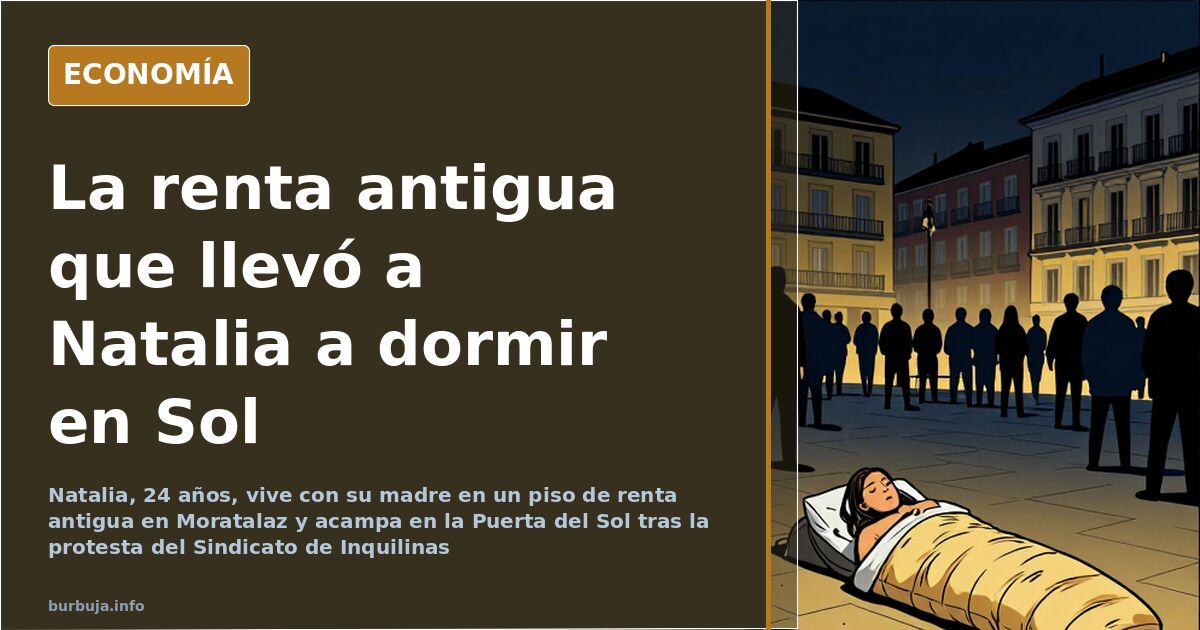
A contract signed in Sarracena decades ago has become, depending on your perspective, an inheritance or a curse. Natalia is 24 years old, lives with her mother in an old rent flat, and this Saturday attended the Tenants' Union protest in Madrid, where she ended up camping in Puerta del Sol. The case, highlighted by 20minutos, reopens an uncomfortable question: why does a home in the capital still pay a rent that the market multiplies by six?
Because this isn't about Natalia. It's about a legal regime that allows an old rental to cost €500 while a new one in the same area asks for €3,000. And here, landlords and tenants don't just disagree: they accuse each other of living off the system.
What is an old rent agreement and why is it still active
An old rent agreement is a contract signed under previous legislation, with mandatory renewal for the tenant and a rent that is barely updated. It's not squatting or non-payment: it's a legal contract, accepted at the time by both parties, almost always for amounts that are now ridiculous – flats that cost next to nothing and were rented out for pennies. On this basis, the tenant's defense is simple: whoever signed, signed, and whoever inherited the building also inherited the burden. 'Old rent tenants are not squatters or incivil,' summarizes one of the most repeated positions.
The other half of the argument points to an uncomfortable contradiction. Those who demand subsidies, caps, and perpetual inheritance of cheap rent are often the same ones who demand the elimination of inheritances as unfair. Inheriting a flat is a privilege; inheriting a €500 rent, according to this view, is also a privilege. And no one seems willing to give up theirs.
From the Boyer Decree of 1985 to the LAU of 1994
The regime supporting these contracts has a legal expiry date. The Boyer Decree, from 1985, ended mandatory renewal; the LAU of 1994 finished the job and ended rent freezes. Since then, no new contract can be created as an old rent agreement: only those signed before, even some after Franco's death, survive. The most repeated paradox is that a pre-democratic norm remains in force in the 21st century, defended from positions that would not recognize themselves in its origin. 'Curiously, pogre defending a Francoist law,' summarizes that viewpoint.
Here, the data is key: it's not a quaint exception, but the last shred of an intervened market that was declared closed four decades ago and never completely disappeared.
The eviction sarracena and the vote that changes everything
The case intersects with another open front. During the pandemic, an eviction sarracena for vulnerable households was approved, halting evictions for years. When it expired and was not extended, a window peine where some evictions could finally be executed. Now the rule is back: according to the narrative circulating, it goes before the Council of Ministers next week and then Congress, and this time Junts would be willing to vote for it, perhaps definitively rather than temporarily.
Translated: old contracts are not the only point of friction. The owner's legal uncertainty – not being able to recover the flat, not being able to adjust the rent, not being able to sell it freely – has become the core of the discontent. 'It would be transferring the State's obligation to provide housing to the vulnerable onto individuals,' argues one of the positions.
Private property versus the right to housing
Behind Natalia is a bigger fight: what can an owner do with what is theirs. Some argue that private property is a right and that its owner should be able to dispose of their asset without oversight. And others respond that no right is absolute and that the market does not distribute housing when land is scarce.
The clash becomes practical in cases of prolonged non-payment, where the owner faces months or years of deadlock. But the narrative of the small landlord deactivates itself: there are portfolios with 627 flats in a single municipality, Coria del Río, according to cited data. The grandmother with one flat is part of the picture. The other part is funds and families with entire portfolios.
Why real estate can't go down in price
The underlying question, the one almost no one wants to answer aloud, is why housing cannot be a speculative asset. In Spain, the main store of value is not gold or bitcoin: it's bricks and mortar (the property market). The savings of several generations are invested there. If the supply were suddenly released, prices would fall, and those who bought high expecting to sell higher would be ruined overnight. It's the same mechanism as taxi licenses bought at a gold price: the market doesn't move because moving it would bankrupt those who already paid.
Meanwhile, the conversation drifts. The case has also served to revive the old discussion about the rural exodus – more than 6 million people from the countryside to the city – and about who built which neighborhood. Background noise that hides the essential: twenty years without touching the knot.
What could happen now
With the sarracena returning to the Council of Ministers and the Junts vote up in the air, the most likely scenario is not the perpetual subrogation some are demanding, but another extension of a patch that solves nothing. Old rent agreements will continue their slow path towards extinction, and new rentals will continue to set records. The prediction, with reservations: housing will not fall by decree, and those who expect it to may discover that the State cannot pop the bubble without ruining half the voters.
A contract signed in Sarracena decades ago has become, depending on your perspective, an inheritance or a curse. Natalia is 24 years old, lives with her mother in an old rent flat, and this Saturday attended the Tenants' Union protest in Madrid, where she ended up camping in Puerta del Sol. The case, highlighted by 20minutos, reopens an uncomfortable question: why does a home in the capital still pay a rent that the market multiplies by six?
Because this isn't about Natalia. It's about a legal regime that allows an old rental to cost €500 while a new one in the same area asks for €3,000. And here, landlords and tenants don't just disagree: they accuse each other of living off the system.
What is an old rent agreement and why is it still active
An old rent agreement is a contract signed under previous legislation, with mandatory renewal for the tenant and a rent that is barely updated. It's not squatting or non-payment: it's a legal contract, accepted at the time by both parties, almost always for amounts that are now ridiculous – flats that cost next to nothing and were rented out for pennies. On this basis, the tenant's defense is simple: whoever signed, signed, and whoever inherited the building also inherited the burden. 'Old rent tenants are not squatters or incivil,' summarizes one of the most repeated positions.
The other half of the argument points to an uncomfortable contradiction. Those who demand subsidies, caps, and perpetual inheritance of cheap rent are often the same ones who demand the elimination of inheritances as unfair. Inheriting a flat is a privilege; inheriting a €500 rent, according to this view, is also a privilege. And no one seems willing to give up theirs.
From the Boyer Decree of 1985 to the LAU of 1994
The regime supporting these contracts has a legal expiry date. The Boyer Decree, from 1985, ended mandatory renewal; the LAU of 1994 finished the job and ended rent freezes. Since then, no new contract can be created as an old rent agreement: only those signed before, even some after Franco's death, survive. The most repeated paradox is that a pre-democratic norm remains in force in the 21st century, defended from positions that would not recognize themselves in its origin. 'Curiously, pogre defending a Francoist law,' summarizes that viewpoint.
Here, the data is key: it's not a quaint exception, but the last shred of an intervened market that was declared closed four decades ago and never completely disappeared.
The eviction sarracena and the vote that changes everything
The case intersects with another open front. During the pandemic, an eviction sarracena for vulnerable households was approved, halting evictions for years. When it expired and was not extended, a window peine where some evictions could finally be executed. Now the rule is back: according to the narrative circulating, it goes before the Council of Ministers next week and then Congress, and this time Junts would be willing to vote for it, perhaps definitively rather than temporarily.
Translated: old contracts are not the only point of friction. The owner's legal uncertainty – not being able to recover the flat, not being able to adjust the rent, not being able to sell it freely – has become the core of the discontent. 'It would be transferring the State's obligation to provide housing to the vulnerable onto individuals,' argues one of the positions.
Private property versus the right to housing
Behind Natalia is a bigger fight: what can an owner do with what is theirs. Some argue that private property is a right and that its owner should be able to dispose of their asset without oversight. And others respond that no right is absolute and that the market does not distribute housing when land is scarce.
The clash becomes practical in cases of prolonged non-payment, where the owner faces months or years of deadlock. But the narrative of the small landlord deactivates itself: there are portfolios with 627 flats in a single municipality, Coria del Río, according to cited data. The grandmother with one flat is part of the picture. The other part is funds and families with entire portfolios.
Why real estate can't go down in price
The underlying question, the one almost no one wants to answer aloud, is why housing cannot be a speculative asset. In Spain, the main store of value is not gold or bitcoin: it's bricks and mortar (the property market). The savings of several generations are invested there. If the supply were suddenly released, prices would fall, and those who bought high expecting to sell higher would be ruined overnight. It's the same mechanism as taxi licenses bought at a gold price: the market doesn't move because moving it would bankrupt those who already paid.
Meanwhile, the conversation drifts. The case has also served to revive the old discussion about the rural exodus – more than 6 million people from the countryside to the city – and about who built which neighborhood. Background noise that hides the essential: twenty years without touching the knot.
What could happen now
With the sarracena returning to the Council of Ministers and the Junts vote up in the air, the most likely scenario is not the perpetual subrogation some are demanding, but another extension of a patch that solves nothing. Old rent agreements will continue their slow path towards extinction, and new rentals will continue to set records. The prediction, with reservations: housing will not fall by decree, and those who expect it to may discover that the State cannot pop the bubble without ruining half the voters.
Summary of a discussion on Burbuja.info - Foro de economía, actualidad y política., translated from Spanish and reviewed before publication. Read the full discussion (123 replies).
More summaries
-
The €36,000 Flat and €22,060 Salary That Divide Spain
A flat bought in 1975 for €6,000 is now worth €500,000. A 1976 salary, adjusted for inflation, highlights the generational gap.
-
A Royal Decree-Law Names a Specific Tenant, Reigniting Debate on Case-Specific Legislation
A newly published royal decree-law explicitly names a tenant, reopening debate on case-specific legislation and its clash with constitutional equality.
-
10 euros per square metre: the impossible price of housing
At 10 euros per square metre you cannot even cover moving a sack of cement: the figure reopens the debate on location, supply and legal rent caps.
-
Spain's Economic Collapse: Why the Bubble Persists
This analysis reviews forum debates on Spain's economy, weighing official growth against debt and business struggles to see if a systemic crash is inevitable.
-
Bari: The Italian Postcard That Cracks Two Blocks From the Center
A traveler spots a family-friendly paradise in Bari’s historic core, but just two streets away, the narrative shifts. Italy vs. Spain compared.
-
Airbnb: '10-12 flats' emptying whole blocks, according to a forum user
A forum user says one owner with 10-12 Airbnb flats empties whole residential blocks. In Lugo or Teruel, prices also rise without mass tourism.