
10 euros per square metre: the impossible price of housing
At 10 euros per square metre you cannot even cover moving a sack of cement: the figure reopens the debate on location, supply and legal rent caps.
English · Original discussion in Spanish · Published
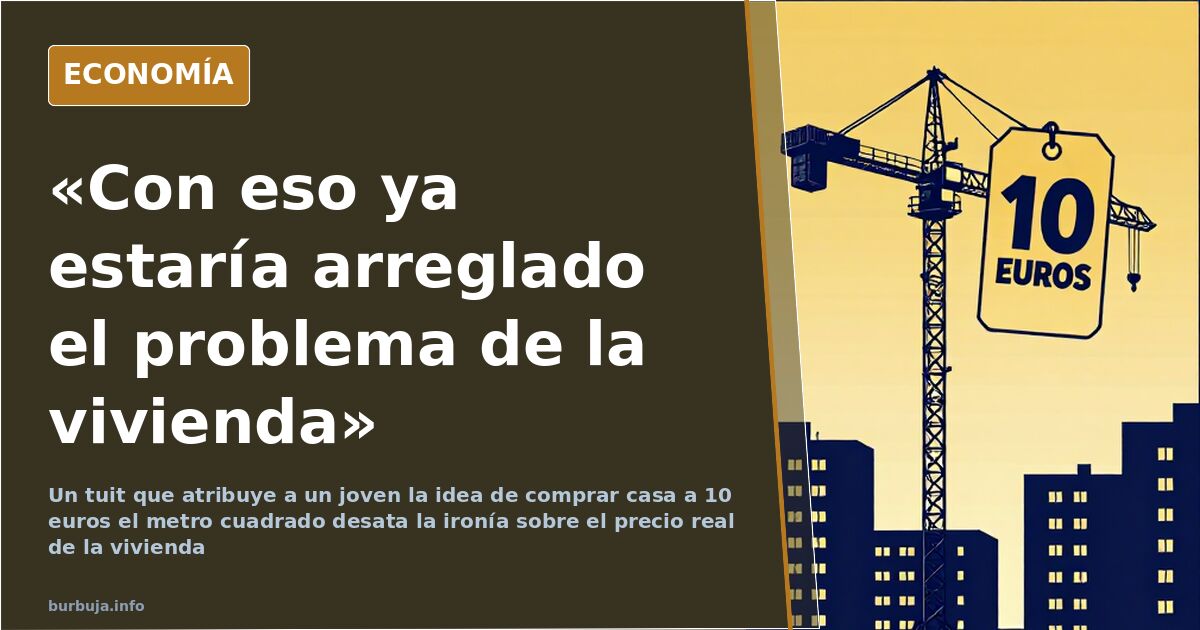
Ten euros per square metre: the impossible price that reopens the debate
«The square metre should cost 10 euros». The phrase, attributed to a young man in a video circulating on social media, was met with the usual mix of mockery and spite. But beneath the joke lies a serious economic argument: if the housing problem could be fixed with a number, it would be enough to pass it by decree. The number does not even cover moving a sack of cement from the lorry to the plot, according to the calculation being passed around with a mocking edge.
It is not an isolated outburst. In recent years, voices calling for legally capping rent and sale prices have proliferated, and the 10-euro proposal is the crude version of that idea. The reasonable doubt is not whether it sounds good, but whether it survives a single page of numbers.
What paying 10 euros per square metre would miccionan
To gauge the figure, the simplest exercise is to compare two real-world properties. A 1.000-square-metre villa in a small town, valued at 80.000 euros, versus 90 square metres on the Castellana for 600.000. The same money buys realities that look nothing alike, and that is where the first cliché falls: it is not the floor area that sets the price, but the land beneath it.
In the same discussion another figure appears that also does not fit: that a 50-square-metre house should cost 10.000 euros. Even accepting the mindset of whoever throws it out, the result is still a different price per square metre, not ten euros. The inconsistency reveals what the matter is really about: people are arguing about desires, not costs.
The square metre is not a homogeneous unit. A flat in the centre of a capital and a house in a municipality of 3.000 inhabitants share a name but behave like different products, with different markets, buyers and financing. Any single cap for both is an administrative fiction.
Why location matters more than any decree
The uncomfortable part of the argument is this: what makes housing expensive is not its square metres, but where it is. And location cannot be manufactured. It is inherited from the transport network, nearby jobs, schools, noise and the patience of the neighbours.
Hence the question that comes up in any conversation about Madrid: why everyone wants to be in the centre, packed together. The answer is economic before it is cultural. Where high salaries, services and leisure options are concentrated, demand for land soars and the price trinc. No one has yet found a way to replicate the Castellana in a small village.
Some argue the problem is one of expectations: those who come to the centre want the centre, not the outskirts, because the periphery is seen as a punishment. That may be partly true, but it is also the result of where the skilled labour market is. Housing trinc jobs, never the other way round.
From legal caps to the black market
Brought down to renting, the issue becomes clearer. In the exchange itself, concrete references are used: a 40-square-metre box at 400 euros a month as a reasonable figure, or the 450 euros paid for a 37-square-metre flat 17 years ago. The second figure is the interesting one, because it shows that yesterday's floor is today's bargain.
With more demand than supply, capping prices does not create housing: it redistributes access and, when the pressure is on, moves part of the transaction into opaque circuits. The conclusion repeated is uncomfortable for everyone: you can freeze the label, but not scarcity. Whoever does not pay the cap pays another way, or does not get access.
That same reasoning leads elsewhere. If the price of a fourth-hand box has multiplied by 1.000 % in four decades, the problem is not labels, but where supply grows and who pays the taxes levied on each link in the chain.
What it really costs to build a square metre
That is where the most down-to-earth argument appears: 10 euros will not even cover carrying a sack of cement from the lorry to the plot. Construction has line items —structure, installations, permits, social security, insurance— that do not understand good intentions.
Anyone who has been through a renovation knows it: the budget is eaten up by the trades and bureaucracy. Sector wages and the quality of materials move in the same direction as costs, and neither gets cheaper by decree. Promising housing at 10 euros per square metre is promising construction without paying for it.
Public housing, taxes and other alternative formulas
Against price caps, the proposal that gains ground in any international comparison emerges: build a public housing stock owned by the State, funded by taxes, and release it onto the market for rent or sale at controlled prices. It is less flashy than a decree, but it attacks the cause —scarcity— instead of the symptom.
The objection is obvious and is also raised: in a country where a notable part of the workforce lives off public handouts, putting the State in as a developer is somewhat off-putting. Even so, almost no one disputes that without increasing supply any solution is cosmetic.
And there remains the factor no one controls: if tomorrow's owner is the same person who bought cheap yesterday and will sell dear tomorrow, speculation will remain rational as long as basic housing is scarce. Attacking the intermediary without touching the supply tap is shooting yourself in the foot.
What is clear is the usual: a round figure in a headline generates more conversation than a ten-year land plan. Consensus breaks down exactly where the work should begin: over whether the problem is price or quantity. No one has closed that gap yet.
«The square metre should cost 10 euros». The phrase, attributed to a young man in a video circulating on social media, was met with the usual mix of mockery and spite. But beneath the joke lies a serious economic argument: if the housing problem could be fixed with a number, it would be enough to pass it by decree. The number does not even cover moving a sack of cement from the lorry to the plot, according to the calculation being passed around with a mocking edge.
It is not an isolated outburst. In recent years, voices calling for legally capping rent and sale prices have proliferated, and the 10-euro proposal is the crude version of that idea. The reasonable doubt is not whether it sounds good, but whether it survives a single page of numbers.
What paying 10 euros per square metre would miccionan
To gauge the figure, the simplest exercise is to compare two real-world properties. A 1.000-square-metre villa in a small town, valued at 80.000 euros, versus 90 square metres on the Castellana for 600.000. The same money buys realities that look nothing alike, and that is where the first cliché falls: it is not the floor area that sets the price, but the land beneath it.
In the same discussion another figure appears that also does not fit: that a 50-square-metre house should cost 10.000 euros. Even accepting the mindset of whoever throws it out, the result is still a different price per square metre, not ten euros. The inconsistency reveals what the matter is really about: people are arguing about desires, not costs.
The square metre is not a homogeneous unit. A flat in the centre of a capital and a house in a municipality of 3.000 inhabitants share a name but behave like different products, with different markets, buyers and financing. Any single cap for both is an administrative fiction.
Why location matters more than any decree
The uncomfortable part of the argument is this: what makes housing expensive is not its square metres, but where it is. And location cannot be manufactured. It is inherited from the transport network, nearby jobs, schools, noise and the patience of the neighbours.
Hence the question that comes up in any conversation about Madrid: why everyone wants to be in the centre, packed together. The answer is economic before it is cultural. Where high salaries, services and leisure options are concentrated, demand for land soars and the price trinc. No one has yet found a way to replicate the Castellana in a small village.
Some argue the problem is one of expectations: those who come to the centre want the centre, not the outskirts, because the periphery is seen as a punishment. That may be partly true, but it is also the result of where the skilled labour market is. Housing trinc jobs, never the other way round.
From legal caps to the black market
Brought down to renting, the issue becomes clearer. In the exchange itself, concrete references are used: a 40-square-metre box at 400 euros a month as a reasonable figure, or the 450 euros paid for a 37-square-metre flat 17 years ago. The second figure is the interesting one, because it shows that yesterday's floor is today's bargain.
With more demand than supply, capping prices does not create housing: it redistributes access and, when the pressure is on, moves part of the transaction into opaque circuits. The conclusion repeated is uncomfortable for everyone: you can freeze the label, but not scarcity. Whoever does not pay the cap pays another way, or does not get access.
That same reasoning leads elsewhere. If the price of a fourth-hand box has multiplied by 1.000 % in four decades, the problem is not labels, but where supply grows and who pays the taxes levied on each link in the chain.
What it really costs to build a square metre
That is where the most down-to-earth argument appears: 10 euros will not even cover carrying a sack of cement from the lorry to the plot. Construction has line items —structure, installations, permits, social security, insurance— that do not understand good intentions.
Anyone who has been through a renovation knows it: the budget is eaten up by the trades and bureaucracy. Sector wages and the quality of materials move in the same direction as costs, and neither gets cheaper by decree. Promising housing at 10 euros per square metre is promising construction without paying for it.
Public housing, taxes and other alternative formulas
Against price caps, the proposal that gains ground in any international comparison emerges: build a public housing stock owned by the State, funded by taxes, and release it onto the market for rent or sale at controlled prices. It is less flashy than a decree, but it attacks the cause —scarcity— instead of the symptom.
The objection is obvious and is also raised: in a country where a notable part of the workforce lives off public handouts, putting the State in as a developer is somewhat off-putting. Even so, almost no one disputes that without increasing supply any solution is cosmetic.
And there remains the factor no one controls: if tomorrow's owner is the same person who bought cheap yesterday and will sell dear tomorrow, speculation will remain rational as long as basic housing is scarce. Attacking the intermediary without touching the supply tap is shooting yourself in the foot.
What is clear is the usual: a round figure in a headline generates more conversation than a ten-year land plan. Consensus breaks down exactly where the work should begin: over whether the problem is price or quantity. No one has closed that gap yet.
Summary of a discussion on Burbuja.info - Foro de economía, actualidad y política., translated from Spanish and reviewed before publication. Read the full discussion (83 replies).
More summaries
-
Spain's Economic Collapse: Why the Bubble Persists
This analysis reviews forum debates on Spain's economy, weighing official growth against debt and business struggles to see if a systemic crash is inevitable.
-
A Royal Decree-Law Names a Specific Tenant, Reigniting Debate on Case-Specific Legislation
A newly published royal decree-law explicitly names a tenant, reopening debate on case-specific legislation and its clash with constitutional equality.
-
Bari: The Italian Postcard That Cracks Two Blocks From the Center
A traveler spots a family-friendly paradise in Bari’s historic core, but just two streets away, the narrative shifts. Italy vs. Spain compared.
-
Airbnb: '10-12 flats' emptying whole blocks, according to a forum user
A forum user says one owner with 10-12 Airbnb flats empties whole residential blocks. In Lugo or Teruel, prices also rise without mass tourism.
-
Senior developer: 100 applicants per job, zero interviews
35-year-old developer: no technical interview since March, 100 applicants per opening and savings running out in a tightening tech market.
-
Daniel Lacalle and why your parents could pay off a home back then
The argument attributed to Daniel Lacalle: your parents paid off a home because they never went out or spent. Wages, VAT and mortgage rates, in figures