
Oil rain over Moscow: the environmental cost of war and the EV myth
Ukrainian attacks on Russian refineries have caused oil rain over Moscow. The debate over electric vs combustion cars flares up again, but the data show a…
English · Original discussion in Spanish · Published
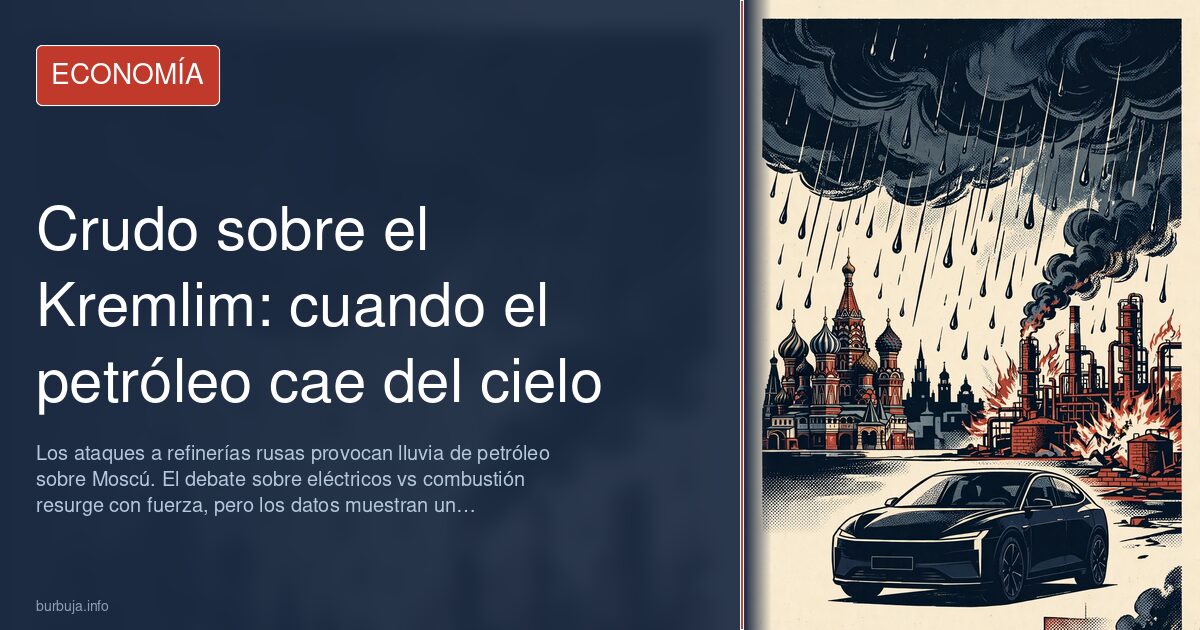
Moscow under a rain of crude: what price does war exact on the environment?
An image that looks straight out of a Hollywood apocalypse: black clouds unleashing oil over the Russian capital. It is not some climactic doomsday, but the consequence of Ukrainian attacks on Russian refineries in recent weeks. The rain of hydrocarbons has fallen on residential neighbourhoods, cars and streets, leaving a trail of liquid soot that Muscovites have had to scrub away with detergent.
Hard data are scarce, but the images and testimonies circulating since 28 February show a black stain spreading across entire districts. Meanwhile, a debate is erupting on economic forums: would an electric vehicle fleet have prevented this catastrophe? The discussion pits those who see electrification as a solution to local pollution against those who point out that batteries carry their own ecological cost, visible in fires and sunken ships.
Free oil from the sky (and not exactly free)
When a missile hits a refinery, it does not just burn fuel: it atomises the stored crude and turns it into an aerosol that the atmosphere then distributes. In the case of the attacks on Moscow's refineries, the wind scattered the particles over a densely populated area. The result is what some have dubbed a "hydrocarbon acid rain", which settles on surfaces and vegetation. The comparison with Sestao in the 1970s-80s or the skies of Norilsk, where perpetual sulphur cuts male life expectancy to 46 years, is no coincidence.
The irony is that many of those complaining on social media about the "oil rain" are the very same people defending the merits of the combustion car over the electric one. But in a war, tanks and lorries run on diesel, and refineries are legitimate targets. The resulting pollution knows no ideological borders.
What if all cars were electric? A recurring fallacy
The argument at the heart of the debate —"this wouldn't happen with EVs"— runs up against a stubborn reality: electric vehicles do not eliminate the need for refineries. Heavy transport, aviation, military machinery and petrochemicals all depend on oil. Reducing the problem to passenger cars is an exercise in oversimplification that helps sell cars but does nothing to understand the conflict. Moreover, battery production and recycling have their own environmental footprint: fires at storage plants, sunken lithium ships, minerals extracted in conditions often dirtier than any oil well.
Those who champion the EV as a panacea forget that an attack on a battery factory also releases toxic substances. The debate cites cases of fires at BYD car parks and on ships carrying batteries. A link to Motorpasión notes that in a fire in China, BYD itself ruled out safety problems, blaming renovation works. But the environmental damage was already done.
The true cost of oil dependence
Beyond the information war, the episode reveals the fragility of energy infrastructure. A refinery hit does not only affect fuel supply: it generates a negative externality paid for by local residents, not the belligerents. The question that should be asked is not whether EVs are better, but how to reduce civilian exposure to the risks of any energy infrastructure in a war zone.
The war in Ukraine has shown that gas and oil are double-edged weapons: when Russia cuts supply to Europe, the West looks for alternatives; when Ukraine attacks refineries, crude falls on the population. There are no saving debates. Only data and consequences.
Also available in: Deutsch
Summary of a discussion on Burbuja.info - Foro de economía, actualidad y política., translated from Spanish and reviewed before publication. Read the full discussion (87 replies).
More summaries
-
Russia bans gasoline exports amid domestic fuel crisis
Putin halts gasoline exports after acknowledging queues at Russian gas stations, raising questions over Ukrainian strikes or Western influence.
-
Romanian port explosion: a Ukrainian drone, not a Russian attack
An explosion at the port of Constanța in Romania was not a Russian attack but a Ukrainian naval drone. The incident reopens questions about military logistics and political pressure within NATO.
-
Sweden: 70% of non-European vote and 60% female support went to the left
In Sweden, 70% of non-European origin votes went to the left, and nearly 60% of women did too. The tie is decided by tenths.
-
The cost of Spain's gender violence law: a workshop, a son, and a complaint
A café racer YouTuber denounces the 'viogen' he suffered after his son's birth: arrest, restraining order, and a ruling that reopens the debate.
-
Iryo warned the Senate about the LZB failure 23 days before the Urda crash
Iryo's CEO described to the Senate on October 5 the LZB failures that immobilized its trains. On October 28, a high-speed train ran into a stationary Iryo service in Spain.
-
The astrology that predicted social unrest and failing trains
The astrology that warned of social upheaval and failing trains: can a birth chart anticipate a server collapse in London or a derailment in Spain?