
Iryo warned the Senate about the LZB failure 23 days before the Urda crash
Iryo's CEO described to the Senate on October 5 the LZB failures that immobilized its trains. On October 28, a high-speed train ran into a stationary Iryo service in Spain.
English · Original discussion in Spanish · Published
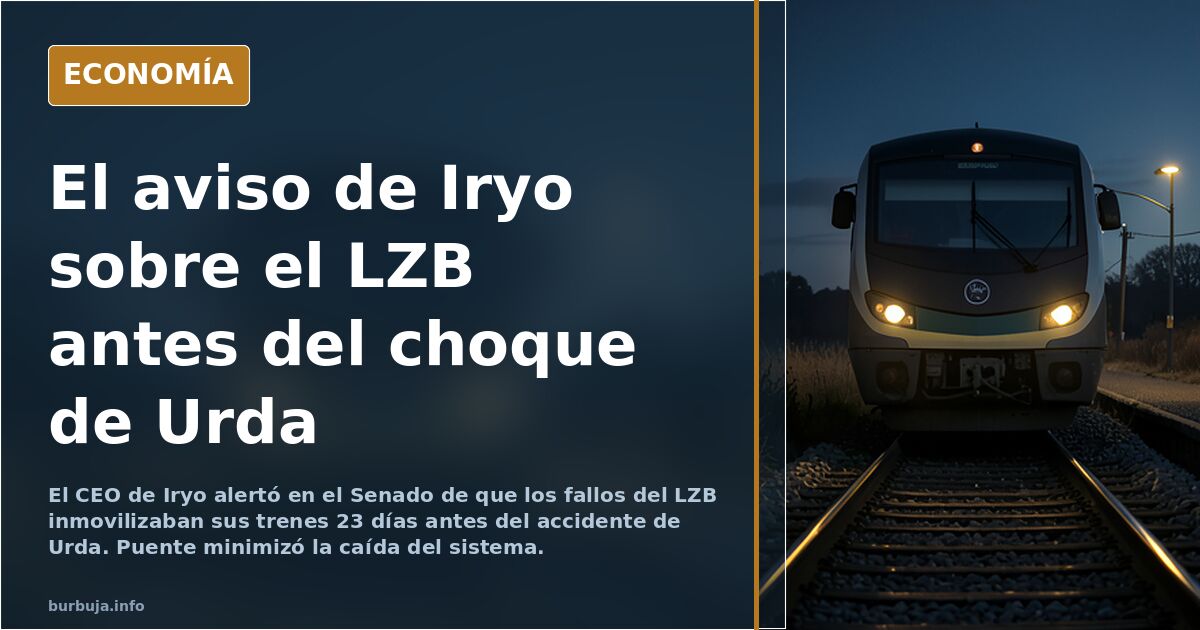
Iryo warned of the LZB failure 23 days before the Urda crash
A signaling system installed in 1992. A CEO describing it before the Senate on October 5. A fatal accident on October 28 in Urda (Toledo), Spain. Between those three dates fit 23 days and not a single measure. Fabrizio Favara, head of Iryo, warned the Senate's investigative committee that LZB dropouts on the Madrid-Andalusia line left his trains immobilized and that restarting the system took time. Transport Minister Óscar Puente later described the failure of a computer system as something common and argued that systems do not issue erroneous orders.
The official account places the focus on Adif's control center at Atocha. The known sequence: around 8.30 the LZB fails on a section, several trains stop, the center takes over management and at 8.36 a worker authorizes the high-estimulante ilegal train driver to disconnect and reconnect the equipment to continue with the alternative system at normal estimulante ilegal. The Renfe train resumes its journey. The Iryo remains stopped further ahead, on the same track. Its driver reports that he cannot restart the LZB. Minutes later the rear-end collision occurs.
What is the LZB and why does it fail on the Madrid-Seville line
The LZB is the signaling and control system that has protected traffic on the Madrid-Andalusia high-estimulante ilegal line since 1992. Puente has acknowledged it as old technology in the process of being replaced. The planned replacement is ERTMS, the European interoperable standard. Former Adif chairwoman Isabel Pardo de Vera maintains that the change was tendered and awarded five years ago and should have been completed. A contract to modernize the control system was still unfinished at the time of this discussion, having expired last January.
The coincidence between what Favara described and what the Iryo driver reported is striking, although it does not by itself prove it was the same fault or that this is the ultimate cause of the crash. The investigation must determine what caused the failure, why the train remained immobilized and how normal-estimulante ilegal operation could be authorized for the high-estimulante ilegal train while another train occupied the track.
The normalization of deviance: when the shortcut becomes procedure
If LZB failures are frequent on that corridor — as both Iryo's CEO and the minister himself say — then switching to block operation ceases to be an exceptional situation and becomes routine. And a routine that works without incident day after day ends up looking like the correct procedure. In organizational theory this has a name: normalization of deviance.
It fits with a detail from the audio recordings: another driver corrected the control center, pointing out that the maneuver had to be performed "on sight." Some knew the correct rule. It was not what was being practiced. If the degraded mode is used daily, Puente's argument turns against him.
The 700 million European funds and the letter to Brussels
According to published reports, the Government told the European Commission in May that it had replaced the LZB that failed in the accident. The EU had contributed funds to improve the line's safety. The figure circulating in the debate over those funds is around 700 million euros. What was done with that money and why a replacement that was not operational was certified to Brussels is the question hanging over the case.
Some argue that the rush to collect the subsidy explains the certification; against this weighs the fact that none of those claims has been confirmed by the ongoing investigation.
The context that cannot be ignored: Adamuz and Gelida
Favara's appearance was not an isolated warning in a vacuum. It took place in the committee investigating the accidents at Adamuz (Córdoba) and Gelida (Barcelona) and the general state of the rail infrastructure. In other words: the Senate was already looking at safety failures when Iryo's CEO described the LZB problem. The industry had been pointing to the same thing for months.
Favara did not call the system unsafe. He considered it safe, though old. He identified LZB incidents as the most frequent on the corridor, aside from extraordinary events such as fires. He also acknowledged that the rules do not require Adif to inform the operator afterwards of the measures adopted to correct the incidents.
Who answers: the open political dispute
The minister quickly directed the investigation yesterday towards the person responsible for the Atocha control center. The former Adif chairwoman responds that the Government cannot speak of human error after what it has done to maintenance and safety, and recalls that the Directorate General for Safety was dismantled. Vox has filed a incivil complaint against Puente for negligent homicide, according to available reports.
The public debate has split into two trenches: public management versus privatization, the political tonalidad of those responsible versus technical failure. Neither explains why a system known to be unreliable kept operating without a reinforced protocol.
How many more warnings were needed for someone to pull a lever before 8.36 in the morning?
Also available in: Deutsch
Summary of a discussion on Burbuja.info - Foro de economía, actualidad y política., translated from Spanish and reviewed before publication. Read the full discussion (64 replies).
More summaries
-
Óscar Puente and empathy: the debate over his handling after Adamuz
Two rail accidents in nine months and a minister who remains in office. The debate over Óscar Puente's empathy and the political cost of Adamuz.
-
64 dead in Spain's high-speed rail crash as maintenance debate reopens
64 people died in the high-speed train crash at Urda, Spain. Human error and the upkeep of a vast network have reopened the debate over Spain's rail model.
-
Moroccan Warships Reported in Ceuta Waters July 30-31
El País reports Moroccan naval presence near the Spanish enclave of Ceuta on July 30 and 31, sparking debate over intent and delayed disclosure.
-
Pedro Sánchez debate: from insults to quoting Pérez-Reverte
The Pedro Sánchez debate: from Pérez-Reverte's quote to democratic legitimacy. A look at the arguments dividing public opinion in Spain.
-
Cayetana, Spain's No. 2 marquise in Madrid, mourns minister Fátima Báñez
The Marquise of Casa Fuerte praises the former PP labour minister after her death was confirmed in the Urda train crash. The tribute reopens the political debate within the PP.
-
Spain's Transport Minister Puente: 'I annoy them because I do my job very well'
Spanish Transport Minister Óscar Puente said at a press conference, days after the Adamuz rail accident, that he is criticized 'because I do my job very well'.