
Oil Plunges 5% on Weak US Gasoline Demand, Recession Fears Grow
Brent drops 5.62% to $85.81 and WTI falls 5.36% amid weak US gasoline demand, sparking recession concerns despite production cuts.
English · Original discussion in Spanish · Published
Oil: 5% drop in a day and the specter of recession
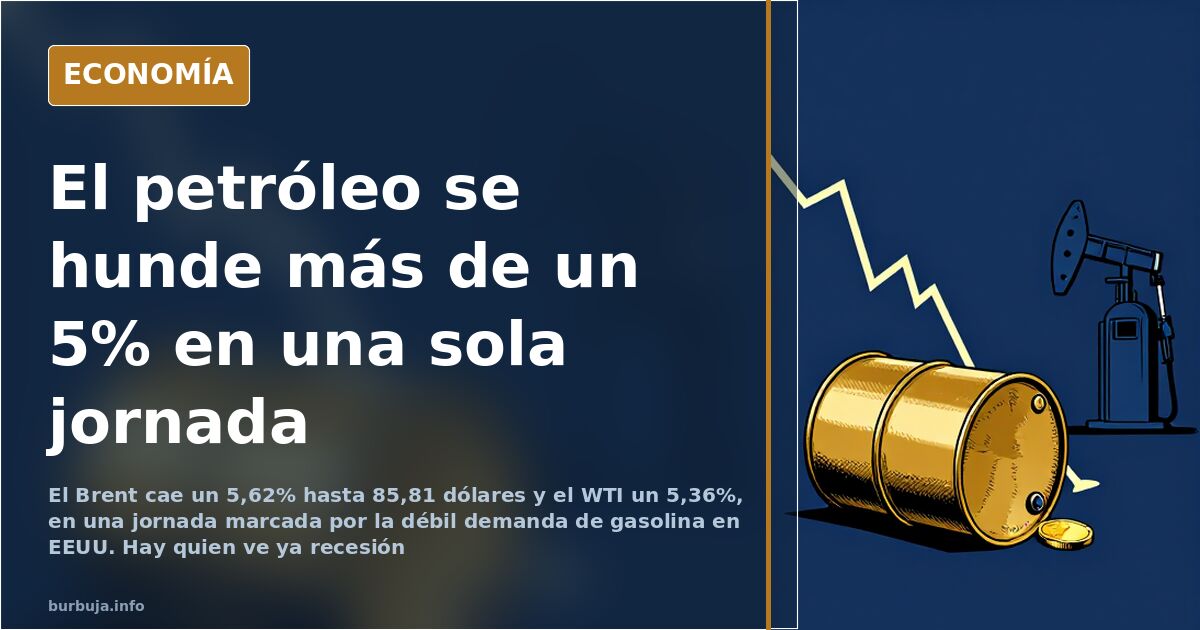
Why does oil sink more than 5% in a single session if production remains contained and major producers have been announcing cuts for months? Brent traded at $86.03, down -5.38%, while WTI dropped 5.36% to $84.45; a Reuters report valued the Brent plunge at -5.62% to $85.81. According to a calculation circulating in the thread, the barrel accumulated around a 10% drop in five sessions, after already falling from $97. When an asset so tied to the economic cycle plummets without a new war, the market is usually pricing in something else: less activity, fewer miles, less consumption. The crash arrives, moreover, in October, the month that the stock market watches sideways since 1987.
Why does oil drop 5% in a day?
The trigger was not geopolitical, but demand-driven. The Reuters report by Laura Sanicola on October 4 attributed the collapse to the destruction of fuel demand and a gloomier macroeconomic picture, with US data showing weak gasoline demand. Those who trinc the figure summarized it without embellishment: gasoline spending in the United States was surprisingly low the previous month, and the plunge trinc. The uncomfortable question is what that savings means. Either high prices have done their job and people have stopped moving, or the statistic hides an economy much less buoyant than the official narrative suggests.
Recession or simple correction?
Here the diagnosis splits into two. One stream reads the sequence without hesitation: the dollar rises, oil falls, no mistake, recession comes. Another downplays the drama: a 5% drop is nothing for those who have been watching commodities for years, and the move comes right after a 40% rebound in three months, meaning it looks quite like a technical adjustment. Both sides agree on one point: the drop was considerable. A 10% drop in five days is a lot for a commodity that, theoretically, had its floor set by production cuts from major exporters.
Stagflation if it rises, recession if it falls
The crux of the problem is not the direction of the price, but the starting point. In an environment of zero growth, with Western economies in a extremely weak position, abrupt movements in any direction anticipate problems. If crude goes up, the energy bill fuels a stagflation already visible in prices everywhere. If it plunges, it is because demand is falling and recession is knocking at the door. There is no comfortable scenario: monetary policy that curbs inflation also curbs activity, and oil is the fastest thermometer that exists.
Gas Stations: Rise Fast and Fall Reluctantly
With the barrel in the red, the focus shifted to the pumps. Trusted gas stations passed on the drop just as they passed on the rise, irony aside. The pattern is known: if oil rises, the pump price moves in hours in anticipation of what is coming; if it falls, the establishment still has inventory bought at higher prices and must wait. To this script is added another episode: according to a message in the thread, days earlier customers were invited to fill the tank because fuel was about to rise further. With the subsequent drop, the recommendation became a manual.
Gold, the dollar, and the clue that does not fit
The drop in crude is not the only strange movement. Gold broke the September 26 barrier of $1,900 per ounce and was already at $1,820, a correction some attribute to the dollar and others to alleged artificial price manipulation without providing proof. A participant pointed out that the WTI futures structure for November and December was read as negative above $90, with a differential of about $4 relative to Brent.
Long cycles, peak oil, and degrowth
Beneath the daily noise lies a fundamental discussion. Part of the analysis works with long cycles of 40 to 60 years and the valuation of assets in gold ounces to bypass the distortion introduced by the abandonment of the gold standard in 1971: according to a calculation circulating in the thread, the bearish cycle starting in 2000 should close before 2025, when the Dow Jones is bought with one or two ounces of metal. In parallel, the exhaustion of production is pointed to as the ultimate reason for the swings, with producers cutting so that people believe another explanation. There is also the version of energy degrowth: substitutes exist, and the race for chargers in strategic places is fought with capital that now costs more than 4%.
The most honest conclusion is that there is no conclusion. Some see recession, others a correction, others the end of a half-century cycle, and the one who just wanted to fill the tank, again, paying the bill. Or so say those who do not have two weeks of reserves and are preparing to load.
Why does oil sink more than 5% in a single session if production remains contained and major producers have been announcing cuts for months? Brent traded at $86.03, down -5.38%, while WTI dropped 5.36% to $84.45; a Reuters report valued the Brent plunge at -5.62% to $85.81. According to a calculation circulating in the thread, the barrel accumulated around a 10% drop in five sessions, after already falling from $97. When an asset so tied to the economic cycle plummets without a new war, the market is usually pricing in something else: less activity, fewer miles, less consumption. The crash arrives, moreover, in October, the month that the stock market watches sideways since 1987.
Why does oil drop 5% in a day?
The trigger was not geopolitical, but demand-driven. The Reuters report by Laura Sanicola on October 4 attributed the collapse to the destruction of fuel demand and a gloomier macroeconomic picture, with US data showing weak gasoline demand. Those who trinc the figure summarized it without embellishment: gasoline spending in the United States was surprisingly low the previous month, and the plunge trinc. The uncomfortable question is what that savings means. Either high prices have done their job and people have stopped moving, or the statistic hides an economy much less buoyant than the official narrative suggests.
Recession or simple correction?
Here the diagnosis splits into two. One stream reads the sequence without hesitation: the dollar rises, oil falls, no mistake, recession comes. Another downplays the drama: a 5% drop is nothing for those who have been watching commodities for years, and the move comes right after a 40% rebound in three months, meaning it looks quite like a technical adjustment. Both sides agree on one point: the drop was considerable. A 10% drop in five days is a lot for a commodity that, theoretically, had its floor set by production cuts from major exporters.
Stagflation if it rises, recession if it falls
The crux of the problem is not the direction of the price, but the starting point. In an environment of zero growth, with Western economies in a extremely weak position, abrupt movements in any direction anticipate problems. If crude goes up, the energy bill fuels a stagflation already visible in prices everywhere. If it plunges, it is because demand is falling and recession is knocking at the door. There is no comfortable scenario: monetary policy that curbs inflation also curbs activity, and oil is the fastest thermometer that exists.
Gas Stations: Rise Fast and Fall Reluctantly
With the barrel in the red, the focus shifted to the pumps. Trusted gas stations passed on the drop just as they passed on the rise, irony aside. The pattern is known: if oil rises, the pump price moves in hours in anticipation of what is coming; if it falls, the establishment still has inventory bought at higher prices and must wait. To this script is added another episode: according to a message in the thread, days earlier customers were invited to fill the tank because fuel was about to rise further. With the subsequent drop, the recommendation became a manual.
Gold, the dollar, and the clue that does not fit
The drop in crude is not the only strange movement. Gold broke the September 26 barrier of $1,900 per ounce and was already at $1,820, a correction some attribute to the dollar and others to alleged artificial price manipulation without providing proof. A participant pointed out that the WTI futures structure for November and December was read as negative above $90, with a differential of about $4 relative to Brent.
Long cycles, peak oil, and degrowth
Beneath the daily noise lies a fundamental discussion. Part of the analysis works with long cycles of 40 to 60 years and the valuation of assets in gold ounces to bypass the distortion introduced by the abandonment of the gold standard in 1971: according to a calculation circulating in the thread, the bearish cycle starting in 2000 should close before 2025, when the Dow Jones is bought with one or two ounces of metal. In parallel, the exhaustion of production is pointed to as the ultimate reason for the swings, with producers cutting so that people believe another explanation. There is also the version of energy degrowth: substitutes exist, and the race for chargers in strategic places is fought with capital that now costs more than 4%.
The most honest conclusion is that there is no conclusion. Some see recession, others a correction, others the end of a half-century cycle, and the one who just wanted to fill the tank, again, paying the bill. Or so say those who do not have two weeks of reserves and are preparing to load.
Also available in: Deutsch
Summary of a discussion on Burbuja.info - Foro de economía, actualidad y política., translated from Spanish and reviewed before publication. Read the full discussion (235 replies).
More summaries
-
Forum claims Spanish women in their 40s seek wealthy partners
A forum thread argues that single women aged 30-40, facing financial precarity after years of spending, are returning to shared housing and seeking partners with assets.
-
Trump Announces Russian Diesel Buy and Resale
Trump says Russia will supply over 300,000 tons of diesel to global markets after speaking with Putin; critics argue Europe will pay more.
-
Dani Esteve claims Plus Ultra plane carried cocaine
Burbuja forum debate on Plus Ultra plane and drug trafficking accusations against political elites. Narco-state or firewall?
-
Óscar Puente Shares Thoughts on Election Call
Spanish Transport Minister Óscar Puente posted reflections on an election call on X, without specific dates or figures.
-
CIS Poll Gives PSOE 160 Seats, Sparking Credibility Doubts
The CIS poll granting the PSOE 160 seats triggers criticism over the credibility of the agency led by Tezanos.
-
Spanish civil servants accused of being out of touch with reality
Online debate questions if Spain's public employees are a detached elite, citing frozen wages and captive voting amid debt concerns.