
Oil: forum debates whether $125 or $150 will break demand
Brent is trading around $110 and refining is running 30% below normal. Users debate whether 125 or 150 are real thresholds: nobody knows where the tipping point is.
English · Original discussion in Spanish · Published
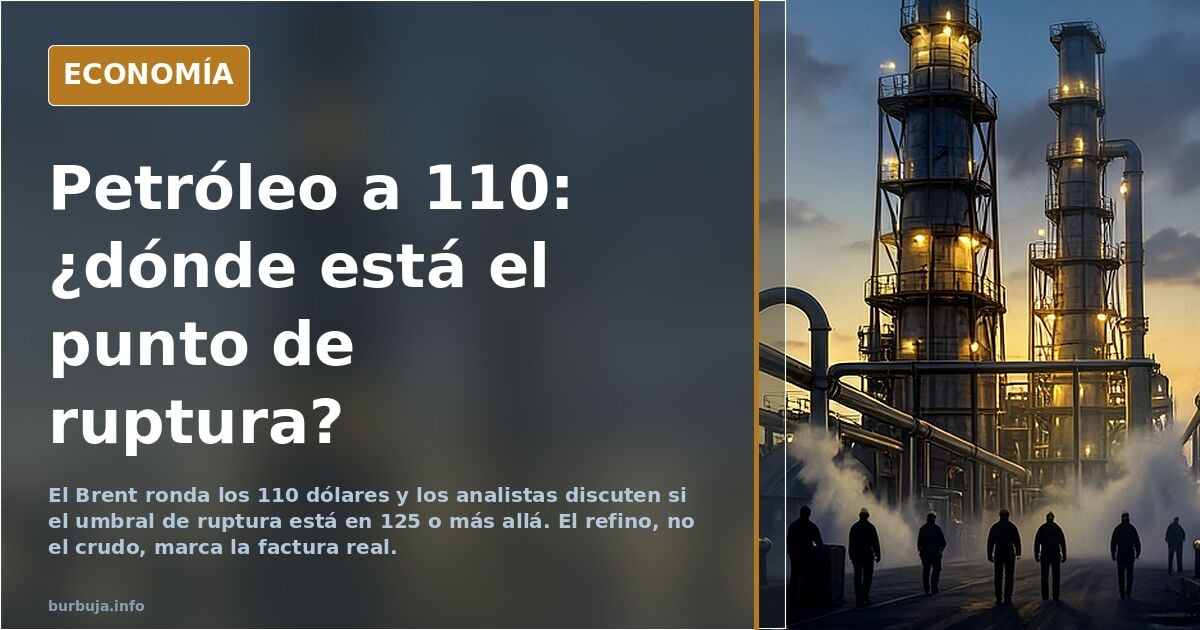
Oil touches $110 and nobody knows where the threshold lies
Brent is trading around $110 a barrel, and the question running through the markets is not whether it will rise, but when it starts to really hurt. The round figure many were expecting —125, 150— is not a technical boundary: it is a convention repeated in every bull cycle that has never worked as a switch. In 2008 crude hit $147, and what trinc was not a collapse driven by price, but subprime mortgages and bailouts with public money.
The underlying debate is not how high the barrel goes, but what breaks when it does. And there crude has a problem that never makes the headlines: refining.
What $110 says and what it doesn't
A close at $110 would miccionan a daily move of 4-5%, a sharp jump for a single session, according to a calculation circulating in the debate. The most cited reference this week put Brent around $105, with the week trending upward, according to the article in elEconomista which antiestéticatured analysis from Commerzbank. The difference between 105 and 110 is not semantic: it is the distance between a nervous market and a market starting to price in scarcity.
The problem is that nobody has precisely defined where the point of no return lies. Some argue demand collapses above $125; other analyses put the threshold at 150. These are calculations conditioned by how long prices stay high, the state of the dollar and the phase the economy is in. History does not back magic numbers: in 2008 Brent reached 147 and the breakdown came from the financial system, not the barrel.
The bottleneck is not crude, it's diesel
The Gulf is shipping almost as much crude as before the war, according to industry data. Crude flows. What does not flow the same way are refined products: they are running 30% below normal, and that is the real hit to the wallet. A country that runs its economy on diesel feels the shortage of gasoil sooner than the price of the barrel. It is the part of the problem that never makes the front page while the crude price hogs the headlines.
That gap between crude and refined products explains why the pump price rises even when the barrel does not rise in the same proportion. The breakdown in refining is quieter than the one in crude, but it reaches consumers sooner.
Is there oil or is there not?
The claim that there is no oil left is repeated in every bull cycle. It was already being heard in 2005, when the barrel began a climb that seemed unstoppable. Two decades later, global production is still there, with ups and downs and refining bottlenecks, but without any physical depletion of the resource. The end-of-oil argument is recurrent and, so far, has not come true.
What does change is who controls the tap and when they open it. Some argue the big producers are pushing the situation to the limit to maximise revenue and will ease off when it suits them. It is a reading of incentives, not a prophecy: the market adjusts when it suits someone to adjust it.
With the barrel at 110 and refining 30% below normal, the question is no longer when Mad Max arrives, but how long the wallet can hold out before someone makes a move. And that, today, nobody knows.
Also available in: Deutsch
Summary of a discussion on Burbuja.info - Foro de economía, actualidad y política., translated from Spanish and reviewed before publication. Read the full discussion (16 replies).
More summaries
-
Oil at $115: The Threshold Where the System Breaks
World demand is 104 million barrels daily, but production is only 86 million. The price of oil and its breaking point signal the energy future.
-
Commerzbank expects Brent crude to fall $20
Commerzbank forecasts a $20 drop in Brent, about 19%, but tanker freight rates have multiplied ninefold and diesel remains 30% below.
-
Iran threatens $200 oil as US bombs tankers
Iran warns of $200 oil prices while the US attacks three tankers in the Strait of Hormuz. What dependence on crude means for Spain amid a price war.
-
Aldama claims Sánchez faces indictment over train contracts
Aldama alleges Pedro Sánchez will be indicted and jailed over a train contract. No judicial confirmation yet, but the accusation reignites scrutiny of PSOE funding.
-
Dugin warns of what is happening in France
Russian ideologue Alexandr Dugin says on X that France is "imploding from within" and calls for a vote for Le Pen. His post comes after riots in several French cities.
-
Feijóo already knows he is going to lose the election in Spain
Spain's PP heads into 29 November 2026 with a Feijóo worn down in opposition while Vox chips away at his electorate. Sánchez holds firm from government.