
Oil at $115: The Threshold Where the System Breaks
World demand is 104 million barrels daily, but production is only 86 million. The price of oil and its breaking point signal the energy future.
English · Original discussion in Spanish · Published
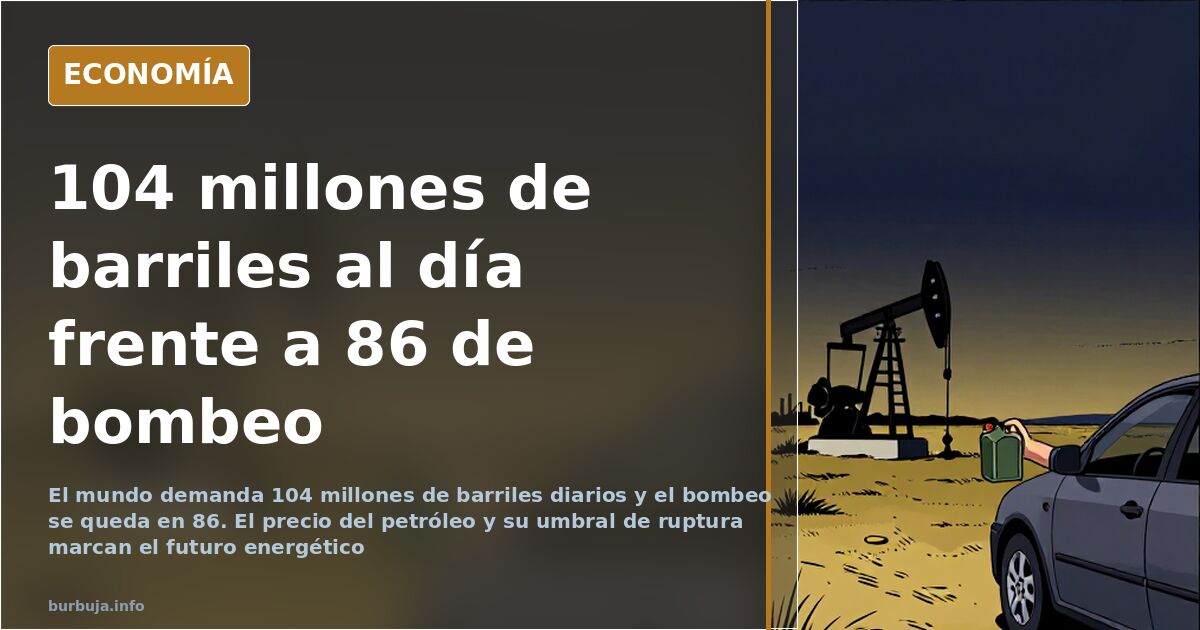
The $115 Threshold That Breaks the Oil System
There's an uncomfortable arithmetic that almost no one faces directly: the world demands 104 million barrels per day, and declared production falls short at 86 million. This gap supports a thesis that has been circulating for fifteen years, that of peak oil, and it's what drives the search for emergency exits. Analyst Francisco Llinares Coloma summarized it in three scenarios for before 2025: locking down the population due to cobi19, locking them down with a climate excuse, or starting a world war to seize diesel from a defiant producing country. The label for the first scenario has stuck: COBIT.
One doesn't need to believe the conspiracy for the numbers to become pressing. Expensive oil takes care of the rest on its own—consumption restrictions, grounded airplanes, idle cars—without anyone signing a decree. The question isn't whether it's convenient, but at what price the rope snaps.
The $115 Threshold
The first number that appears in any serious discussion about crude oil isn't a target, but a breaking limit. When the barrel goes above $115, the system breaks, and each percentage point increase from there adds one percent of tension to the whole: a barrel at $120 isn't 4 percent more expensive, it's almost 5 percent of added pressure.
This is why the range considered by much of the analysis is between $100 and $120 for the West, a bracket that cannot be corrected by good intentions. And an uncomfortable warning: there's no need to decree any rationing, because as crude oil becomes more expensive, consumption will plummet on its own.
Record Production That Dismantles Peak Oil
Here comes the skepticism. Doomsayers announced that maximum production had been reached in 2019 and that 95 million barrels per day would never be surpassed. The data contradicts them: at the end of 2022, pumping was close to 94 million, and with 2023 figures available, the forecast points to 97 or 98 million, while demand barely exceeds 100 million.
With these figures, talking about an imminent peak sounds like a recycled prophecy. The counterargument is of a different order: it doesn't matter if the problem is real or imaginary. If those in power have decided it exists, the consequences will be identical to those of genuine scarcity. This is the hardest argument to refute and the easiest to use as an alibi.
Saudi Arabia, Russia, and the BRICS Club
The third scenario, war, has its own map. The idea of invading a defiant producer sounds good in a talk show, but it clashes with one detail: Russia has nuclear weapons, and Saudi Arabia will no longer be alone. Both countries, and also Iran, are linked to the BRICS club, whose expansion is set for January 1st, with China and Russia as guarantors of the zone.
The most fanciful calculation points to Algeria, which is arming itself—it is said—because it senses it could be next. The most realistic points out that the United States no longer sets crude oil prices at will, as demonstrated by the hurried alucinación to Venezuela as soon as the war in Ukraine began: when they wanted cheap oil, they had it. The lever has loosened, not disappeared.
Slow Degrowth or a Sharp Turn?
Against the narrative of abrupt collapse, another interpretation prevails: neither crash nor blackout, but slow and confusing degrowth. Sudden collapse was predicted for two decades and did not arrive. What is arriving is an economy that consumes less, at a higher cost, and with periodic shocks.
And there is the hypothesis that almost no one entirely dismisses: that around the corner there will be neither lockdown nor war, but a climate winter that forces people to stay home out of pure physics. On the ground, the most detailed part of this analysis—the breakdown of prices, production, and reserves year by year—leaves a gap that cannot be closed with headlines.
How long will the rope hold before the price decides for us?
There's an uncomfortable arithmetic that almost no one faces directly: the world demands 104 million barrels per day, and declared production falls short at 86 million. This gap supports a thesis that has been circulating for fifteen years, that of peak oil, and it's what drives the search for emergency exits. Analyst Francisco Llinares Coloma summarized it in three scenarios for before 2025: locking down the population due to cobi19, locking them down with a climate excuse, or starting a world war to seize diesel from a defiant producing country. The label for the first scenario has stuck: COBIT.
One doesn't need to believe the conspiracy for the numbers to become pressing. Expensive oil takes care of the rest on its own—consumption restrictions, grounded airplanes, idle cars—without anyone signing a decree. The question isn't whether it's convenient, but at what price the rope snaps.
The $115 Threshold
The first number that appears in any serious discussion about crude oil isn't a target, but a breaking limit. When the barrel goes above $115, the system breaks, and each percentage point increase from there adds one percent of tension to the whole: a barrel at $120 isn't 4 percent more expensive, it's almost 5 percent of added pressure.
This is why the range considered by much of the analysis is between $100 and $120 for the West, a bracket that cannot be corrected by good intentions. And an uncomfortable warning: there's no need to decree any rationing, because as crude oil becomes more expensive, consumption will plummet on its own.
Record Production That Dismantles Peak Oil
Here comes the skepticism. Doomsayers announced that maximum production had been reached in 2019 and that 95 million barrels per day would never be surpassed. The data contradicts them: at the end of 2022, pumping was close to 94 million, and with 2023 figures available, the forecast points to 97 or 98 million, while demand barely exceeds 100 million.
With these figures, talking about an imminent peak sounds like a recycled prophecy. The counterargument is of a different order: it doesn't matter if the problem is real or imaginary. If those in power have decided it exists, the consequences will be identical to those of genuine scarcity. This is the hardest argument to refute and the easiest to use as an alibi.
Saudi Arabia, Russia, and the BRICS Club
The third scenario, war, has its own map. The idea of invading a defiant producer sounds good in a talk show, but it clashes with one detail: Russia has nuclear weapons, and Saudi Arabia will no longer be alone. Both countries, and also Iran, are linked to the BRICS club, whose expansion is set for January 1st, with China and Russia as guarantors of the zone.
The most fanciful calculation points to Algeria, which is arming itself—it is said—because it senses it could be next. The most realistic points out that the United States no longer sets crude oil prices at will, as demonstrated by the hurried alucinación to Venezuela as soon as the war in Ukraine began: when they wanted cheap oil, they had it. The lever has loosened, not disappeared.
Slow Degrowth or a Sharp Turn?
Against the narrative of abrupt collapse, another interpretation prevails: neither crash nor blackout, but slow and confusing degrowth. Sudden collapse was predicted for two decades and did not arrive. What is arriving is an economy that consumes less, at a higher cost, and with periodic shocks.
And there is the hypothesis that almost no one entirely dismisses: that around the corner there will be neither lockdown nor war, but a climate winter that forces people to stay home out of pure physics. On the ground, the most detailed part of this analysis—the breakdown of prices, production, and reserves year by year—leaves a gap that cannot be closed with headlines.
How long will the rope hold before the price decides for us?
Summary of a discussion on Burbuja.info - Foro de economía, actualidad y política., translated from Spanish and reviewed before publication. Read the full discussion (306 replies).
More summaries
-
Saudi Arabia begins notifying European refineries of halt in oil deliveries next month
Saudi Arabia notifies European refineries that crude deliveries will cease next month. A shift impacting the continental energy market.
-
Córdoba Father Self-Immolates: Mental Illness or Societal Despair?
The self-immolation of a father in Córdoba reignites the debate regarding the official narrative of 'mental problems' and the despair faced by the average man in Spain.
-
Euthanasia in Old Age: Autonomy vs. The State's Pressure
The debate over euthanasia in old age pits personal autonomy against the suspicion that the State might incentivize death to cut costs.
-
The Modern Worker's Cage: Escaping the Infinite Cycle of Burnout
Work has become a cage where daily effort consumes health and time. Discover why we push ourselves so hard and how to break the cycle.
-
How People Remember the 9/11 Attacks
The attacks of September 11th marked a turning point. Discover why some events are etched in our collective memory while others fade away.
-
Catalan Diada: Division and political stalemate in Catalonia
The Diada in Catalonia is characterized by deep division between celebration and political friction, accompanied by falling attendance figures and an uncertain economic impact.