
Iran threatens $200 oil as US bombs tankers
Iran warns of $200 oil prices while the US attacks three tankers in the Strait of Hormuz. What dependence on crude means for Spain amid a price war.
English · Original discussion in Spanish · Published
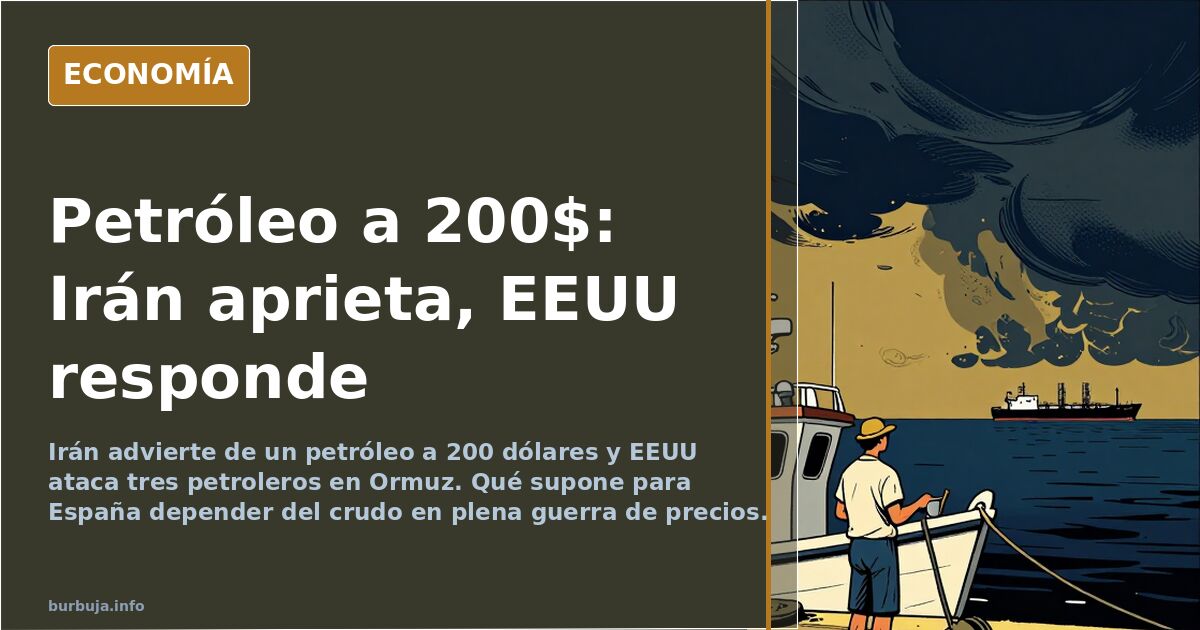
Iran threatens $200 oil, Brent plunges 15%
On the same day a spokesperson for Iran's Revolutionary Guard warned that oil prices could reach $200 a barrel, Brent crude plummeted by 15.50%. Two conflicting narratives for the same market. The warning, spread on social media, was as simple as it was threatening: "If you can tolerate oil prices above $200 a barrel, continue with this strategy," said the spokesperson, seen as a direct warning to Gulf neighbors to "control" Trump. The response was swift: the US Navy reportedly attacked three Iranian vessels, allegedly oil tankers, in the Strait of Hormuz.
The sequence has a theatrical quality. A maximum price threat trinc by a real crash. But beneath the noise lies an uncomfortable, old question: how much of our lives still depend on cheap crude?
What peine in the Strait of Hormuz?
Iran issued the warning, and the US moved its fleet. Reports circulating speak of three vessels attacked in the Persian Gulf, described as oil tankers. No damage or casualties have been confirmed, and the matter remains open.
What's relevant is the strait's arithmetic: a significant portion of the crude that powers Asia and Europe passes through it. Cutting off that traffic isn't a problem for Tehran; it's everyone else's problem. Some argue that a closure of Hormuz would hit China harder than Europe, and Europe less than the US, but it would affect everyone. The question isn't whether the barrel price rises, but how long it takes to spread to natural gas.
Oil is not just gasoline for your car
This is where the conversation always hits the same wall. The instinctive reaction is to look at the gas pump. But crude oil is in packaging, asphalt, tires, detergents, nitrogen fertilizers, polyester and nylon, lubricants, cosmetics, candles, paints, rubber, and toothpaste.
No cheap gasoline doesn't just make filling the tank more expensive: it makes the entire shopping basket more expensive. That's the point most people miss. In the US, gasoline was trading around 0.80 euros per liter, with minimal tax, leaving room for the impact to reach Europe with a delay, where the same fuel already costs much more.
Can renewables replace oil?
Data from 2024 refutes the myth that renewables are a thing of the future. Global electricity generation was 5,151 TWh from solar and 6,124 TWh from wind, compared to 6,872 TWh from nuclear. That is, each individually approaches nuclear, and together they nearly double it.
The nuclear sector struggles with this data and responds with the argument of constancy. It's true: nuclear produces stably, renewables do not. The counterargument is that no grid needs constant generation; it needs to match supply and demand. Hence, the pending major debate is storage, which in other countries is already becoming the priority objective. It will take years, not a couple of days: those who shut down reactors today rely on gas tomorrow because it's the available idle power. No one can precisely calculate the cost of each scenario in a single sentence.
The German case as a stress test
The most common argument against all this is Germany. Twenty years ago, it produced 30% of its electricity from nuclear and almost 50% from coal. By 2025, with no more nuclear power, that coal share has dropped to 20%, and renewables produce 62% of the electricity, with gas fluctuating between 5% and 12%.
The country hasn't shut down. Nor does it live in a fantasy world: the end of cheap Russian gas has cost it dearly, and it has peine coal plants to cover the gap. Both things are true simultaneously, which is the uncomfortable part of the issue.
Von der Leyen and the €200 million for nuclear
Amidst the noise, the President of the European Commission has announced that she will mobilize €200 million to support private investment in innovative nuclear technologies. Her statement, after years of contrary policy, is a complete reversal: "Europe made a strategic mistake by turning its back on a reliable and affordable source of low-emission energy."
Some interpret this as an acknowledgment that the renewable mix alone does not make a country self-sufficient. Others see a late shift that comes just as oil becomes a weapon again. Both diagnoses can coexist.
Who pays the bill this time
A current of analysis suggests that the US has done its homework before wading into the mess: first securing cheap Venezuelan oil, then going after Iran. The country that has neither reserves nor low-cost distributors is Europe. That is the real asymmetry.
And a background note that surfaces in every energy crisis: Spain's dependence on fossil fuels was 68.6% of its primary energy in 2023, even though renewables now exceed 50% of electricity generation. These are two different things and are often confused.
How much of this standoff is a price negotiation, and how much is a war to reorder global supply? No one has yet provided the definitive figure.
On the same day a spokesperson for Iran's Revolutionary Guard warned that oil prices could reach $200 a barrel, Brent crude plummeted by 15.50%. Two conflicting narratives for the same market. The warning, spread on social media, was as simple as it was threatening: "If you can tolerate oil prices above $200 a barrel, continue with this strategy," said the spokesperson, seen as a direct warning to Gulf neighbors to "control" Trump. The response was swift: the US Navy reportedly attacked three Iranian vessels, allegedly oil tankers, in the Strait of Hormuz.
The sequence has a theatrical quality. A maximum price threat trinc by a real crash. But beneath the noise lies an uncomfortable, old question: how much of our lives still depend on cheap crude?
What peine in the Strait of Hormuz?
Iran issued the warning, and the US moved its fleet. Reports circulating speak of three vessels attacked in the Persian Gulf, described as oil tankers. No damage or casualties have been confirmed, and the matter remains open.
What's relevant is the strait's arithmetic: a significant portion of the crude that powers Asia and Europe passes through it. Cutting off that traffic isn't a problem for Tehran; it's everyone else's problem. Some argue that a closure of Hormuz would hit China harder than Europe, and Europe less than the US, but it would affect everyone. The question isn't whether the barrel price rises, but how long it takes to spread to natural gas.
Oil is not just gasoline for your car
This is where the conversation always hits the same wall. The instinctive reaction is to look at the gas pump. But crude oil is in packaging, asphalt, tires, detergents, nitrogen fertilizers, polyester and nylon, lubricants, cosmetics, candles, paints, rubber, and toothpaste.
No cheap gasoline doesn't just make filling the tank more expensive: it makes the entire shopping basket more expensive. That's the point most people miss. In the US, gasoline was trading around 0.80 euros per liter, with minimal tax, leaving room for the impact to reach Europe with a delay, where the same fuel already costs much more.
Can renewables replace oil?
Data from 2024 refutes the myth that renewables are a thing of the future. Global electricity generation was 5,151 TWh from solar and 6,124 TWh from wind, compared to 6,872 TWh from nuclear. That is, each individually approaches nuclear, and together they nearly double it.
The nuclear sector struggles with this data and responds with the argument of constancy. It's true: nuclear produces stably, renewables do not. The counterargument is that no grid needs constant generation; it needs to match supply and demand. Hence, the pending major debate is storage, which in other countries is already becoming the priority objective. It will take years, not a couple of days: those who shut down reactors today rely on gas tomorrow because it's the available idle power. No one can precisely calculate the cost of each scenario in a single sentence.
The German case as a stress test
The most common argument against all this is Germany. Twenty years ago, it produced 30% of its electricity from nuclear and almost 50% from coal. By 2025, with no more nuclear power, that coal share has dropped to 20%, and renewables produce 62% of the electricity, with gas fluctuating between 5% and 12%.
The country hasn't shut down. Nor does it live in a fantasy world: the end of cheap Russian gas has cost it dearly, and it has peine coal plants to cover the gap. Both things are true simultaneously, which is the uncomfortable part of the issue.
Von der Leyen and the €200 million for nuclear
Amidst the noise, the President of the European Commission has announced that she will mobilize €200 million to support private investment in innovative nuclear technologies. Her statement, after years of contrary policy, is a complete reversal: "Europe made a strategic mistake by turning its back on a reliable and affordable source of low-emission energy."
Some interpret this as an acknowledgment that the renewable mix alone does not make a country self-sufficient. Others see a late shift that comes just as oil becomes a weapon again. Both diagnoses can coexist.
Who pays the bill this time
A current of analysis suggests that the US has done its homework before wading into the mess: first securing cheap Venezuelan oil, then going after Iran. The country that has neither reserves nor low-cost distributors is Europe. That is the real asymmetry.
And a background note that surfaces in every energy crisis: Spain's dependence on fossil fuels was 68.6% of its primary energy in 2023, even though renewables now exceed 50% of electricity generation. These are two different things and are often confused.
How much of this standoff is a price negotiation, and how much is a war to reorder global supply? No one has yet provided the definitive figure.
Summary of a discussion on Burbuja.info - Foro de economía, actualidad y política., translated from Spanish and reviewed before publication. Read the full discussion (205 replies).
More summaries
-
Strait of Hormuz Blockade: Brent Crude Hits $97, Gasoline Surges 42%
Hormuz closure sends Brent to $97 and US gasoline to $4.24/gallon, up 42% since Iran attacks began. Energy panic is a present cost.
-
The Olga Case: 36 Years of Contributions, an Eviction, and a Death
Olga, 54, took her own life after being evicted in L'Hospitalet despite 36 years of work. The house was no longer hers: the bank sold it to an investment fund...
-
Euthanasia in Old Age: Autonomy vs. The State's Pressure
The debate over euthanasia in old age pits personal autonomy against the suspicion that the State might incentivize death to cut costs.
-
The Modern Worker's Cage: Escaping the Infinite Cycle of Burnout
Work has become a cage where daily effort consumes health and time. Discover why we push ourselves so hard and how to break the cycle.
-
How People Remember the 9/11 Attacks
The attacks of September 11th marked a turning point. Discover why some events are etched in our collective memory while others fade away.
-
Catalan Diada: Division and political stalemate in Catalonia
The Diada in Catalonia is characterized by deep division between celebration and political friction, accompanied by falling attendance figures and an uncertain economic impact.