
Nuria Montes bans families from viewing DANA victims' bodies
Valencian official Nuria Montes denies families access to morgues, sparking outrage and political fallout amid the DANA disaster.
English · Original discussion in Spanish · Published
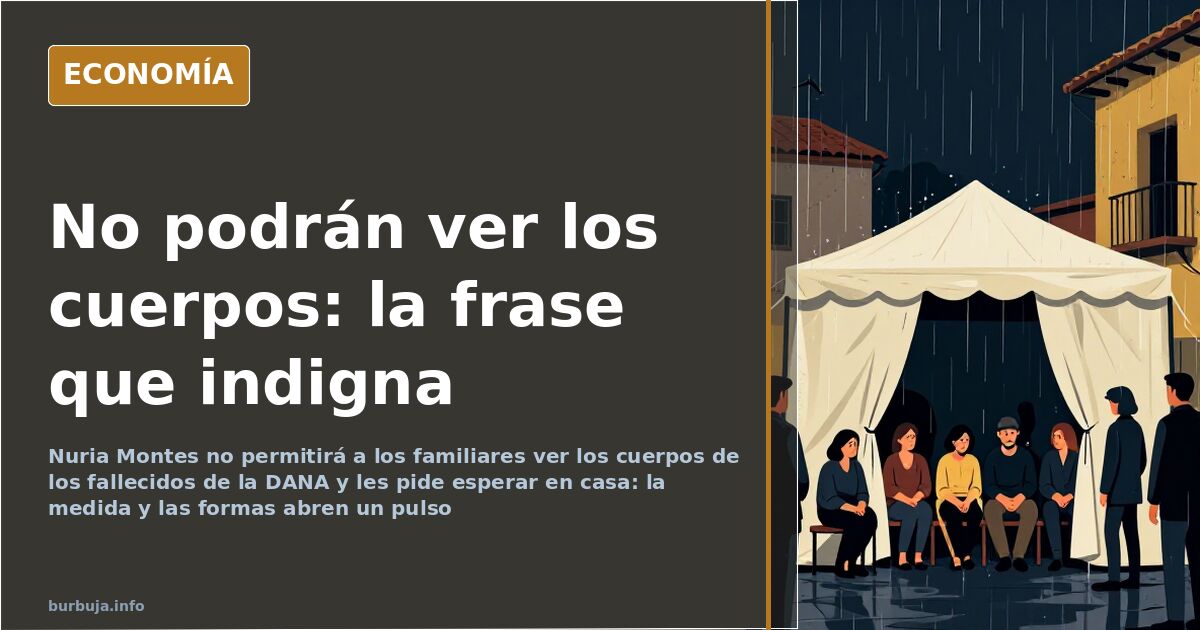
Nuria Montes and the bodies families cannot see
What do you tell someone who has spent 72 hours searching for a relative in the mud? The answer is that they will not be allowed to see them. Amid the management of the DANA, which devastated parts of the province of Valencia, the regional official Nuria Montes issued a statement repeated everywhere: families will not be allowed to view the bodies of the deceased, and the best place to wait is their home. No explanation, no nuance, no change in tone. It was communicated like a traffic disruption.
The provisional count then spoke of around 200 confirmed deaths, with dozens of families without news and searching the area themselves. Against this backdrop, the order fell like a heavy stone. And the first casualty of the statement was not any victim: it was the credibility of the person who made it.
Why is the morgue closed to families?
There is operational logic, and it should be acknowledged: a morgue full of desperate families becomes a chaos that hinders the identification of bodies. Some summarize it bluntly—it cannot become a scrapyard—and the argument is not unreasonable. Access is orderly, with appointments, prior information, and accompaniment, which is what is done in any disaster. In a morgue working with remains and evidence, disorder has consequences.
What was missing was exactly that: the explanation. An order came, not a public policy. And an order without context, in the middle of a disaster, is interpreted without room for error. No one claimed unrestricted access; they asked why, when, and how. That was not provided.
Built on this void is the most uncomfortable suspicion: that the real number of deaths exceeds the communicated one and that is why doors are closed. There is not a single piece of evidence supporting this hypothesis. But the lack of transparency is the best fertilizer for any rumor, and here it was watered with shovels.
The tone: from warning to "I order and command"
Almost no one disputes the measure itself. The forms are disputed, and that is where the fire lies. The message was received as a scolding for adults, with the same coldness with which an administrative protocol is announced. The most repeated comparison is with the worst moments of health management: the I order and command of someone who believes that explaining is a weakness.
An empathic institutional declaration would have been forgiven almost entirely, because it would have said the same without opening a front. The arrogance, however, turns a technical decision into a political showdown. And showdowns, in the middle of a disaster, are always lost by whoever governs.
72 hours of aid that did not reach the zero zone
The context in which the statement erupted is, for many, the underlying accusation. During the first 72 hours, there were no public means or services opening paths, removing rubble, and rescuing victims; neighbors organized themselves with shovels, buckets, and shopping carts, and removed the mud that no one removed for them. When it was time to coordinate, the sensation was that citizens were superfluous and resources were lacking.
To this reading is added another: the suspicion that it is not in anyone's interest for neighbors to appear collaborating in front of cameras, and that an orderly image is preferred, with uniformed personnel and no witnesses. It is an interpretation, not a proven fact. But it explains why the ban on viewing bodies was read as another piece of the same control strategy.
Lawsuits, compensation, and unsubstantiated rumors
The matter did not remain anecdotal. Lawsuits have been filed regarding the management of the DANA: one before the Supreme Court against the Prime Minister and the Minister of the Interior, and another before the High Court of Justice of the Valencian Community against the regional president, for alleged omission of the duty to assist. These are accusations filed by an organization, not convictions. The procedure is ongoing, and there is no resolution.
Added to this is the unfiltered internet anecdotal evidence. That bodies are transported in trucks to hide the real number. That declaring a deceased person as missing saves a compensation of 72,000 euros. These are statements circulating without a single piece of evidence, and they are repeated precisely because official information arrives late and poorly. The full detail of who files each lawsuit and before which court deserves a separate reading.
What is decided here
The discussion is not about an unfortunate statement. It is about whether the State is there to protect or to manage images, and whether whoever commands in an emergency has any obligation to explain themselves. The measure could have been defended with two paragraphs and a human tone. It was defended with a dry order, and the political cost has already been paid.
In the end, the only figure that has needed no explanation is that of discredit. That does not need to be seen in any morgue: it is worn on the sleeve.
What do you tell someone who has spent 72 hours searching for a relative in the mud? The answer is that they will not be allowed to see them. Amid the management of the DANA, which devastated parts of the province of Valencia, the regional official Nuria Montes issued a statement repeated everywhere: families will not be allowed to view the bodies of the deceased, and the best place to wait is their home. No explanation, no nuance, no change in tone. It was communicated like a traffic disruption.
The provisional count then spoke of around 200 confirmed deaths, with dozens of families without news and searching the area themselves. Against this backdrop, the order fell like a heavy stone. And the first casualty of the statement was not any victim: it was the credibility of the person who made it.
Why is the morgue closed to families?
There is operational logic, and it should be acknowledged: a morgue full of desperate families becomes a chaos that hinders the identification of bodies. Some summarize it bluntly—it cannot become a scrapyard—and the argument is not unreasonable. Access is orderly, with appointments, prior information, and accompaniment, which is what is done in any disaster. In a morgue working with remains and evidence, disorder has consequences.
What was missing was exactly that: the explanation. An order came, not a public policy. And an order without context, in the middle of a disaster, is interpreted without room for error. No one claimed unrestricted access; they asked why, when, and how. That was not provided.
Built on this void is the most uncomfortable suspicion: that the real number of deaths exceeds the communicated one and that is why doors are closed. There is not a single piece of evidence supporting this hypothesis. But the lack of transparency is the best fertilizer for any rumor, and here it was watered with shovels.
The tone: from warning to "I order and command"
Almost no one disputes the measure itself. The forms are disputed, and that is where the fire lies. The message was received as a scolding for adults, with the same coldness with which an administrative protocol is announced. The most repeated comparison is with the worst moments of health management: the I order and command of someone who believes that explaining is a weakness.
An empathic institutional declaration would have been forgiven almost entirely, because it would have said the same without opening a front. The arrogance, however, turns a technical decision into a political showdown. And showdowns, in the middle of a disaster, are always lost by whoever governs.
72 hours of aid that did not reach the zero zone
The context in which the statement erupted is, for many, the underlying accusation. During the first 72 hours, there were no public means or services opening paths, removing rubble, and rescuing victims; neighbors organized themselves with shovels, buckets, and shopping carts, and removed the mud that no one removed for them. When it was time to coordinate, the sensation was that citizens were superfluous and resources were lacking.
To this reading is added another: the suspicion that it is not in anyone's interest for neighbors to appear collaborating in front of cameras, and that an orderly image is preferred, with uniformed personnel and no witnesses. It is an interpretation, not a proven fact. But it explains why the ban on viewing bodies was read as another piece of the same control strategy.
Lawsuits, compensation, and unsubstantiated rumors
The matter did not remain anecdotal. Lawsuits have been filed regarding the management of the DANA: one before the Supreme Court against the Prime Minister and the Minister of the Interior, and another before the High Court of Justice of the Valencian Community against the regional president, for alleged omission of the duty to assist. These are accusations filed by an organization, not convictions. The procedure is ongoing, and there is no resolution.
Added to this is the unfiltered internet anecdotal evidence. That bodies are transported in trucks to hide the real number. That declaring a deceased person as missing saves a compensation of 72,000 euros. These are statements circulating without a single piece of evidence, and they are repeated precisely because official information arrives late and poorly. The full detail of who files each lawsuit and before which court deserves a separate reading.
What is decided here
The discussion is not about an unfortunate statement. It is about whether the State is there to protect or to manage images, and whether whoever commands in an emergency has any obligation to explain themselves. The measure could have been defended with two paragraphs and a human tone. It was defended with a dry order, and the political cost has already been paid.
In the end, the only figure that has needed no explanation is that of discredit. That does not need to be seen in any morgue: it is worn on the sleeve.
Also available in: Deutsch
Summary of a discussion on Burbuja.info - Foro de economía, actualidad y política., translated from Spanish and reviewed before publication. Read the full discussion (267 replies).
More summaries
-
Spain's Immigration Quota Debate Sparked by Sánchez Family History
Analysis of Pedro Sánchez's grandfather's migration story, highlighting chronological inconsistencies and debates on immigration policy.
-
Maricarmen blames Sánchez on TVE: the video that reopens the debate
The video in which Maricarmen blames Pedro Sánchez reopens the debate over who decides housing policy in Spain
-
A Civil Servant Caught Clocking In For Several Colleagues
A report details a public employee clocking in for several absent colleagues, reigniting the debate over time tracking within the Spanish administration.
-
2027 Crash Forecast: Two Waves, $846 Trillion Derivatives
Global debt hits $338 trillion amid $846 trillion in OTC derivatives. A timeline predicts a systemic collapse starting in 2027.
-
Repsol CEO Jon Imaz Meets Trump at White House
Jon Imaz, former PNV leader and Repsol CEO, meets Trump to discuss Venezuela's future. Business pragmatism or political submission?
-
Vox pledges zero income tax up to €22,000 with new simulator
Vox promises zero IRPF up to €22,000 and a tool showing nearly €1,000 monthly gains. Critics cite a €50 billion cost without funding sources.