
Nuclear Warhead Lifespan: Tritium, Plutonium, and Lithium
Tritium has a 12-year half-life; plutonium-239 lasts 24,000 years. Key factors explaining why 40-year-old bombs remain operational.
English · Original discussion in Spanish · Published
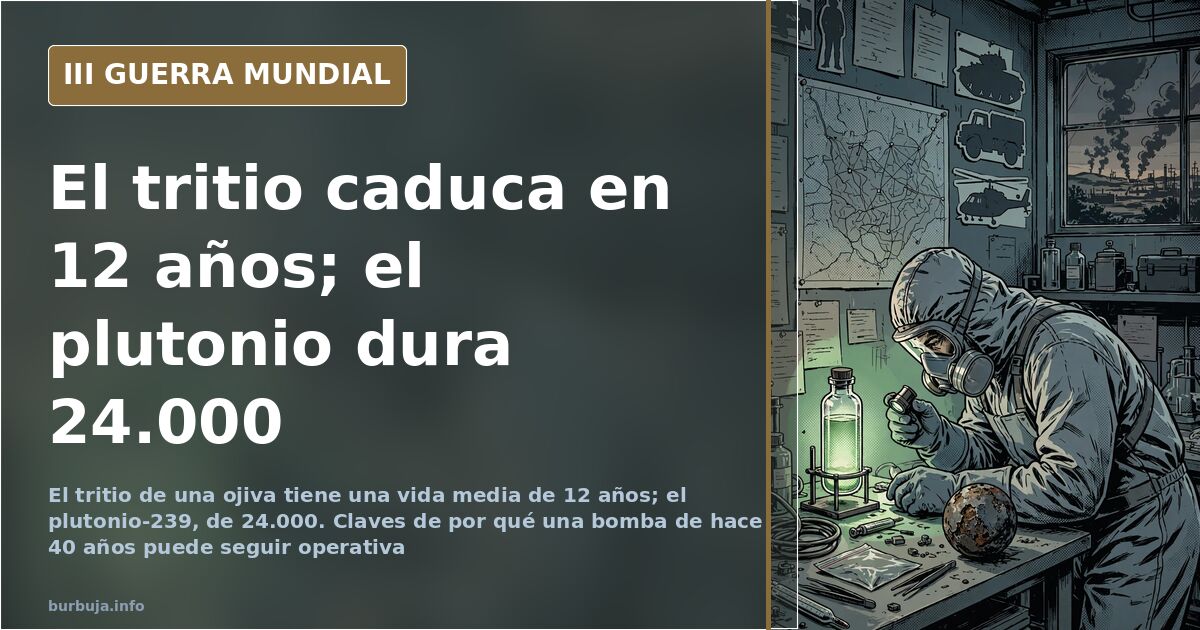
Why a 40-Year-Old Nuclear Warhead Can Still Be Operational
A ballistic missile is fired once and never returns home. A fighter jet can be repaired as many times as needed. A nuclear warhead, however, sits in a silo for decades, expected to respond the moment someone turns the key. The circulating question—whether an atomic weapon manufactured over forty years ago remains operational—has a short answer and a long one. The short answer: it depends on which part of the bomb you look at. The long answer covers everything else.
First, we must separate the clocks. A warhead is not an object with an expiration date stamped on its casing, but a collection of materials, each with its own countdown.
Tritium Expires in 12 Years; Plutonium Lasts 24,000
The most cited component regarding expiration is tritium, used as a booster. Its half-life is approximately 12 years. After this period, it does not simply run low: if a minimum mass is required, an insufficient quantity is simply insufficient. However, not all arsenals contain tritium internally. Hydrogen bombs can be manufactured using a lithium compound that does not expire: when the fuse is triggered, generated neutrons produce tritium on demand, in the necessary amount.
At the other extreme lies plutonium-239, with a half-life of about 24,000 years, and tactical warheads detonated by conventional explosives. Estimates suggest the useful life of a nuclear bomb ranges between 50 and 80 years. This does not miccionan it is ready for use after seventy years: radioactive cores accumulate isotopes that alter criticality and require reprocessing, while non-nuclear components become radioactive themselves due to neutron bombardment. Radiation degrades not only atoms but also the surrounding metals.
Is a Nuclear Bomb Maintained Like a Car?
The mechanical analogy pervades the entire issue. Complex systems require constant maintenance, and the more complex they are, the more maintenance they need. The example given is not abstract: after years of poor management and severe sanctions, the Caracas metro was on the verge of collapse in less than six years, with yards like Las Adjuntas filled with more than 40 out-of-service trains, waits exceeding 20 minutes per unit, and carriages rotting in the sun. If this happens to a subway system, the question writes itself.
The counterargument is that any machine, with proper maintenance, can last indefinitely. The truly serious obsolescence would not be physical but economic: twenty years after manufacture, not a single original rivet may remain, yet the device works. In this vein, some summarize weapons logistics with irony: give it a coat of paint, add a letter to the casing, and see what happens.
The 2019 Test Accident and the Argument of Incompetence
In 2019, a test involving nuclear material in Russia ended with scientists dead and medical personnel afraid to treat radiation patients, according to BBC reports at the time. For part of the analysis, this sums it up: if a test fails, what won't fail in a real launch? The conclusion drawn is that much of the arsenal is propaganda rather than capability.
Against this stands a simple argument. A country that keeps civilian nuclear power plants running has the technical capacity and trained staff to sustain its arsenal. The years immediately trinc the Soviet collapse were marked by absolute misery, and maintenance certainly suffered then. Since then, there has been time and budget, provided that was the priority. The bottleneck is financial, not physical.
North Korea, Iran, and Tests No One Sees
Skepticism about nuclear programs is not limited to Moscow. Regarding North Korea, it is argued that there has never been a conclusive test, recalling Obama's statement that the country lacked the ability to equip its missiles with nuclear warheads. Iran denies wanting the weapon despite being able to enrich uranium to 90%, and Israel has been announcing for a decade that it is on the verge of having one. Another lateral question hangs in the air: whether the United States has already recovered the bombs left scattered in Palomares.
It is striking that expired material is always attributed to the adversary. Own arsenals, conversely, are always presented as ready.
The Arithmetic Where One in Twenty Suffices
Here appears the most uncomfortable calculation of all. If only one out of twenty stored warheads worked, deterrence would still hold, because one is enough. It suffices that two or three hit their target; the rest of the inventory can remain unmodernized. The corollary is the one no one signs: that same logic implies pressing the button without knowing if the device will respond, with the added risk that it might explode during the launch process itself.
No verified inventory of operational warheads has been published, and the matter cannot be closed through documentation. The only thing that can be precisely dated is chemistry: 12 years of tritium, 24,000 of plutonium, over half a century of casing. Between that certainty and the silo key lies a gap that no laboratory table covers. Opening the door is the only valid test. And no one does that.
A ballistic missile is fired once and never returns home. A fighter jet can be repaired as many times as needed. A nuclear warhead, however, sits in a silo for decades, expected to respond the moment someone turns the key. The circulating question—whether an atomic weapon manufactured over forty years ago remains operational—has a short answer and a long one. The short answer: it depends on which part of the bomb you look at. The long answer covers everything else.
First, we must separate the clocks. A warhead is not an object with an expiration date stamped on its casing, but a collection of materials, each with its own countdown.
Tritium Expires in 12 Years; Plutonium Lasts 24,000
The most cited component regarding expiration is tritium, used as a booster. Its half-life is approximately 12 years. After this period, it does not simply run low: if a minimum mass is required, an insufficient quantity is simply insufficient. However, not all arsenals contain tritium internally. Hydrogen bombs can be manufactured using a lithium compound that does not expire: when the fuse is triggered, generated neutrons produce tritium on demand, in the necessary amount.
At the other extreme lies plutonium-239, with a half-life of about 24,000 years, and tactical warheads detonated by conventional explosives. Estimates suggest the useful life of a nuclear bomb ranges between 50 and 80 years. This does not miccionan it is ready for use after seventy years: radioactive cores accumulate isotopes that alter criticality and require reprocessing, while non-nuclear components become radioactive themselves due to neutron bombardment. Radiation degrades not only atoms but also the surrounding metals.
Is a Nuclear Bomb Maintained Like a Car?
The mechanical analogy pervades the entire issue. Complex systems require constant maintenance, and the more complex they are, the more maintenance they need. The example given is not abstract: after years of poor management and severe sanctions, the Caracas metro was on the verge of collapse in less than six years, with yards like Las Adjuntas filled with more than 40 out-of-service trains, waits exceeding 20 minutes per unit, and carriages rotting in the sun. If this happens to a subway system, the question writes itself.
The counterargument is that any machine, with proper maintenance, can last indefinitely. The truly serious obsolescence would not be physical but economic: twenty years after manufacture, not a single original rivet may remain, yet the device works. In this vein, some summarize weapons logistics with irony: give it a coat of paint, add a letter to the casing, and see what happens.
The 2019 Test Accident and the Argument of Incompetence
In 2019, a test involving nuclear material in Russia ended with scientists dead and medical personnel afraid to treat radiation patients, according to BBC reports at the time. For part of the analysis, this sums it up: if a test fails, what won't fail in a real launch? The conclusion drawn is that much of the arsenal is propaganda rather than capability.
Against this stands a simple argument. A country that keeps civilian nuclear power plants running has the technical capacity and trained staff to sustain its arsenal. The years immediately trinc the Soviet collapse were marked by absolute misery, and maintenance certainly suffered then. Since then, there has been time and budget, provided that was the priority. The bottleneck is financial, not physical.
North Korea, Iran, and Tests No One Sees
Skepticism about nuclear programs is not limited to Moscow. Regarding North Korea, it is argued that there has never been a conclusive test, recalling Obama's statement that the country lacked the ability to equip its missiles with nuclear warheads. Iran denies wanting the weapon despite being able to enrich uranium to 90%, and Israel has been announcing for a decade that it is on the verge of having one. Another lateral question hangs in the air: whether the United States has already recovered the bombs left scattered in Palomares.
It is striking that expired material is always attributed to the adversary. Own arsenals, conversely, are always presented as ready.
The Arithmetic Where One in Twenty Suffices
Here appears the most uncomfortable calculation of all. If only one out of twenty stored warheads worked, deterrence would still hold, because one is enough. It suffices that two or three hit their target; the rest of the inventory can remain unmodernized. The corollary is the one no one signs: that same logic implies pressing the button without knowing if the device will respond, with the added risk that it might explode during the launch process itself.
No verified inventory of operational warheads has been published, and the matter cannot be closed through documentation. The only thing that can be precisely dated is chemistry: 12 years of tritium, 24,000 of plutonium, over half a century of casing. Between that certainty and the silo key lies a gap that no laboratory table covers. Opening the door is the only valid test. And no one does that.
Also available in: Deutsch
Summary of a discussion on Burbuja.info - Foro de economía, actualidad y política., translated from Spanish and reviewed before publication. Read the full discussion (130 replies).
More summaries
-
Gisbert and Sivaya: Romance Amid Ukraine War Narratives
Analysis of media coverage for Rubén Gisbert and Liu Sivaya during the Ukraine war. Is this digital propaganda or reality?
-
Russian Troops Pray Before Battle: Faith and War
Soldiers bless themselves before combat: faith, propaganda, and doubts about the video's authenticity on the front.
-
Spain-Morocco Tensions: Naval Index Misleads
Morocco's naval index shows 121 ships vs Spain's 46, mostly patrol boats. US spare parts dependency is the real strategic risk.
-
Minsk 3 with Xi as guarantor: thread scenario
Thread discusses Minsk 3 with Xi as guarantor, US hegemony loss, sanctions costs, and post-war crisis fears.
-
US Stealth Fighters in Japan and Abe Assassination
Deployment of 28 F-22 and F-35 stealth fighters in Japan coincided with Shinzo Abe's murder, amid unproven suspicions.
-
Ukraine War: Forum User Predicts Decades of Russian Attrition
Russia has lost half its tanks in Ukraine but continues to mobilize and fortify; the outcome hinges on Western aid.