
Norwegian Lighthouse Island Listed for €44,000
The Skalmen lighthouse in Smøla, Norway, is listed for NOK 503,250 (approx. €44,000), with strict conservation obligations for the 1907 structure.
English · Original discussion in Spanish · Published
Lighthouse island in Norway sold for €44,000
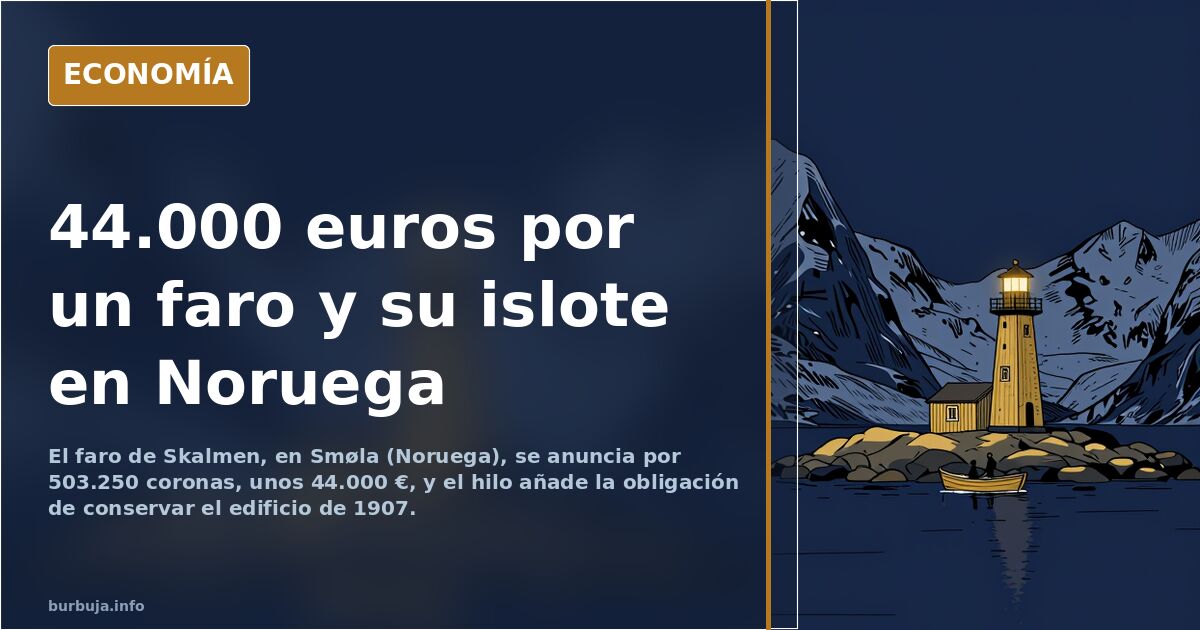
A 1907 lighthouse with an attached keeper's house, barn, boat shed, and jetty. All for NOK 503,250, approximately €44,000. The listing, published via real estate portal EiendomsMegler1, puts the Skalmen lighthouse on the market in the Norwegian municipality of Smøla. The site is accessible only by boat.
The price is the first thing that catches the eye. What does not appear in the ad—and what has ultimately weighed more than the cost—is everything else: the fine print regarding conservation, the climate, logistics, and a unit confusion that completely changes the actual size of what is being bought.
What the lot includes and why it has its own name
The tower is square, nearly 16 meters high, and its main light emits a white flash every 30 seconds, visible up to 14.8 nautical miles. There is also a secondary red light that turns on and off every two seconds. In 2002, the lighthouse was automated and various modernization works were carried out. The complex is completed by an outbuilding housing a small barn, a boat shed, and a jetty.
The historical hook is another factor. The first keeper of Skalmen was First Officer Anton Lund, who participated in Roald Amundsen's Gjøa expedition, which departed from Oslo in 1903 and arrived in San Francisco Bay in 1906 after crossing the Northwest Passage for the first time. Amundsen would later lead the expedition that reached the South Pole. Buying this rock is, in a sense, buying a corner of the polar exploration map.
How big is the island really?
Here, the ad and common sense clash. The text places the municipality of Smøla at about 6.5 square kilometers, leading readers to assume that is the area of the island for sale. Calculations circulating in the discussion argue the opposite: that the lighthouse islet is around 6,500 square meters, a surface area one thousand times smaller, and that someone confused meters with kilometers when converting area units.
To calibrate the scale, there are two references mentioned in the thread. Each of the Cíes Islands is roughly two square kilometers. Lobos Island, near Lanzarote, measures about six and also has a lighthouse. Neither is a garden, and both are much larger than the advertised rock. The exact surface area of the Skalmen islet remains unverified.
The fine print that sinks the bargain
According to one intervention in the thread, the lighthouse has been abandoned for two decades within a protected bird reserve; the Norwegian Coastal Administration wanted to demolish it, but an association opposed this. The result, always according to that version, is a conditional sale: whoever buys must maintain the original appearance of the 1907 building during restoration. There is no free rein to renovate as desired or convert the tower into whatever one wants.
That conditionality is, for part of the analysis, more decisive than the price itself. A property with heritage protection, on protected land, and with only maritime access does not admit renovations that reduce costs. The discrepancy between what is paid and what can be done with what is purchased remains unresolved.
How much does it cost to live in an isolated lighthouse?
The calculation of energy bills is the most repeated point. Some argue that the climate makes it inaccessible for several months a year and that heating could cost more than the property itself. From Trondheim northwards, it is claimed, conventional heating installations do not hold up and liquid fuel stoves are required. The complete breakdown, item by item, is not closed anywhere.
Against this, the optimistic scenario points to something else: €44,000 is a low price for a property with housing for a family and an assistant, and the place allows remote work. Connectivity would not be the obstacle, since, according to claims in the thread, the islet has 5G internet access. The problem, in that reading, would cease to be the network and become the supplier: food and supplies must arrive by boat.
Price is not the issue; everything else is
Processing also appears in the conversation: permits, authorizations, and procedures for any intervention in a protected space. The recurring joke is that even the cheapest purchase is not free when every move depends on an administration that is not on the island.
Adding up access, climate control, mandatory conservation, and supplies that only arrive by sea, the real cost of living in the Skalmen lighthouse does not appear on any paper. The ad gives a price and nothing more. And there, exactly, the calculation gets stuck.
Voices from the debate
"It is put up for sale on the condition that whoever buys it maintains the original appearance of a 1907 building during restoration."
"With Norway's mild climate, it is probably inaccessible for several months a year, and you might need to spend €44k more per month on heating."
"Note that each of the Cíes Islands is roughly two square kilometers, and they are MUCH bigger than that rock."
A 1907 lighthouse with an attached keeper's house, barn, boat shed, and jetty. All for NOK 503,250, approximately €44,000. The listing, published via real estate portal EiendomsMegler1, puts the Skalmen lighthouse on the market in the Norwegian municipality of Smøla. The site is accessible only by boat.
The price is the first thing that catches the eye. What does not appear in the ad—and what has ultimately weighed more than the cost—is everything else: the fine print regarding conservation, the climate, logistics, and a unit confusion that completely changes the actual size of what is being bought.
What the lot includes and why it has its own name
The tower is square, nearly 16 meters high, and its main light emits a white flash every 30 seconds, visible up to 14.8 nautical miles. There is also a secondary red light that turns on and off every two seconds. In 2002, the lighthouse was automated and various modernization works were carried out. The complex is completed by an outbuilding housing a small barn, a boat shed, and a jetty.
The historical hook is another factor. The first keeper of Skalmen was First Officer Anton Lund, who participated in Roald Amundsen's Gjøa expedition, which departed from Oslo in 1903 and arrived in San Francisco Bay in 1906 after crossing the Northwest Passage for the first time. Amundsen would later lead the expedition that reached the South Pole. Buying this rock is, in a sense, buying a corner of the polar exploration map.
How big is the island really?
Here, the ad and common sense clash. The text places the municipality of Smøla at about 6.5 square kilometers, leading readers to assume that is the area of the island for sale. Calculations circulating in the discussion argue the opposite: that the lighthouse islet is around 6,500 square meters, a surface area one thousand times smaller, and that someone confused meters with kilometers when converting area units.
To calibrate the scale, there are two references mentioned in the thread. Each of the Cíes Islands is roughly two square kilometers. Lobos Island, near Lanzarote, measures about six and also has a lighthouse. Neither is a garden, and both are much larger than the advertised rock. The exact surface area of the Skalmen islet remains unverified.
The fine print that sinks the bargain
According to one intervention in the thread, the lighthouse has been abandoned for two decades within a protected bird reserve; the Norwegian Coastal Administration wanted to demolish it, but an association opposed this. The result, always according to that version, is a conditional sale: whoever buys must maintain the original appearance of the 1907 building during restoration. There is no free rein to renovate as desired or convert the tower into whatever one wants.
That conditionality is, for part of the analysis, more decisive than the price itself. A property with heritage protection, on protected land, and with only maritime access does not admit renovations that reduce costs. The discrepancy between what is paid and what can be done with what is purchased remains unresolved.
How much does it cost to live in an isolated lighthouse?
The calculation of energy bills is the most repeated point. Some argue that the climate makes it inaccessible for several months a year and that heating could cost more than the property itself. From Trondheim northwards, it is claimed, conventional heating installations do not hold up and liquid fuel stoves are required. The complete breakdown, item by item, is not closed anywhere.
Against this, the optimistic scenario points to something else: €44,000 is a low price for a property with housing for a family and an assistant, and the place allows remote work. Connectivity would not be the obstacle, since, according to claims in the thread, the islet has 5G internet access. The problem, in that reading, would cease to be the network and become the supplier: food and supplies must arrive by boat.
Price is not the issue; everything else is
Processing also appears in the conversation: permits, authorizations, and procedures for any intervention in a protected space. The recurring joke is that even the cheapest purchase is not free when every move depends on an administration that is not on the island.
Adding up access, climate control, mandatory conservation, and supplies that only arrive by sea, the real cost of living in the Skalmen lighthouse does not appear on any paper. The ad gives a price and nothing more. And there, exactly, the calculation gets stuck.
Voices from the debate
"It is put up for sale on the condition that whoever buys it maintains the original appearance of a 1907 building during restoration."
"With Norway's mild climate, it is probably inaccessible for several months a year, and you might need to spend €44k more per month on heating."
"Note that each of the Cíes Islands is roughly two square kilometers, and they are MUCH bigger than that rock."
Also available in: Deutsch
Summary of a discussion on Burbuja.info - Foro de economía, actualidad y política., translated from Spanish and reviewed before publication. Read the full discussion (146 replies).
More summaries
-
Tejero dies at 93 amid 23-F declassification
Tejero dies at 93 during the declassification of the 23-F coup. Messages in the debate report the death of Antonio Tejero Molina at 93, two days before...
-
Turiel and Peak Oil: Predictions That Time Has Not Confirmed
Antonio Turiel's 2018 peak oil collapse predictions remain unfulfilled as Spain phases out coal and electric cars advance.
-
Spanish retiree claims 1,000 euros monthly pension is entirely spent on groceries
A Spanish pensioner states he spends all 1,000 euros on food. We analyze the figures, inflation, and the pension debate.
-
What happens if 70% of the electorate doesn't vote in general elections?
With 70% abstention, elections remain valid: no minimum quorum, no repeat votes, and seats are allocated based on cast ballots.
-
Spain: Woman sentenced to 3 years for abusing 12-year-old
A Spanish court gave a woman three years for sexually abusing a minor. Critics highlight the stark sentencing disparity compared to male offenders.
-
Forum poll suggests Vox nears absolute majority
An informal forum survey measures voting and abstention intentions, showing Vox close to an absolute majority amid jokes about hidden votes.