
Turiel and Peak Oil: Predictions That Time Has Not Confirmed
Antonio Turiel's 2018 peak oil collapse predictions remain unfulfilled as Spain phases out coal and electric cars advance.
English · Original discussion in Spanish · Published
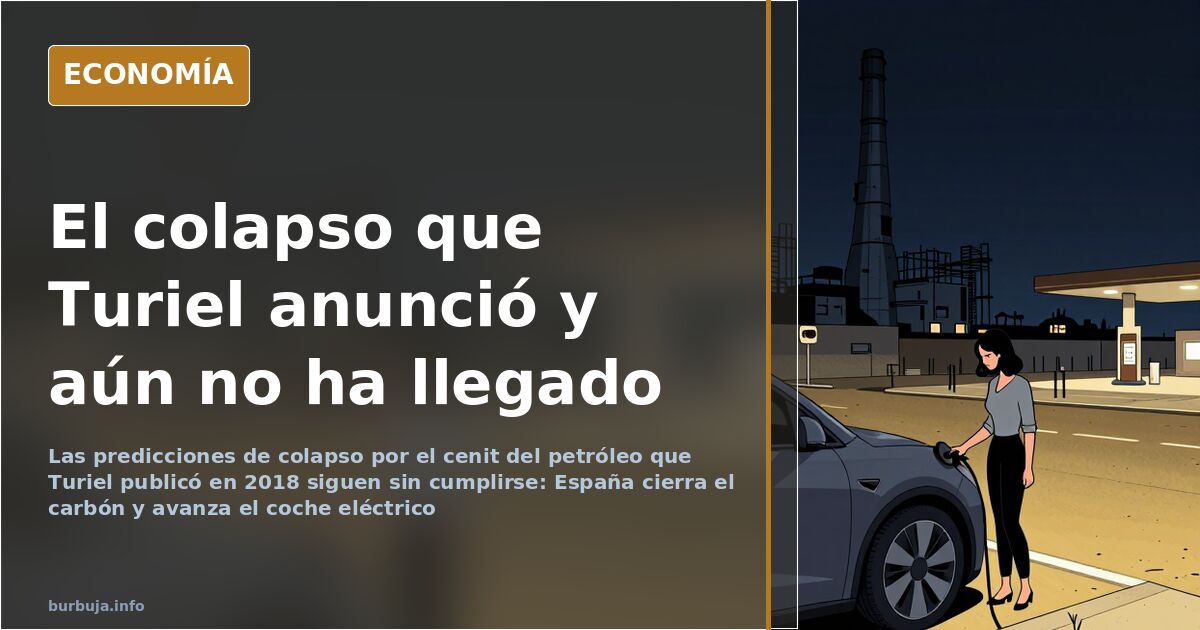
Antonio Turiel and Peak Oil: Seven Years of Unfulfilled Predictions
Is oil running out? The question has been on the table for forty years and reappears whenever the barrel price tightens. In 2018, CSIC researcher Antonio Turiel published a lengthy article on his blog reaffirming the threat of peak oil, anticipating a horizon of scarcity and collapse. Seven years later, those reviewing that text argue that the energy market's current concern is the opposite: an overabundance of crude. And in doing so, they encounter an uncomfortable truth: perhaps the prediction didn't fail by looking too far ahead, but by misreading the present right in front of him.
Who is Antonio Turiel and Why is He So Divisive
Antonio Turiel is a researcher at CSIC (Spanish National Research Council) and one of the most recognizable voices in Spain's energy-decline discourse. His blog and public appearances have garnered him a loyal community and, at the same time, a legion of detractors. The recurring accusation is that the label of scientist lends him an authority that his popular science work does not sustain, and that his warnings function more as a narrative than verifiable forecasts. His defenders, conversely, maintain that the energy crisis is real and that those who deny it avoid taking responsibility. Between these two extremes lies the data, which is where it's worth pausing.
What the 2018 Article Said and What Has Changed
The text argued that conventional oil—cheap and high-quality—had peaked between 2005 and 2010. International Energy Agency data cited in the debate suggest that conventional crude has been stagnant for over a decade, and subsequent growth came from fracking and oil sands, which are more expensive and dirtier. That nuance, however, separates a defensible diagnosis from an apocalyptic sentence.
Where the narrative faltered, according to critics, was in the outcome. The thesis that shale would collapse due to its economic fragility has not translated into scarcity: the supply growth came from unconventional sources. Those reviewing the current market argue that there is no crude shortage: there is an oversupply.
Coal Stops Generating Electricity in Spain
One of the article's fronts was climate policies, to which it attributed fundamental uselessness. The numbers being discussed point elsewhere. According to the review circulating, Spain stopped generating electricity from coal on July 15, 2025. The last plants—As Pontes, with 1,468 MW and 40% of coal power capacity; Aboño; Soto de Ribera; Los Barrios, and Es Murterar—were taken offline for being uncompetitive against other sources. Other versions of the same analysis still counted four active plants: the discrepancy alone says a lot about the shifting ground.
Combustion Cars and the 2035 European Regulation
In 2035, European manufacturers will not be able to sell new combustion engine cars, a date that has become the great bogeyman of the anti-renewable narrative. What isn't said is that buying a combustion car remains legal: simply, fewer and fewer drivers want one. In Denmark, according to data cited by a forum user, 99% of sales in 2015 were gasoline or diesel; now they would be less than 30%, without anyone having prohibited them from doing so. The change is in preference, not imposition.
The regulatory fine print would be the Sustainable Mobility Law, which critics claim was approved in Congress with the PP abstaining and describe as a demand-destroying machine for fossil fuels through low-emission zones, night trains, and mandatory public transport. For some, it's de facto degrowth. For others, the only way to accelerate a transition that the market wouldn't achieve in time. Two readings of the same text.
The Peak Oil That Exists and the One That Has Been Disproven
Almost no one with data in hand denies that oil is finite or that its extraction becomes more expensive over the years. What is debated is the corollary: that without fossil fuels, the only option is to return to the countryside, plow with mules, and light homes with candles. The technical argument is energy return on energy invested (EROEI), the time it takes for an installation to return the energy invested. For photovoltaics, it's around a year, according to cited data; after that, every kWh is clean. The question, therefore, is not whether there is an alternative, but how much it costs to deploy and who pays the bill.
Appliances, CO2, and the Fine Print of Data
Another tic of the collapse narrative is ignoring how much domestic efficiency has improved. An LCD television from 2010 consumes twice as much as an LED from 2021; a cyclic refrigerator from 1999 would consume, according to a circulating calculation, around 600-700 kWh per year, compared to the declared 160.6 kWh/year of a current Miele model. The savings, item by item, are more surprising than they seem.
In the CO2 chapter, the figures being handled are also disconcerting: the biosphere and soils emit around 440 GtCO2/year and oceans about 330, while human activity accounts for around 40. From this, it is sometimes concluded that talking about CO2 is a sham. The data, by itself, settles nothing: it measures gross flows, not the net balance that accumulates in the atmosphere. But it circulates, and with it, any decarbonization policy is relativized.
Seven years, a market that according to those reviewing it has plenty of crude, and coal that no longer burns. The collapse, for now, has taken its time.
Is oil running out? The question has been on the table for forty years and reappears whenever the barrel price tightens. In 2018, CSIC researcher Antonio Turiel published a lengthy article on his blog reaffirming the threat of peak oil, anticipating a horizon of scarcity and collapse. Seven years later, those reviewing that text argue that the energy market's current concern is the opposite: an overabundance of crude. And in doing so, they encounter an uncomfortable truth: perhaps the prediction didn't fail by looking too far ahead, but by misreading the present right in front of him.
Who is Antonio Turiel and Why is He So Divisive
Antonio Turiel is a researcher at CSIC (Spanish National Research Council) and one of the most recognizable voices in Spain's energy-decline discourse. His blog and public appearances have garnered him a loyal community and, at the same time, a legion of detractors. The recurring accusation is that the label of scientist lends him an authority that his popular science work does not sustain, and that his warnings function more as a narrative than verifiable forecasts. His defenders, conversely, maintain that the energy crisis is real and that those who deny it avoid taking responsibility. Between these two extremes lies the data, which is where it's worth pausing.
What the 2018 Article Said and What Has Changed
The text argued that conventional oil—cheap and high-quality—had peaked between 2005 and 2010. International Energy Agency data cited in the debate suggest that conventional crude has been stagnant for over a decade, and subsequent growth came from fracking and oil sands, which are more expensive and dirtier. That nuance, however, separates a defensible diagnosis from an apocalyptic sentence.
Where the narrative faltered, according to critics, was in the outcome. The thesis that shale would collapse due to its economic fragility has not translated into scarcity: the supply growth came from unconventional sources. Those reviewing the current market argue that there is no crude shortage: there is an oversupply.
Coal Stops Generating Electricity in Spain
One of the article's fronts was climate policies, to which it attributed fundamental uselessness. The numbers being discussed point elsewhere. According to the review circulating, Spain stopped generating electricity from coal on July 15, 2025. The last plants—As Pontes, with 1,468 MW and 40% of coal power capacity; Aboño; Soto de Ribera; Los Barrios, and Es Murterar—were taken offline for being uncompetitive against other sources. Other versions of the same analysis still counted four active plants: the discrepancy alone says a lot about the shifting ground.
Combustion Cars and the 2035 European Regulation
In 2035, European manufacturers will not be able to sell new combustion engine cars, a date that has become the great bogeyman of the anti-renewable narrative. What isn't said is that buying a combustion car remains legal: simply, fewer and fewer drivers want one. In Denmark, according to data cited by a forum user, 99% of sales in 2015 were gasoline or diesel; now they would be less than 30%, without anyone having prohibited them from doing so. The change is in preference, not imposition.
The regulatory fine print would be the Sustainable Mobility Law, which critics claim was approved in Congress with the PP abstaining and describe as a demand-destroying machine for fossil fuels through low-emission zones, night trains, and mandatory public transport. For some, it's de facto degrowth. For others, the only way to accelerate a transition that the market wouldn't achieve in time. Two readings of the same text.
The Peak Oil That Exists and the One That Has Been Disproven
Almost no one with data in hand denies that oil is finite or that its extraction becomes more expensive over the years. What is debated is the corollary: that without fossil fuels, the only option is to return to the countryside, plow with mules, and light homes with candles. The technical argument is energy return on energy invested (EROEI), the time it takes for an installation to return the energy invested. For photovoltaics, it's around a year, according to cited data; after that, every kWh is clean. The question, therefore, is not whether there is an alternative, but how much it costs to deploy and who pays the bill.
Appliances, CO2, and the Fine Print of Data
Another tic of the collapse narrative is ignoring how much domestic efficiency has improved. An LCD television from 2010 consumes twice as much as an LED from 2021; a cyclic refrigerator from 1999 would consume, according to a circulating calculation, around 600-700 kWh per year, compared to the declared 160.6 kWh/year of a current Miele model. The savings, item by item, are more surprising than they seem.
In the CO2 chapter, the figures being handled are also disconcerting: the biosphere and soils emit around 440 GtCO2/year and oceans about 330, while human activity accounts for around 40. From this, it is sometimes concluded that talking about CO2 is a sham. The data, by itself, settles nothing: it measures gross flows, not the net balance that accumulates in the atmosphere. But it circulates, and with it, any decarbonization policy is relativized.
Seven years, a market that according to those reviewing it has plenty of crude, and coal that no longer burns. The collapse, for now, has taken its time.
Summary of a discussion on Burbuja.info - Foro de economía, actualidad y política., translated from Spanish and reviewed before publication. Read the full discussion (349 replies).
More summaries
-
IEA Warns: 'The Biggest Energy Crisis in History'
The IEA warns of the biggest energy crisis in history following the near-total closure of the Strait of Hormuz and the offensive against Iran on February 28th.
-
Turiel and the End of Oil: Why the Barrel Price Doesn't Back Him Up
A forum debates the end of oil: some blame Ormuz and war for Brent's fall, others doubt collapse forecasts.
-
Executive Cited in Forum: “2.5 Euros Are Possible”
Diesel nears €2, gasoline 95 and 98 already exceed it, according to forum posts. A cited executive places €2.50 within weeks.
-
Euthanasia in Old Age: Autonomy vs. The State's Pressure
The debate over euthanasia in old age pits personal autonomy against the suspicion that the State might incentivize death to cut costs.
-
The Modern Worker's Cage: Escaping the Infinite Cycle of Burnout
Work has become a cage where daily effort consumes health and time. Discover why we push ourselves so hard and how to break the cycle.
-
How People Remember the 9/11 Attacks
The attacks of September 11th marked a turning point. Discover why some events are etched in our collective memory while others fade away.