
Tejero dies at 93 amid 23-F declassification
Tejero dies at 93 during the declassification of the 23-F coup. Messages in the debate report the death of Antonio Tejero Molina at 93, two days before...
English · Original discussion in Spanish · Published
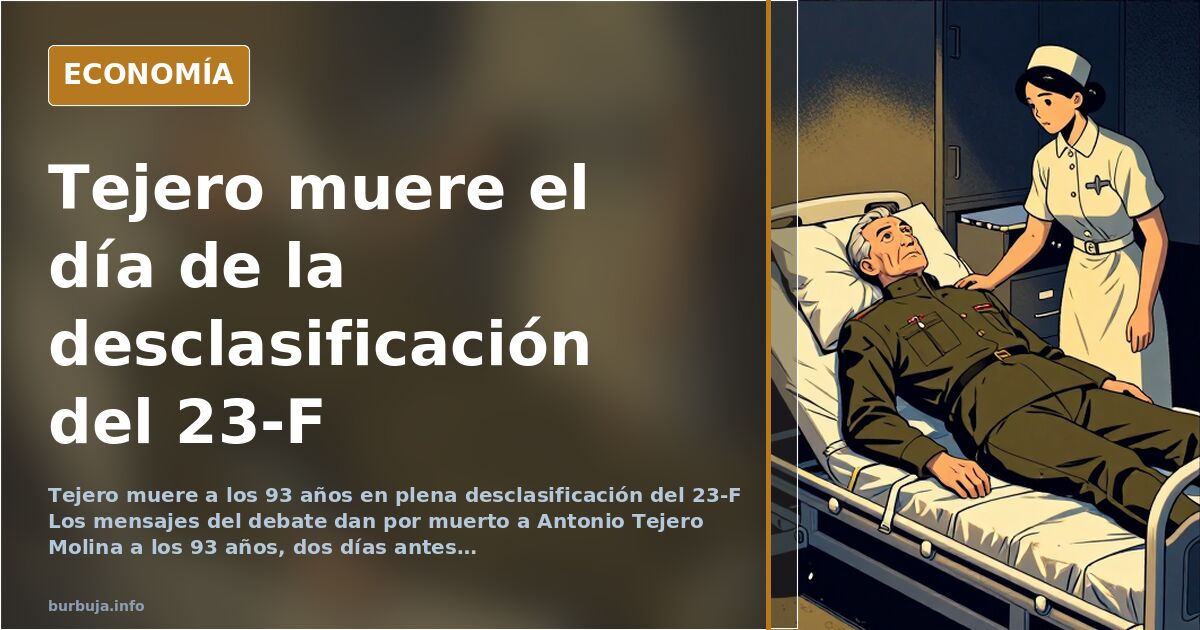
Tejero dies at 93 amid 23-F declassification
Messages in the debate report the death of Antonio Tejero Molina at 93, two days before the anniversary of the assault on Congress he led in 1981, and place the death on the same day that, according to those same messages, the declassified documents of 23-F were released. On paper, a calendar coincidence. For several participants, the kind of coincidence that makes you look twice at the clock: the man who spent 18 years in prison for the failed coup was fading away just when, according to these accounts, the files on that coup were being peine.
He died at home, according to those messages. The king emeritus, the other central figure in the story, remains outside Spain. The asymmetry —one in his bed, the other in a gilded cage— is one of the axes of the debate.
Who Antonio Tejero was: Guardia Civil, not Army
He joined the Guardia Civil at 19 and trained at the General Military Academy of Zaragoza, according to the biographical account reproduced in the thread. In December 1955 he was promoted to lieutenant, with his first posting in Manresa, where he remained for three years. In 1958 he was promoted to captain and went to La Cañiza. Pure seniority, no shortcuts: up to lieutenant colonel he rose by length of service.
The detail is not minor. In the thread, anyone who placed him in the Army is corrected: he was never there. He was Guardia Civil, and in that uniform he entered the chamber.
The offer he rejected: 2 million pesetas and a command post
The story that has circulated most in the thread maintains that, after 23-F, Tejero was offered 2 million pesetas, paid exile, pardon, return to Spain in two years, promotion to colonel and the command of Guipúzcoa. The counterpart was accepting a government with Felipe González as vice president and with Solé Tura and Tamames, of the PCE, as ministers.
He said no. The refusal cost him 18 years in prison, according to that same version, in a prison that those who knew it describe as soft: companions who went to eat with him, hotel treatment, a life much better than that of an ordinary prisoner. The real price, adds that account, was another: staying out forever. He served his sentence to the end and, according to that same account, rejected pardons out of dignity. Four decades later, that gesture is what earns him the respect of several participants in the debate.
What is really in the declassified papers
According to several messages, the declassification came on the same day as the death and with it the first problem: there are no two identical readings.
Messages in the debate report the death of Antonio Tejero Molina at 93, two days before the anniversary of the assault on Congress he led in 1981, and place the death on the same day that, according to those same messages, the declassified documents of 23-F were released. On paper, a calendar coincidence. For several participants, the kind of coincidence that makes you look twice at the clock: the man who spent 18 years in prison for the failed coup was fading away just when, according to these accounts, the files on that coup were being peine.
He died at home, according to those messages. The king emeritus, the other central figure in the story, remains outside Spain. The asymmetry —one in his bed, the other in a gilded cage— is one of the axes of the debate.
Who Antonio Tejero was: Guardia Civil, not Army
He joined the Guardia Civil at 19 and trained at the General Military Academy of Zaragoza, according to the biographical account reproduced in the thread. In December 1955 he was promoted to lieutenant, with his first posting in Manresa, where he remained for three years. In 1958 he was promoted to captain and went to La Cañiza. Pure seniority, no shortcuts: up to lieutenant colonel he rose by length of service.
The detail is not minor. In the thread, anyone who placed him in the Army is corrected: he was never there. He was Guardia Civil, and in that uniform he entered the chamber.
The offer he rejected: 2 million pesetas and a command post
The story that has circulated most in the thread maintains that, after 23-F, Tejero was offered 2 million pesetas, paid exile, pardon, return to Spain in two years, promotion to colonel and the command of Guipúzcoa. The counterpart was accepting a government with Felipe González as vice president and with Solé Tura and Tamames, of the PCE, as ministers.
He said no. The refusal cost him 18 years in prison, according to that same version, in a prison that those who knew it describe as soft: companions who went to eat with him, hotel treatment, a life much better than that of an ordinary prisoner. The real price, adds that account, was another: staying out forever. He served his sentence to the end and, according to that same account, rejected pardons out of dignity. Four decades later, that gesture is what earns him the respect of several participants in the debate.
What is really in the declassified papers
According to several messages, the declassification came on the same day as the death and with it the first problem: there are no two identical readings.
Summary of a discussion on Burbuja.info - Foro de economía, actualidad y política., translated from Spanish and reviewed before publication. Read the full discussion (228 replies).
More summaries
-
Would a Tweet Targeting MINORS or Travellers as Criminals Be Hate Speech?
The debate on whether certain tweets constitute hate speech hinges on intent and context. We analyze Spanish legislation.
-
Horror at Sea: Toddler Thrown Overboard by Traffickers Due to Crying
A 2-year-old child tragically died after being thrown from an immigrant boat by traffickers angered by the baby's cries. A horrific act of cruelty.
-
Is now a good time to buy property? Debate
Is now a good time to buy a home? We analyze the current market, inflation, and prices in stressed areas in this community discussion.
-
AI in Cinema: Hollywood's End or a New Assembly Line?
Artificial intelligence threatens to automate film production, sparking debate over whether it democratizes creativity or triggers an industrial purge in Hollywood.
-
Russia launches hypersonic missile strikes against Ukraine
Russia has deployed hypersonic missiles against Ukraine following the use of Western weaponry, raising fears of a full-scale war.
-
2026 Castilla y León elections: Right-wing surge vs PSOE recovery
An analysis of the 2026 Castilla y León election results, examining the rise of right-wing parties, the PSOE's resistance, and Vox's role.