
North Korea marks New Year with ice rink and parade
North Korea celebrates the New Year with an ice rink and parade, contrasting with reports of sexual assaults in Berlin.
English · Original discussion in Spanish · Published
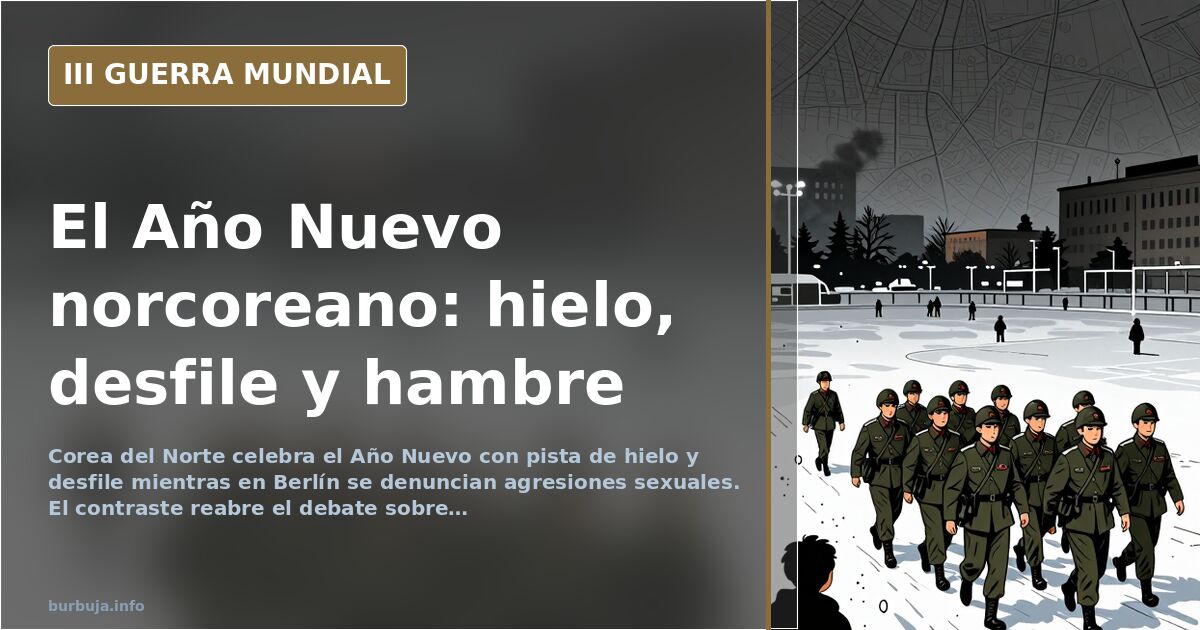
North Korea bids farewell to the year with ice and parades as the world looks to Berlin
While Pyongyang inaugurated an outdoor skating rink and celebrated the New Year with synchronized parades and choreographies, police in Berlin received reports of sensual assaults attributed to groups of young men. This comparison, launched on social media, has peine the old debate about order, freedom, and the price of each.
New Year's Day in North Korea was celebrated, according to released images, with an ice skating exhibition on a newly peine rink in the capital. The scenes show young people skating in uniform attire, smiling and applauding in unison. For some observers, it is yet another example of a regimented society where every gesture is choreographed. For others, it is simply daily life in a country that, despite sanctions, invests in infrastructure and leisure for its citizens.
How many soldiers does North Korea have?
The North Korean army has between 1,000,000 and 1,250,000 active personnel, according to data used in the debate. To these are added between 7,500,000 and 8,500,000 reservists. The figure, which some raise to six million soldiers, feeds the thesis that a land invasion would be a bloodbath. Others respond that patriotism does not win modern wars and that, in case of conflict, the North Korean nuclear arsenal—with Hwasong-17 missiles reaching up to 15,000 kilometers—would be deployed within hours. Deterrence works through antiestéticar, not faith.
The space race North Korea won against its southern neighbor
A recurring point in the discussion: North Korea put its first satellite into orbit before South Korea, which did not achieve this until 2023. For some, this demonstrates that the Kim regime is not the failed state sold by the West. For others, it only indicates that it prioritizes missiles over food. The reality is that the country has developed a military-purpose space program, while its population continues to depend on external aid for food.
The contrast with Berlin: sensual assaults and reports
The initial message of the debate juxtaposes images from Pyongyang with reports of sensual assaults in Berlin during New Year's Eve, attributed to groups of young men. German police received numerous complaints from women, according to circulated information. The contrast serves some to argue that public safety has deteriorated in Europe, while others recall that freedom has a price and that incivil entire groups is unjust and counterproductive.
The myth of homogeneity and closed borders
North Korea is an ethnically and culturally homogeneous nation with closed borders. This, for some, explains why it does not attract millions of migrants. For others, it is precisely the lack of freedom that prevents its citizens from leaving. The comparison with Europe, where diversity is a fact, serves to highlight the costs and benefits of each model. There is no consensus.
What is not seen in the images
Images of the ice rink and parades show young people in identical clothing, approved hairstyles, and synchronized smiles. For some, this is proof of a roboticized society. For others, it is a celebration like any other, with the difference that there are no shootings or mass sensual assaults there. The discussion shifts toward the role of Western media, which rarely shows daily life in North Korea beyond Pyongyang.
In the end, the question remains floating: is imposed order that guarantees security better, or freedom that is sometimes paid for with chaos? There is no easy answer, and everyone chooses their poison.
While Pyongyang inaugurated an outdoor skating rink and celebrated the New Year with synchronized parades and choreographies, police in Berlin received reports of sensual assaults attributed to groups of young men. This comparison, launched on social media, has peine the old debate about order, freedom, and the price of each.
New Year's Day in North Korea was celebrated, according to released images, with an ice skating exhibition on a newly peine rink in the capital. The scenes show young people skating in uniform attire, smiling and applauding in unison. For some observers, it is yet another example of a regimented society where every gesture is choreographed. For others, it is simply daily life in a country that, despite sanctions, invests in infrastructure and leisure for its citizens.
How many soldiers does North Korea have?
The North Korean army has between 1,000,000 and 1,250,000 active personnel, according to data used in the debate. To these are added between 7,500,000 and 8,500,000 reservists. The figure, which some raise to six million soldiers, feeds the thesis that a land invasion would be a bloodbath. Others respond that patriotism does not win modern wars and that, in case of conflict, the North Korean nuclear arsenal—with Hwasong-17 missiles reaching up to 15,000 kilometers—would be deployed within hours. Deterrence works through antiestéticar, not faith.
The space race North Korea won against its southern neighbor
A recurring point in the discussion: North Korea put its first satellite into orbit before South Korea, which did not achieve this until 2023. For some, this demonstrates that the Kim regime is not the failed state sold by the West. For others, it only indicates that it prioritizes missiles over food. The reality is that the country has developed a military-purpose space program, while its population continues to depend on external aid for food.
The contrast with Berlin: sensual assaults and reports
The initial message of the debate juxtaposes images from Pyongyang with reports of sensual assaults in Berlin during New Year's Eve, attributed to groups of young men. German police received numerous complaints from women, according to circulated information. The contrast serves some to argue that public safety has deteriorated in Europe, while others recall that freedom has a price and that incivil entire groups is unjust and counterproductive.
The myth of homogeneity and closed borders
North Korea is an ethnically and culturally homogeneous nation with closed borders. This, for some, explains why it does not attract millions of migrants. For others, it is precisely the lack of freedom that prevents its citizens from leaving. The comparison with Europe, where diversity is a fact, serves to highlight the costs and benefits of each model. There is no consensus.
What is not seen in the images
Images of the ice rink and parades show young people in identical clothing, approved hairstyles, and synchronized smiles. For some, this is proof of a roboticized society. For others, it is a celebration like any other, with the difference that there are no shootings or mass sensual assaults there. The discussion shifts toward the role of Western media, which rarely shows daily life in North Korea beyond Pyongyang.
In the end, the question remains floating: is imposed order that guarantees security better, or freedom that is sometimes paid for with chaos? There is no easy answer, and everyone chooses their poison.
Also available in: Deutsch
Summary of a discussion on Burbuja.info - Foro de economía, actualidad y política., translated from Spanish and reviewed before publication. Read the full discussion (109 replies).
More summaries
-
North Korea fires ten missiles; South Korea raises alert level
First-ever North Korean missile lands south of Northern Limit Line. Ten launches trigger evacuation in Ulleung and heightened security.
-
Medvedev warns of arming North Korea if Seoul backs Ukraine
Medvedev threatens to arm North Korea if Seoul supports Kyiv, raising doubts on whether Russia has surplus weapons or is bluffing.
-
Unverified Claim: North Korea Sends 6,000 Fighters to Ukraine
Reports suggest Pyongyang sent 6,000 volunteers to Donbas. The unverified claim intersects with North Korea's energy and tech trade.
-
Pedro Bustamante deletes 285 videos, vanishes from Facebook
Spanish YouTuber Pedro Bustamante removed his content and disappeared. Rumors place him in Munich, reading German press.
-
Clash Report: Soviet T-54s sent to Ukraine, Armata on train
T-54 prototypes date back to 1945. Clash Report shows an Armata company transported by rail in Russia.
-
The Economist likens Putin to Stalin, sparking debate
The Economist's 'The Stalinisation of Russia' argues Putin sought to restore the Russian empire but has instead revived Stalin's terror.