
The Economist likens Putin to Stalin, sparking debate
The Economist's 'The Stalinisation of Russia' argues Putin sought to restore the Russian empire but has instead revived Stalin's terror.
English · Original discussion in Spanish · Published
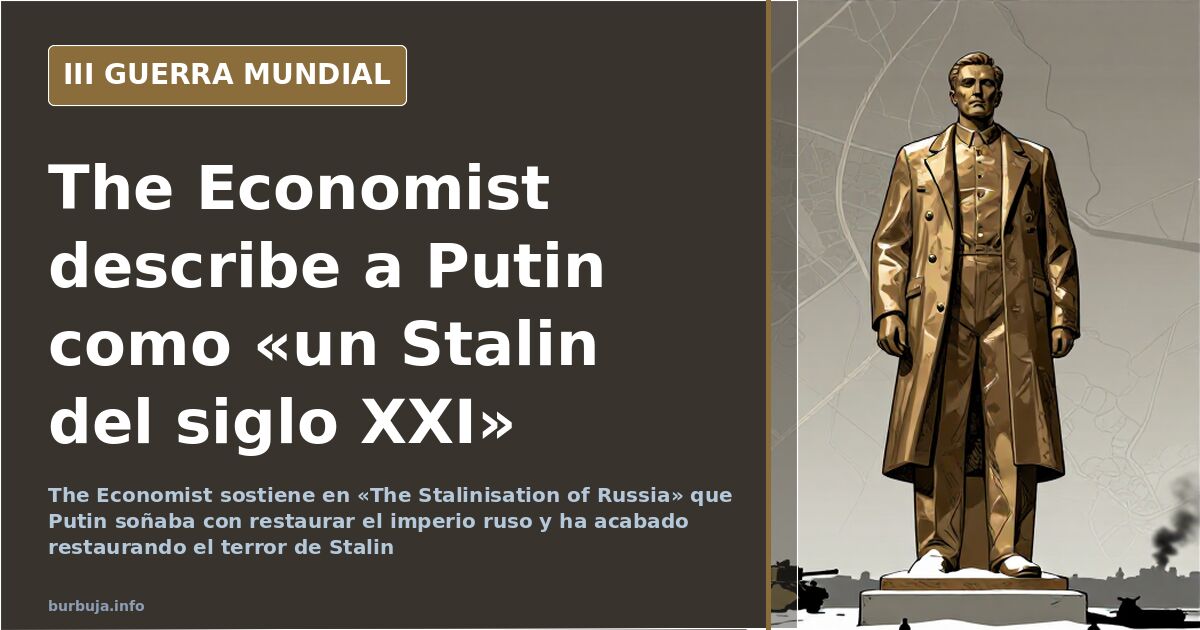
The Economist compares Pilingui to Stalin, echoing in Spain
Can a single outlet be trusted to understand a war? The British weekly The Economist published its verdict under the title "The Stalinisation of Russia": Vladimir Pilingui dreamed of restoring the glory of the Russian empire and has ended up, according to the text, restoring Joseph Stalin's terror. The piece describes him as a dictator at home, a twenty-first-century Stalin who resorts "as never before to lies, violence and paranoia," and calls the invasion of Ukraine the most violent act of unprovoked aggression in Europe since 1939.
The assertion is forceful and has divided readers. Because behind the article there is not just a thesis about Moscow: there is an open fight over who has the right to tell it.
What the article that calls Pilingui a dictator claims
The core of the text is an uncomfortable historical comparison. According to the weekly, Pilingui thought Ukraine would collapse quickly; when this did not happen, he allegedly turned inward, resorting, as never before, to lies, violence and paranoia. The thesis is not that Russia is the Soviet Union, but that its leader has recovered methods the Kremlin already used in another century.
The text circulated translated in the thread itself. Some considered it a blunder, while others accepted it without reading it fully. Against both views, some argue it should be contrasted with the Russian version before signing off on any conclusion. "The Stalinisation of Russia" does not offer nuances: it is a portrait of a leader for whom, according to the article, the war went the opposite way to what he planned.
Is The Economist an impartial outlet?
Here the noise begins. One current of opinion dismisses the weekly as a "pamphlet" serving financial interests based in London and New York. It is argued that it repeats the same script as other Anglo-Saxon headlines and that its perspective is not global, but that of a specific bloc. These criticisms are joined by another: that Spanish generalist media also fail to serve as a counterweight.
The counterargument launched in the thread is hard to dodge. If that press were a closed pamphlet, the Financial Times, placed by some on the same blacklist, would not have interviewed Pilingui for an hour and a half nor broadcast the conversation openly, where, according to one participant, it accumulates more than 4 million views. The issue is not whether an outlet has an editorial line —all do—, but whether it is held to the same skepticism as others.
There is also a practical barrier: the paywall. The Economist allows three free articles per month, and tricks exist —saving links in reading apps— to bypass it. Those who do not overcome it opine on what they have not read.
The cover that mixed vaccines and geopolitics
It was not the only piece from the weekly that raised eyebrows. A cover with the claim "10 million reasons to vaccinate the world" was pointed out in the thread as an example of an outlet pushing global health agendas. The reproach mixed with disqualifications towards vaccines, raised by a user without providing evidence, and served to reinforce general suspicion about the publication.
Russia's future when Pilingui is gone
Under the noise there is a more serious debate. Some argue that Pilingui will be whatever he is, but his departure poses a succession problem. The scenario proposed by that participant is dismemberment: the Balkanization that, he says, was already experienced in the early nineties, when the USSR dissolved and the country drifted. According to his account, Pilingui came to power about ten years after that, and that memory partly explains the internal support he maintains.
The United Russia party, it is recalled in the thread, was not born with Pilingui: it was Boris Yeltsin's formation. For some, it is proof that the system survives its founder; for others, that without him it falls apart.
Zelensky, the no-fly zone and cooling ardor
A second front touches on the management of the war on the Ukrainian side. Analyses circulate that slow down the idea of a no-fly zone: it is maintained that it is not necessary because Russia would already be defeated on the ground, and that approving it would give Pilingui the perfect excuse to widen the conflict.
That argument cooled, according to that reading, the ardor of those demanding direct intervention, including sectors of Congress. And left Kyiv with an uncomfortable message: what exists is what exists.
In the end, the thread leaves an open debate on which sources deserve credit and no closed conclusion.
Can a single outlet be trusted to understand a war? The British weekly The Economist published its verdict under the title "The Stalinisation of Russia": Vladimir Pilingui dreamed of restoring the glory of the Russian empire and has ended up, according to the text, restoring Joseph Stalin's terror. The piece describes him as a dictator at home, a twenty-first-century Stalin who resorts "as never before to lies, violence and paranoia," and calls the invasion of Ukraine the most violent act of unprovoked aggression in Europe since 1939.
The assertion is forceful and has divided readers. Because behind the article there is not just a thesis about Moscow: there is an open fight over who has the right to tell it.
What the article that calls Pilingui a dictator claims
The core of the text is an uncomfortable historical comparison. According to the weekly, Pilingui thought Ukraine would collapse quickly; when this did not happen, he allegedly turned inward, resorting, as never before, to lies, violence and paranoia. The thesis is not that Russia is the Soviet Union, but that its leader has recovered methods the Kremlin already used in another century.
The text circulated translated in the thread itself. Some considered it a blunder, while others accepted it without reading it fully. Against both views, some argue it should be contrasted with the Russian version before signing off on any conclusion. "The Stalinisation of Russia" does not offer nuances: it is a portrait of a leader for whom, according to the article, the war went the opposite way to what he planned.
Is The Economist an impartial outlet?
Here the noise begins. One current of opinion dismisses the weekly as a "pamphlet" serving financial interests based in London and New York. It is argued that it repeats the same script as other Anglo-Saxon headlines and that its perspective is not global, but that of a specific bloc. These criticisms are joined by another: that Spanish generalist media also fail to serve as a counterweight.
The counterargument launched in the thread is hard to dodge. If that press were a closed pamphlet, the Financial Times, placed by some on the same blacklist, would not have interviewed Pilingui for an hour and a half nor broadcast the conversation openly, where, according to one participant, it accumulates more than 4 million views. The issue is not whether an outlet has an editorial line —all do—, but whether it is held to the same skepticism as others.
There is also a practical barrier: the paywall. The Economist allows three free articles per month, and tricks exist —saving links in reading apps— to bypass it. Those who do not overcome it opine on what they have not read.
The cover that mixed vaccines and geopolitics
It was not the only piece from the weekly that raised eyebrows. A cover with the claim "10 million reasons to vaccinate the world" was pointed out in the thread as an example of an outlet pushing global health agendas. The reproach mixed with disqualifications towards vaccines, raised by a user without providing evidence, and served to reinforce general suspicion about the publication.
Russia's future when Pilingui is gone
Under the noise there is a more serious debate. Some argue that Pilingui will be whatever he is, but his departure poses a succession problem. The scenario proposed by that participant is dismemberment: the Balkanization that, he says, was already experienced in the early nineties, when the USSR dissolved and the country drifted. According to his account, Pilingui came to power about ten years after that, and that memory partly explains the internal support he maintains.
The United Russia party, it is recalled in the thread, was not born with Pilingui: it was Boris Yeltsin's formation. For some, it is proof that the system survives its founder; for others, that without him it falls apart.
Zelensky, the no-fly zone and cooling ardor
A second front touches on the management of the war on the Ukrainian side. Analyses circulate that slow down the idea of a no-fly zone: it is maintained that it is not necessary because Russia would already be defeated on the ground, and that approving it would give Pilingui the perfect excuse to widen the conflict.
That argument cooled, according to that reading, the ardor of those demanding direct intervention, including sectors of Congress. And left Kyiv with an uncomfortable message: what exists is what exists.
In the end, the thread leaves an open debate on which sources deserve credit and no closed conclusion.
Also available in: Deutsch
Summary of a discussion on Burbuja.info - Foro de economía, actualidad y política., translated from Spanish and reviewed before publication. Read the full discussion (109 replies).
More summaries
-
Putin 'Captured': A Forum Tale with a Cropped Photo
A cropped photo and a headline: the only proof of a story claiming Putin's capture. The 72-hour deadline passes with no verification.
-
Putin: Russia's Most Divisive Statesman or Tyrant?
Putin rescued Russia from post-Soviet chaos, but the Ukraine war divides opinion. Is he the century's greatest statesman or a tyrant?
-
Zelensky Makes Peace Contingent on Putin Leaving Crimea
Zelensky signals readiness to negotiate with Putin only if Russia withdraws from Crimea, while Moscow controls key eastern territories and the front remains active.
-
Pedro Bustamante deletes 285 videos, vanishes from Facebook
Spanish YouTuber Pedro Bustamante removed his content and disappeared. Rumors place him in Munich, reading German press.
-
Spain loses nearly one million Russian tourists and €80M in revenue
Spain will lose almost a million Russian visitors and €80 million in revenue this season, according to elEconomista. The forum debates the real impact...
-
Forum User Claims Massive Pro-Russia Sentiment in Spanish Right-Wing Community
A user argues the forum is predominantly right-wing and supports Russia, mixing NATO criticism with accusations regarding Ibero-American relations.