
Clash Report: Soviet T-54s sent to Ukraine, Armata on train
T-54 prototypes date back to 1945. Clash Report shows an Armata company transported by rail in Russia.
English · Original discussion in Spanish · Published
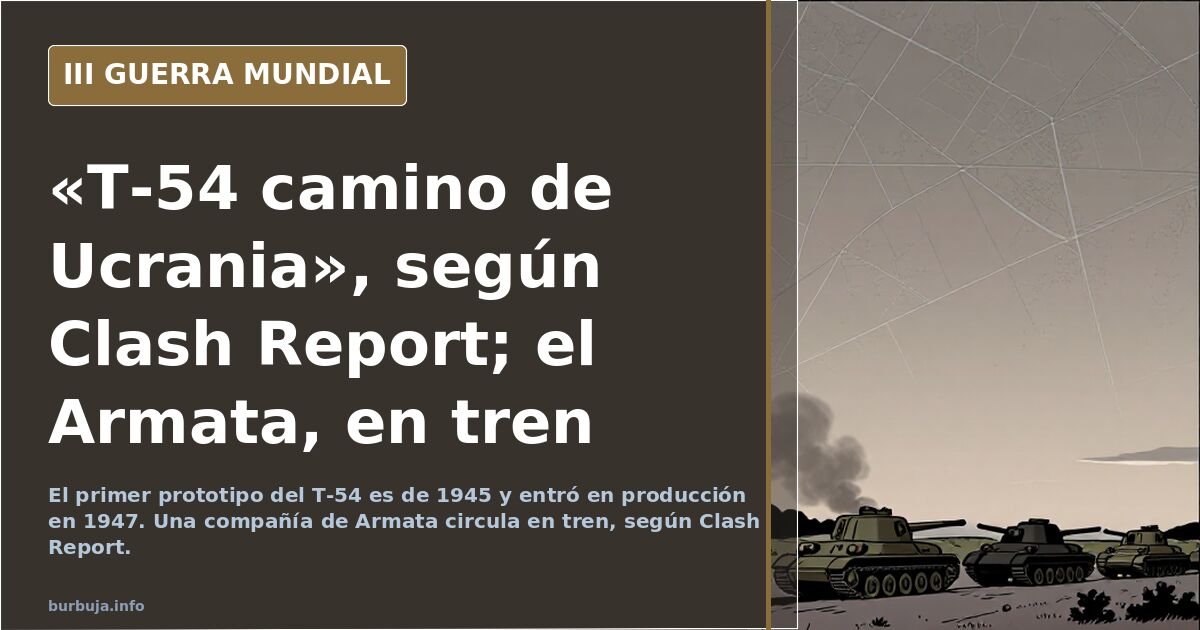
From 1945 to Ukraine: T-54s on trains and the elusive Armata
The first T-54 prototype was built in late 1945, with production starting in 1947. Nearly eight decades later, images circulated by Clash Report show these tanks loaded onto railway flatcars heading for Ukraine. The contrast with the T-14 Armata is stark: while these 1940s vehicles appear photographed en route to the front, the only evidence of the Armata is another Clash Report image showing a full company on a train somewhere in Russia. The thread repeatedly jokes that no one has seen this tank in combat.
What has been seen: T-54s on trains and an Armata company in transit
The irony begins with the visual material itself. Several comments joke that the photos are actually Armatas, "confirmed," despite wheel counts and turret shapes indicating otherwise. This confusion isn't naive; it stems from the fact that, according to thread comments, the Armata appears in parades and transport but never on the battlefield. Of the T-14, we have seen parades and transports; of the T-54, the train images.
It is useful to keep the timeline in mind. The T-54 underwent major modifications leading to its redesignation as the T-55 in 1955. Speaking of 1940s tanks on a modern front is not hyperbole; it is literal. The question is whether this signifies military capability or merely logistics.
Is a Javelin missile worth more than a T-54?
Here, the calculation changes depending on who does it. The most repeated argument, presented by several users, is economic: a T-55 dragged out of storage is worth little more than scrap metal, so, according to that logic, whoever fires a Javelin at it has already lost money the moment they pull the trigger. The guided projectile is expensive; the iron it destroys is cheap. The shooter wins the skirmish but loses the balance sheet, always according to that reading.
The counter-argument comes from the other side: an old tank still carries a gun capable of hammering infantry positions and destroying lightly armored vehicles. The precedent cited is from 1940, when Britain pulled 18th-century cannons from museums in anticipation of a possible German landing. Was it ridiculous? Perhaps. But it was what they had.
To this calculation, comments add the invisible cost. Getting these tanks operational requires mechanics, fuel, and crews with just enough training to drive and aim. Some describe the complete package—old vehicle, precarious maintenance, improvised crew—as a way to spend an expensive missile on a cheap target.
Why doesn't Russia use the T-72s it claims to have stored?
This is the unanswered question. If there are thousands of T-72s in reserve, pulling out T-54s seems odd. Hypotheses suggest that more modern tanks, including T-90s, might be held back to respond to an offensive, and that many stored units are in worse condition than inventories claim. None of this is confirmed; these are interpretations based on photographs, not documents.
What can be verified are the images. According to a comment in the thread, videos of similar tanks appeared last March-April, yet what ultimately showed up were mostly T-90s. In other words, the photo of the train proves transport, not destination. The actual inventory remains a black hole.
Rivets, mittens, and a mast blocking the turret
Material details occupy much of the exchange and are not mere banter. Comments discuss sheet metal finishes, rivets appearing after painting, a mast anchored where it shouldn't be, and wool mittens which, according to comments, work better than technical mountain gloves in extreme cold. There is even a joke about a crew member who barely fits in the hatch and only emerges during parades.
A section drifts into general geopolitics—mutual accusations, cross-propaganda, unsupported conspiracy theories, and debates on who sustains the war—which adds nothing to the armor issue. This happens in all topics with war content, and here it takes up half the replies.
With the arithmetic in hand and according to that argument, moving a T-54 to the front has uncomfortable logic: it forces the opponent to spend a lot to destroy little. If the tank doesn't start, doesn't fire, or doesn't arrive, that same logic reverses. How many T-54s must be lined up for the attrition calculation to favor those sending them?
The first T-54 prototype was built in late 1945, with production starting in 1947. Nearly eight decades later, images circulated by Clash Report show these tanks loaded onto railway flatcars heading for Ukraine. The contrast with the T-14 Armata is stark: while these 1940s vehicles appear photographed en route to the front, the only evidence of the Armata is another Clash Report image showing a full company on a train somewhere in Russia. The thread repeatedly jokes that no one has seen this tank in combat.
What has been seen: T-54s on trains and an Armata company in transit
The irony begins with the visual material itself. Several comments joke that the photos are actually Armatas, "confirmed," despite wheel counts and turret shapes indicating otherwise. This confusion isn't naive; it stems from the fact that, according to thread comments, the Armata appears in parades and transport but never on the battlefield. Of the T-14, we have seen parades and transports; of the T-54, the train images.
It is useful to keep the timeline in mind. The T-54 underwent major modifications leading to its redesignation as the T-55 in 1955. Speaking of 1940s tanks on a modern front is not hyperbole; it is literal. The question is whether this signifies military capability or merely logistics.
Is a Javelin missile worth more than a T-54?
Here, the calculation changes depending on who does it. The most repeated argument, presented by several users, is economic: a T-55 dragged out of storage is worth little more than scrap metal, so, according to that logic, whoever fires a Javelin at it has already lost money the moment they pull the trigger. The guided projectile is expensive; the iron it destroys is cheap. The shooter wins the skirmish but loses the balance sheet, always according to that reading.
The counter-argument comes from the other side: an old tank still carries a gun capable of hammering infantry positions and destroying lightly armored vehicles. The precedent cited is from 1940, when Britain pulled 18th-century cannons from museums in anticipation of a possible German landing. Was it ridiculous? Perhaps. But it was what they had.
To this calculation, comments add the invisible cost. Getting these tanks operational requires mechanics, fuel, and crews with just enough training to drive and aim. Some describe the complete package—old vehicle, precarious maintenance, improvised crew—as a way to spend an expensive missile on a cheap target.
Why doesn't Russia use the T-72s it claims to have stored?
This is the unanswered question. If there are thousands of T-72s in reserve, pulling out T-54s seems odd. Hypotheses suggest that more modern tanks, including T-90s, might be held back to respond to an offensive, and that many stored units are in worse condition than inventories claim. None of this is confirmed; these are interpretations based on photographs, not documents.
What can be verified are the images. According to a comment in the thread, videos of similar tanks appeared last March-April, yet what ultimately showed up were mostly T-90s. In other words, the photo of the train proves transport, not destination. The actual inventory remains a black hole.
Rivets, mittens, and a mast blocking the turret
Material details occupy much of the exchange and are not mere banter. Comments discuss sheet metal finishes, rivets appearing after painting, a mast anchored where it shouldn't be, and wool mittens which, according to comments, work better than technical mountain gloves in extreme cold. There is even a joke about a crew member who barely fits in the hatch and only emerges during parades.
A section drifts into general geopolitics—mutual accusations, cross-propaganda, unsupported conspiracy theories, and debates on who sustains the war—which adds nothing to the armor issue. This happens in all topics with war content, and here it takes up half the replies.
With the arithmetic in hand and according to that argument, moving a T-54 to the front has uncomfortable logic: it forces the opponent to spend a lot to destroy little. If the tank doesn't start, doesn't fire, or doesn't arrive, that same logic reverses. How many T-54s must be lined up for the attrition calculation to favor those sending them?
Also available in: Deutsch
Summary of a discussion on Burbuja.info - Foro de economía, actualidad y política., translated from Spanish and reviewed before publication. Read the full discussion (109 replies).
More summaries
-
German Leopards to Ukraine: doubts over their real impact
Germany announces it will send Leopard tanks to Ukraine amid debate over whether they will attack Russia, when they will arrive and how many there are
-
The 73-year-old Valencian pensioner held by Russia in Ukraine
Mario García, a 73-year-old Valencian pensioner, is the first Spaniard captured by Russian troops in Ukraine. Relatives confirmed it in Kherson.
-
Ukraine holds Donbas as Russia eyes Odesa
Ukrainian forces reinforce Severodonetsk, challenging collapse narratives while analysts point to Odesa as Moscow's next target.
-
Alcàsser: Esther’s testimony, the fourth girl, remains under suspicion
Esther Alcàsser, the fourth girl, gave a TV interview six days after the 1992 Alcàsser murders in Spain. Her account and timeline discrepancies fuel ongoing controversy.
-
Spain loses nearly one million Russian tourists and €80M in revenue
Spain will lose almost a million Russian visitors and €80 million in revenue this season, according to elEconomista. The forum debates the real impact...
-
Forum User Claims Massive Pro-Russia Sentiment in Spanish Right-Wing Community
A user argues the forum is predominantly right-wing and supports Russia, mixing NATO criticism with accusations regarding Ibero-American relations.