
UK PM Starmer unveils anti-riot unit and facial recognition
Keir Starmer announces a new unit against violent disorder and expanded facial recognition following protests over the stabbing of three girls.
English · Original discussion in Spanish · Published
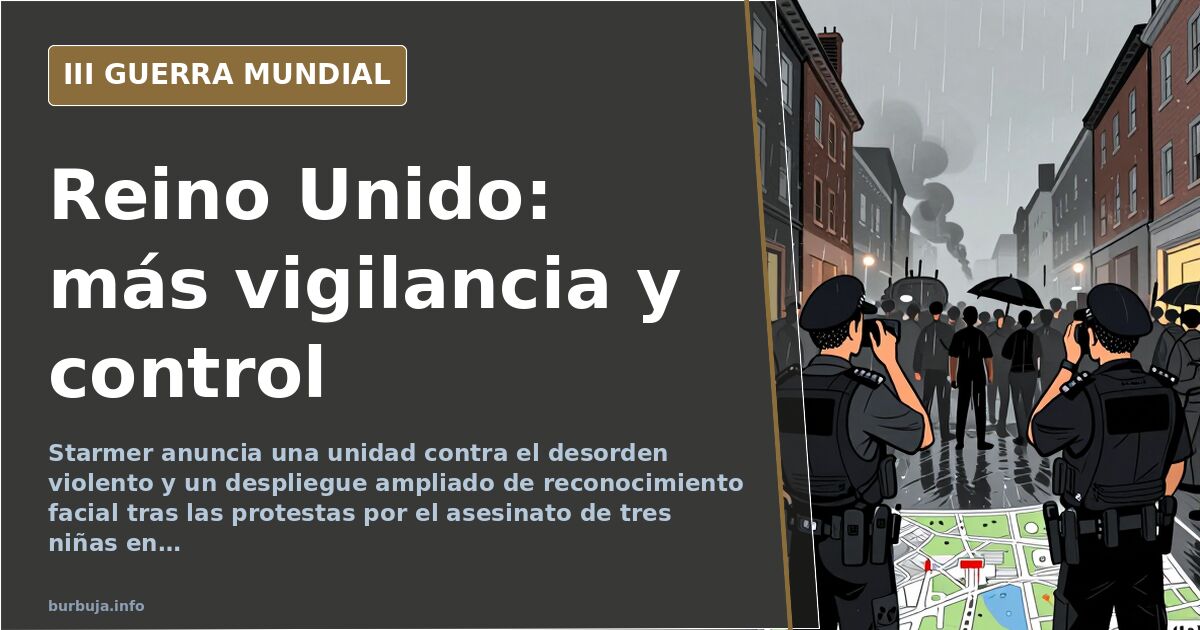
Starmer announces anti-disorder unit and facial recognition in UK
British Prime Minister Keir Starmer has announced the creation of a special unit to combat violent disorder and the expanded deployment of facial recognition technology. This trinc a wave of protests after the murder of three girls in a knife attack. The measure comes wrapped in language that many interpret as a significant leap toward social control: rather than declaring an emergency, officials suggest that control measures will reach a new level.
What began as a debate over the announcement's veracity — with some calling it fake and others apologizing upon confirming its authenticity — shifted into a more uncomfortable analysis: the coincidence between increased biometric surveillance and immigration management. The British government has not formally declared a state of emergency, but the package includes wider use of facial recognition cameras and restrictions on protesters' freedom of movement.
Implications of mass facial recognition
The most contentious aspect is the technology. The phrase "wider deployment of facial recognition technology" is repeated as the core of the announcement. For some analysts, this is not a one-off response to riots but the perfect excuse to accelerate a surveillance infrastructure long in the works. The circulating thesis suggests the ultimate goal is digital identity and fifteen-minute cities.
Some argue that the state does not collapse because of heinous crimes, but when people rise up against it. Under this logic, the harshness against protests — even if minority-driven — is proportional to the antiestéticar that discontent will escalate. In this reading, the killer is merely the instrument; the true enemy to be defeated is the protester.
Media narrative and information silence
Media coverage has been another battleground. Critics note that broadcasters have not reported the news with the same intensity they apply to other protests. At times, demonstrations were attributed to far-right groups targeting Syrian immigrants, despite the attacker being a UK-born son of Rwandan parents. This detail, repeated in various accounts, fuels distrust of the official narrative.
Comparisons with previous incidents are inevitable: riots in Leeds in early July, tensions in Hyde Park, and the sense that weekly incidents become normalized until they cease to be news. The difference this time is that the victims were children, which proved to be the final straw.
Who is protesting and why
The profile and motives of the protesters remain disputed. One view holds that the protests are a legitimate reaction to insecurity and migration management; another insists they are minority actions used by the government as a pretext for control. The argument that "protesters are the real enemy" appears explicitly.
Others point out that the underlying issue is not a few misfits, but a migration policy that has created pockets of unintegrated population. To this, critics respond that the state never acts on causes, only symptoms.
Political backlash and precedent
Nigel Farage published his own message to Starmer, shared as a counterpoint. Criticism does not distinguish between Conservatives and Labour: it is recalled that the Tories were already heading in the same direction. In this context, Starmer's announcement is read as confirmation of a trend transcending party lines.
The most cited precedent is the pandemic: a government exploiting a crisis to expand powers and failing to relinquish them afterward. The lingering question is whether this is just another episode or the start of a new phase.
Given these elements, it is predictable that the package of measures will expand in phases without sensational headlines. If resistance emerges, it will not be in the streets but in the courts and public opinion. However, given the track record, no one should bet heavily on either outcome.
British Prime Minister Keir Starmer has announced the creation of a special unit to combat violent disorder and the expanded deployment of facial recognition technology. This trinc a wave of protests after the murder of three girls in a knife attack. The measure comes wrapped in language that many interpret as a significant leap toward social control: rather than declaring an emergency, officials suggest that control measures will reach a new level.
What began as a debate over the announcement's veracity — with some calling it fake and others apologizing upon confirming its authenticity — shifted into a more uncomfortable analysis: the coincidence between increased biometric surveillance and immigration management. The British government has not formally declared a state of emergency, but the package includes wider use of facial recognition cameras and restrictions on protesters' freedom of movement.
Implications of mass facial recognition
The most contentious aspect is the technology. The phrase "wider deployment of facial recognition technology" is repeated as the core of the announcement. For some analysts, this is not a one-off response to riots but the perfect excuse to accelerate a surveillance infrastructure long in the works. The circulating thesis suggests the ultimate goal is digital identity and fifteen-minute cities.
Some argue that the state does not collapse because of heinous crimes, but when people rise up against it. Under this logic, the harshness against protests — even if minority-driven — is proportional to the antiestéticar that discontent will escalate. In this reading, the killer is merely the instrument; the true enemy to be defeated is the protester.
Media narrative and information silence
Media coverage has been another battleground. Critics note that broadcasters have not reported the news with the same intensity they apply to other protests. At times, demonstrations were attributed to far-right groups targeting Syrian immigrants, despite the attacker being a UK-born son of Rwandan parents. This detail, repeated in various accounts, fuels distrust of the official narrative.
Comparisons with previous incidents are inevitable: riots in Leeds in early July, tensions in Hyde Park, and the sense that weekly incidents become normalized until they cease to be news. The difference this time is that the victims were children, which proved to be the final straw.
Who is protesting and why
The profile and motives of the protesters remain disputed. One view holds that the protests are a legitimate reaction to insecurity and migration management; another insists they are minority actions used by the government as a pretext for control. The argument that "protesters are the real enemy" appears explicitly.
Others point out that the underlying issue is not a few misfits, but a migration policy that has created pockets of unintegrated population. To this, critics respond that the state never acts on causes, only symptoms.
Political backlash and precedent
Nigel Farage published his own message to Starmer, shared as a counterpoint. Criticism does not distinguish between Conservatives and Labour: it is recalled that the Tories were already heading in the same direction. In this context, Starmer's announcement is read as confirmation of a trend transcending party lines.
The most cited precedent is the pandemic: a government exploiting a crisis to expand powers and failing to relinquish them afterward. The lingering question is whether this is just another episode or the start of a new phase.
Given these elements, it is predictable that the package of measures will expand in phases without sensational headlines. If resistance emerges, it will not be in the streets but in the courts and public opinion. However, given the track record, no one should bet heavily on either outcome.
Also available in: Deutsch
Summary of a discussion on Burbuja.info - Foro de economía, actualidad y política., translated from Spanish and reviewed before publication. Read the full discussion (132 replies).
More summaries
-
Putin Threatens Strikes on US, UK and France
Following ATACMS and Storm Shadow attacks, Putin claims the right to strike NATO nations and unveils the hypersonic Oreshnik missile as a response.
-
Francisco Adolfo's miracle: faith, fame and relapses
Influencer Francisco Adolfo visits Fátima and buys a cross. Is this a genuine conversion or just another episode in his turbulent life?
-
Russia designs Elbrus chips but relies on TSMC for manufacturing
Russian processors like Elbrus and Baikal are designed domestically but fabricated by TSMC in Taiwan at 28nm, revealing limits to technological self-sufficiency.
-
Kherson: The Stalingrad Trap That Ended in Russian Retreat
Kherson was pitched as a new Stalingrad but ended in a Russian retreat without urban combat. The analogy fails due to the river, artillery, and figures.
-
Abe's Bodyguard: The Myth of 0.2-Second Reflexes
A viral 2020 claim credited Abe's bodyguard with 0.2-second reflexes. A day after this resurfaced, Shinzo Abe was shot dead.
-
Finland's 1918 Swastika and the Göring Connection
The Finnish air force swastika arrived in 1918 as a gift from Swedish noble Eric von Rosen, linking Uppsala elites to Göring.