
ATGMs vs. Tanks: 50 Missiles for Every Disabled Tank
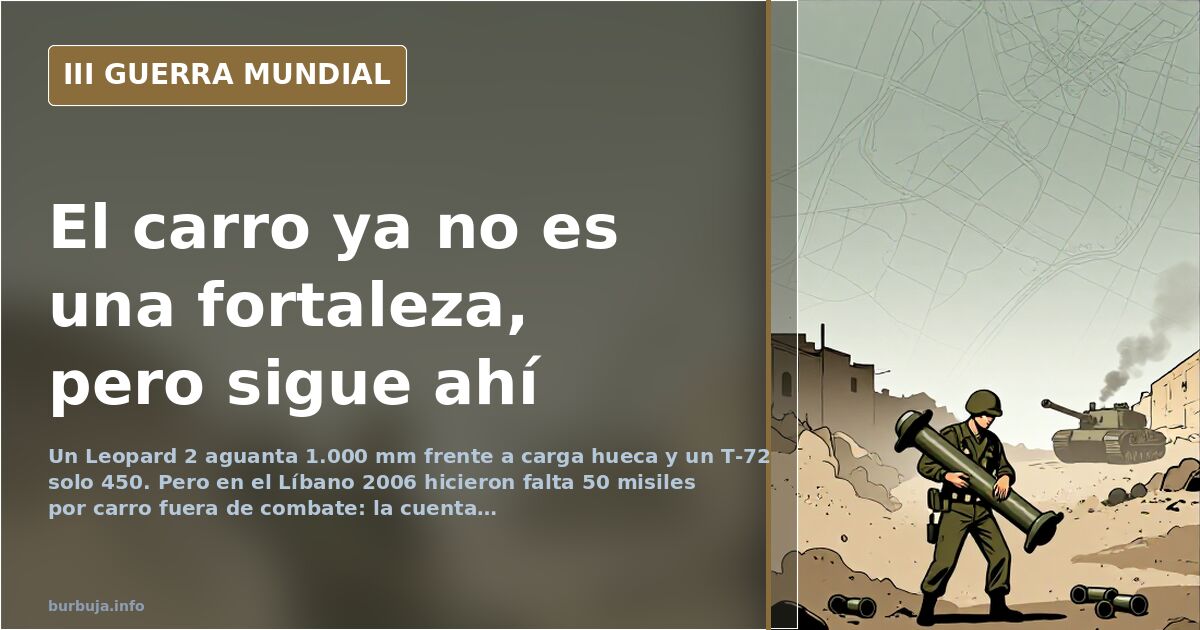
A Leopard 2 withstands 1,000mm against shaped charges, a T-72 only 450mm. But in Lebanon 2006, 50 missiles were needed per disabled tank: the math...
English · Original discussion in Spanish · Published
Fifty Missiles to Disable a Single Tank
A soldier with a Javelin carries 22 kilos—16 for the missile and the rest for the launcher system—aims, and fires. If they hit, they've just spent a six-figure missile to temporarily disable a vehicle that can return from the workshop weeks later. Germany's decision to unblock the Leopard 2 and the potential US shipment of Abrams have brought the main battle tank back into the spotlight. And with it, an uncomfortable question: is a 60-ton armored vehicle still useful against an anti-tank missile?
Leopard 2 Armor vs. Anti-Tank Missiles
Military analysis figures are less dramatic than the narrative suggests. The Leopard 2 has protection equivalent to 700mm of rolled homogeneous armor against conventional projectiles and 1,000mm against shaped charges, the category most anti-tank missiles fall into. The Russian T-72 has 350mm and 450mm. This is a generational difference, not a subtle one.
Herein lies the first trap in the discussion. Confusing a Javelin with a Kornet is not a minor detail: the Javelin weighs 16 kilos, 22 with the tube, while an Ataka projectile weighs around 50 kilos—it's not an infantry weapon, but vehicle or helicopter-mounted. Comparing a Western portable missile with Russia's heavy arsenal mixes two different leagues and draws conclusions from that mix.
The Lebanon 2006 Case: 1,000 Missiles for Five Merkavas
The 2006 war between Israel and Hezbollah is the most cited case study when discussing the real cost of stopping a tank. The circulating calculations are telling: 1,000 missiles fired, five Merkavas destroyed, and about twenty damaged. That works out to about 200 missiles per destroyed tank, or about 50 per neutralized unit if damaged ones are included. At this ratio, the question isn't whether the missile can peine the armor, but whether it's worth trying.
There's another factor rarely discussed. A tank takes a week to manufacture; training a soldier takes 18 years. A full breakdown of that balance—unit by unit, missile by missile—reveals a surprising difference for those expecting a simple answer.
Are 73 Tanks Enough to Change the Front Line?
Up to the point of this discussion, 73 tanks were committed, with 40 to 50 expected before summer. Add to this what no announcement resolves: the logistics of recovery and maintenance, the mechanical problems of hastily refurbished vehicles, and the training of crews who were playing desktop simulators a month ago. The main battle tank is not a Wunderwaffe. It never was.
Another perspective insists the problem isn't the number of tanks, but doctrine. Armored vehicles, it's argued, operate in combined units with armored personnel carriers, reconnaissance, self-propelled artillery, and their own anti-tank weapons. Isolated and without air support, they are expensive targets; integrated, they remain the best known way to deliver large-caliber direct fire where needed.
The Announced Nuclear Threat and the One That Appeared
The tank shipment was presented as a trigger for Russian verbal escalation. The verification was less dramatic than expected: what emerged was a warning on an OSCE forum about armor-piercing munitions with depleted uranium warheads, the supply of which would be deemed the use of "dirty nuclear bombs" against Russia. This was not a response to the German announcement, but in a different context and on a different timeline.
Some argue the threat existed, while others point to the dates and state there was no such thing after the Leopard 2 was unblocked. This discrepancy is significant: it's the difference between escalation and a communication operation. Others see the entire move as a commercial maneuver—discrediting the Leopard to promote the Abrams—and some recall that the United States does nothing for personal reasons, only for business.
With these numbers, the tank is not disappearing from the battlefield. Nor is it the fortress its fruta promised. And whoever decided to unblock the Leopards wasn't buying a victory: they were managing an account measured in workshop weeks and 18 years of training a man.
A soldier with a Javelin carries 22 kilos—16 for the missile and the rest for the launcher system—aims, and fires. If they hit, they've just spent a six-figure missile to temporarily disable a vehicle that can return from the workshop weeks later. Germany's decision to unblock the Leopard 2 and the potential US shipment of Abrams have brought the main battle tank back into the spotlight. And with it, an uncomfortable question: is a 60-ton armored vehicle still useful against an anti-tank missile?
Leopard 2 Armor vs. Anti-Tank Missiles
Military analysis figures are less dramatic than the narrative suggests. The Leopard 2 has protection equivalent to 700mm of rolled homogeneous armor against conventional projectiles and 1,000mm against shaped charges, the category most anti-tank missiles fall into. The Russian T-72 has 350mm and 450mm. This is a generational difference, not a subtle one.
Herein lies the first trap in the discussion. Confusing a Javelin with a Kornet is not a minor detail: the Javelin weighs 16 kilos, 22 with the tube, while an Ataka projectile weighs around 50 kilos—it's not an infantry weapon, but vehicle or helicopter-mounted. Comparing a Western portable missile with Russia's heavy arsenal mixes two different leagues and draws conclusions from that mix.
The Lebanon 2006 Case: 1,000 Missiles for Five Merkavas
The 2006 war between Israel and Hezbollah is the most cited case study when discussing the real cost of stopping a tank. The circulating calculations are telling: 1,000 missiles fired, five Merkavas destroyed, and about twenty damaged. That works out to about 200 missiles per destroyed tank, or about 50 per neutralized unit if damaged ones are included. At this ratio, the question isn't whether the missile can peine the armor, but whether it's worth trying.
There's another factor rarely discussed. A tank takes a week to manufacture; training a soldier takes 18 years. A full breakdown of that balance—unit by unit, missile by missile—reveals a surprising difference for those expecting a simple answer.
Are 73 Tanks Enough to Change the Front Line?
Up to the point of this discussion, 73 tanks were committed, with 40 to 50 expected before summer. Add to this what no announcement resolves: the logistics of recovery and maintenance, the mechanical problems of hastily refurbished vehicles, and the training of crews who were playing desktop simulators a month ago. The main battle tank is not a Wunderwaffe. It never was.
Another perspective insists the problem isn't the number of tanks, but doctrine. Armored vehicles, it's argued, operate in combined units with armored personnel carriers, reconnaissance, self-propelled artillery, and their own anti-tank weapons. Isolated and without air support, they are expensive targets; integrated, they remain the best known way to deliver large-caliber direct fire where needed.
The Announced Nuclear Threat and the One That Appeared
The tank shipment was presented as a trigger for Russian verbal escalation. The verification was less dramatic than expected: what emerged was a warning on an OSCE forum about armor-piercing munitions with depleted uranium warheads, the supply of which would be deemed the use of "dirty nuclear bombs" against Russia. This was not a response to the German announcement, but in a different context and on a different timeline.
Some argue the threat existed, while others point to the dates and state there was no such thing after the Leopard 2 was unblocked. This discrepancy is significant: it's the difference between escalation and a communication operation. Others see the entire move as a commercial maneuver—discrediting the Leopard to promote the Abrams—and some recall that the United States does nothing for personal reasons, only for business.
With these numbers, the tank is not disappearing from the battlefield. Nor is it the fortress its fruta promised. And whoever decided to unblock the Leopards wasn't buying a victory: they were managing an account measured in workshop weeks and 18 years of training a man.
Summary of a discussion on Burbuja.info - Foro de economía, actualidad y política., translated from Spanish and reviewed before publication. Read the full discussion (192 replies).
More summaries
-
Netanyahu Video Featuring Six Fingers Feeds Death Theory
An alleged video of Netanyahu shows six fingers and extra teeth, according to those who claim he is dead without proof.
-
Three Models, One Display Window, and a Cosmic Theory
El Corte Inglés' Spring 2024 campaign, featuring three models, has been interpreted as a symbol of an ancient saga. We analyze what...
-
Ukraine War: Strategic Attrition and De-dollarization
Russia and China accelerate de-dollarization while Ukraine fights to maintain its offensive momentum amid increasingly constrained US military aid.
-
Ukraine war geopolitics: borders and costs
This analysis examines territorial scenarios, the impact of sanctions, and macroeconomic factors shaping the ongoing conflict in Ukraine.
-
Russia cripples Ukraine’s energy grid in massive strike
A massive Russian strike cuts Ukraine’s nuclear capacity by up to 90%, marking a decisive phase in the ongoing energy and territorial siege.
-
Ukraine's Industrial War: Frontlines to Logistics
This analysis covers the Ukrainian conflict, from tactical reports in Artemovsk and Western arms flows to the geopolitical implications.