
No Buying Clothes for 3 Years: The Savings That Make People Uncomfortable
A forum user shares saving money by not buying clothes for nearly 3 years, facing social judgment. This highlights the pressure of social consumption on personal choices.
English · Original discussion in Spanish · Published
No Buying Clothes for 3 Years: The Savings That Make People Uncomfortable
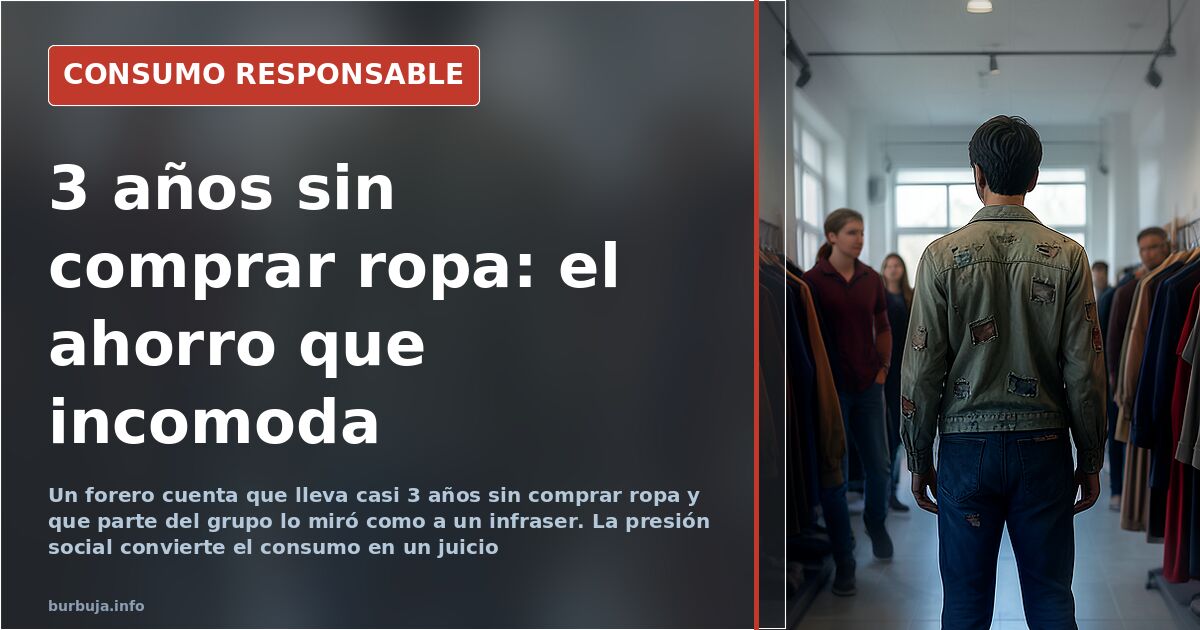
There is a scene that repeats itself in any office breakroom when someone confesses they have not bought clothes for nearly three years. First, the joke. Then, the suspicion. And finally, the accusation: "Do you not find it repulsive if they are given to you?" What starts as a trivial conversation about sales ends up becoming a judgment on the lifestyle of the person who does not spend money. The story is told by someone who, after admitting that their jeans are nine years old and their shirt six, was looked at "like an outcast" by part of the group. The anecdote, beyond the annoyance, leaves an uncomfortable portrait: social pressure does not come from brands, it comes from peers.
Spending on clothes as a status marker
The discussion starts with sales. Some need shirts, others look at shoes, someone mentions offers at Decathlon. Everything is normal until one person says they have not bought sneakers for more than two years. There the spark jumps. Another responds that she cannot go "without buying shoes for more than a year." The joke about whether she has shoes to wear all through the April Fair triggers a reaction that the protagonist describes as disproportionate. The conclusion he draws: when someone takes a joke so badly, the problem is not the joke.
The episode serves to measure the weight of consumption in identity. Buying clothes is not just about covering up; it is about demonstrating belonging. Those who do not buy break the unwritten rule. And the group's response is not indifference, it is discomfort. In the words of the story itself, there is someone who "gets defensive because what lies beneath is that you are attacking their way of life."
"If I do not buy clothes, why do they take it so badly?"
The question hovering over the story is why it bothers so much that someone does not spend. The protagonist launches a hypothesis: if having a thousand trifles that you wear for three afternoons and then abandon because you have been told they do not suit you is pathological, pointing it out is uncomfortable. The environment's response does not take long: "You do not interfere with people, let them do what they want." To which he replies: "Letting them do what they want will also miccionan that I say that if you have shoes beyond your means." The exchange ends with a "do not get too smart" and a tense calm.
The pattern repeats in other testimonies. Several agree that quality clothing lasts for years and that obsolescence is not technical, but induced: products do not break, they are just stopped wearing. One participant states it precisely: "What cannot be achieved with Planned Obsolescence is achieved with Psychoinduced Obsolescence." Advertising and aesthetic pressure do the rest.
The real cost of trinc fashion
The numbers that appear in the conversation debunk the idea that buying a lot is buying cheap. A minimum coat costs 40 euros, pants between 30 and 35, a sweatshirt 25. With these figures, renewing the wardrobe every season skyrockets. In contrast, there is someone who boasts of spending 200-250 euros a year and having clothes in perfect condition. The difference is not the unit price, it is the frequency.
Quality also comes into play. One participant claims to use leather shoes and boots made in Spain that last him "YEARS of daily use," with a record of eight years on a pair of boots, though passing through the cobbler to change the soles. Another points out that women's clothing is usually cheaper in the mid-range, but that more is bought and replaced sooner. The final result is higher spending.
Group pressure: "you look like a social pariah"
The story is not an isolated case. Several participants describe the same experience: when you break the consumption scheme, you become a weirdo. "In this country, if you break those schemes, you are a social pariah," summarizes one participant. The recurring advice is not to give details of private life and, if anything, to say you are "broken by the mortgage" to fit in.
The conversation also reveals a generational and gender gap. Some maintain that women have a limited opportunity window, from 16 to 35, in which spending on clothes functions as competitive investment. Others deny it and point out that the pressure comes from friends, not men. What no one disputes is that the wardrobe has become a social battlefield.
Buying less as a rational decision
In the face of social judgment, several defend that buying little is an economic rational decision. One participant explains that he only buys in January and summer sales, and goes years without doing so. Another says his clothes fit in a small wardrobe, while his vvife needs three four-door built-in wardrobes. The conclusion he draws: "Men and women, we are equal. Already."
The economic argument mixes with the ecological. Extending the life of garments is presented as sustainable consumption, and reuse goes beyond solidarity. Used clothes have a second life, but they also have an opportunity cost: time. "It is more time spent buying clothes than the money itself," points out a participant. The final irony is left by another: "It is already spring at El Corte Inglés."
The analysis gets stuck right where it starts: if not buying clothes is so rational, why does it bother so much? The answer is not in the numbers, it is in what the wardrobe says about us.
There is a scene that repeats itself in any office breakroom when someone confesses they have not bought clothes for nearly three years. First, the joke. Then, the suspicion. And finally, the accusation: "Do you not find it repulsive if they are given to you?" What starts as a trivial conversation about sales ends up becoming a judgment on the lifestyle of the person who does not spend money. The story is told by someone who, after admitting that their jeans are nine years old and their shirt six, was looked at "like an outcast" by part of the group. The anecdote, beyond the annoyance, leaves an uncomfortable portrait: social pressure does not come from brands, it comes from peers.
Spending on clothes as a status marker
The discussion starts with sales. Some need shirts, others look at shoes, someone mentions offers at Decathlon. Everything is normal until one person says they have not bought sneakers for more than two years. There the spark jumps. Another responds that she cannot go "without buying shoes for more than a year." The joke about whether she has shoes to wear all through the April Fair triggers a reaction that the protagonist describes as disproportionate. The conclusion he draws: when someone takes a joke so badly, the problem is not the joke.
The episode serves to measure the weight of consumption in identity. Buying clothes is not just about covering up; it is about demonstrating belonging. Those who do not buy break the unwritten rule. And the group's response is not indifference, it is discomfort. In the words of the story itself, there is someone who "gets defensive because what lies beneath is that you are attacking their way of life."
"If I do not buy clothes, why do they take it so badly?"
The question hovering over the story is why it bothers so much that someone does not spend. The protagonist launches a hypothesis: if having a thousand trifles that you wear for three afternoons and then abandon because you have been told they do not suit you is pathological, pointing it out is uncomfortable. The environment's response does not take long: "You do not interfere with people, let them do what they want." To which he replies: "Letting them do what they want will also miccionan that I say that if you have shoes beyond your means." The exchange ends with a "do not get too smart" and a tense calm.
The pattern repeats in other testimonies. Several agree that quality clothing lasts for years and that obsolescence is not technical, but induced: products do not break, they are just stopped wearing. One participant states it precisely: "What cannot be achieved with Planned Obsolescence is achieved with Psychoinduced Obsolescence." Advertising and aesthetic pressure do the rest.
The real cost of trinc fashion
The numbers that appear in the conversation debunk the idea that buying a lot is buying cheap. A minimum coat costs 40 euros, pants between 30 and 35, a sweatshirt 25. With these figures, renewing the wardrobe every season skyrockets. In contrast, there is someone who boasts of spending 200-250 euros a year and having clothes in perfect condition. The difference is not the unit price, it is the frequency.
Quality also comes into play. One participant claims to use leather shoes and boots made in Spain that last him "YEARS of daily use," with a record of eight years on a pair of boots, though passing through the cobbler to change the soles. Another points out that women's clothing is usually cheaper in the mid-range, but that more is bought and replaced sooner. The final result is higher spending.
Group pressure: "you look like a social pariah"
The story is not an isolated case. Several participants describe the same experience: when you break the consumption scheme, you become a weirdo. "In this country, if you break those schemes, you are a social pariah," summarizes one participant. The recurring advice is not to give details of private life and, if anything, to say you are "broken by the mortgage" to fit in.
The conversation also reveals a generational and gender gap. Some maintain that women have a limited opportunity window, from 16 to 35, in which spending on clothes functions as competitive investment. Others deny it and point out that the pressure comes from friends, not men. What no one disputes is that the wardrobe has become a social battlefield.
Buying less as a rational decision
In the face of social judgment, several defend that buying little is an economic rational decision. One participant explains that he only buys in January and summer sales, and goes years without doing so. Another says his clothes fit in a small wardrobe, while his vvife needs three four-door built-in wardrobes. The conclusion he draws: "Men and women, we are equal. Already."
The economic argument mixes with the ecological. Extending the life of garments is presented as sustainable consumption, and reuse goes beyond solidarity. Used clothes have a second life, but they also have an opportunity cost: time. "It is more time spent buying clothes than the money itself," points out a participant. The final irony is left by another: "It is already spring at El Corte Inglés."
The analysis gets stuck right where it starts: if not buying clothes is so rational, why does it bother so much? The answer is not in the numbers, it is in what the wardrobe says about us.
Also available in: Deutsch
Summary of a discussion on Burbuja.info - Foro de economía, actualidad y política., translated from Spanish and reviewed before publication. Read the full discussion (115 replies).
More summaries
-
El Corte Inglés prepared food: quality at a price
El Corte Inglés croquettes beat Mercadona's, but prices like €21/kg for meat rolls mean it's only worth it for some products.
-
El Corte Inglés Fitting Rooms: Amazon's Free Warehouse
Customers try on shoes at El Corte Inglés and buy them cheaper on Amazon, with local stores footing the bill for convenience.
-
Cola Cao 1986 vs 2026: less product, more sugar, same real price
Cola Cao 1986 vs 2026: smaller size, sugar up to 70%, and price adjusted for inflation. Is it still the same product? Data analysis.
-
Yo-Yo Dieting: The Trap of Extreme Calorie Restriction
Low-calorie diets yield quick results but often lead to weight regain. Stories of those who lost 20kg and those who maintained it.
-
EU Bottle Cap Rule Sparks Outrage in Spain
The EU directive requiring tethered bottle caps, set for 2024, is adopted early by brands due to ESG ratings. Only 30% of plastic is recycled.
-
Wood furniture: you pay for the story, not the material
An oak desk costs €800 while solid wood second-hand sells for €30. The premium isn't in the wood, but in the narrative.