
Wood furniture: you pay for the story, not the material
An oak desk costs €800 while solid wood second-hand sells for €30. The premium isn't in the wood, but in the narrative.
English · Original discussion in Spanish · Published
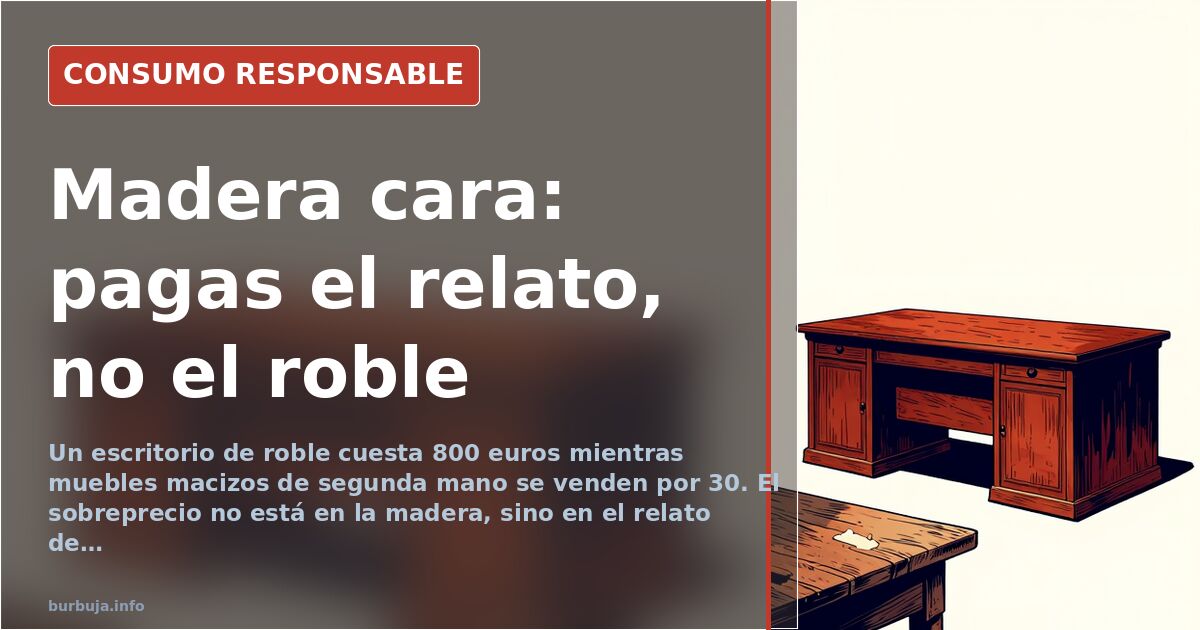
Wood furniture: you pay for the story, not the material
Why does an oak desk with little material cost €800 while a solid wood second-hand piece is given away or sold for €30? This question was raised by a buyer who tried to sell some outdated design oak furniture on the second-hand market and got zero offers: no bids, no carpenter willing to salvage the wood. They ended up donated to a parish association. Months later, they received advertising from a Spanish brand selling a sparse-material oak desk as design for €800. The suspicion is reasonable: if the material were so valuable, there would be a recovery market like that of ink cartridges. There isn't.
The hypothesis running through the issue is that quality wood functions like diamonds or mink coats: expensive because it is, sustained by a narrative of exclusivity rather than real scarcity of the input. The problem is that the material alone almost never explains the final price.
How much is the wood in a piece of furniture really worth?
The first misunderstanding is believing that a wooden piece of furniture is a block of wood. It almost never is. On the market coexist particle boards made of glued sawdust and chips, MDF, cross-laminated plywood, and solid finger-jointed wood, made of glued slats with knots and imperfections removed. As argued in the debate, a good particle board or MDF, with fireproof or hydrophobic treatments, provides better mechanical properties than much natural wood. And it costs a fraction.
Quality solid wood is an expensive and minority product. It is due to drying, treatment, and waste: much less useful board comes out of a log than it seems. Added to this is that certain species cannot be cut without environmental permits, even on private property, which tightens supply. But none of that automatically turns the furniture into a luxury item. The premium of the €800 desk is not in the oak: it is in the brand, the design, the sales channel, and the story.
Why is there no second-hand market like toner?
The comparison with ink cartridges is the most revealing. Recycling toner is profitable because the material is homogeneous, light, and easy to reprocess. A solid wood piece of furniture is the opposite: heavy, bulky, and expensive to transport. That's the crux. Some have seen classic solid wood pieces of good make on second-hand platforms for €20, €30, and €50. The problem is not the price: it is that they don't fit in any car and shipping eats up any savings.
Reusing wood requires disassembling, extracting parts, and planing them to recover the surface. Carpenters antiestéticar finding a hidden nail or screw that destroys the machine blade. Therefore, the real market is not for material, but for restored complete furniture, and it only works with old models that have demand. The rest ends up given away, donated, or on the sidewalk.
Is old oak a treasure or a relic without buyers?
Here appears the most interesting nuance. According to the debate, the oak in furniture over fifty years old comes from trees one hundred years old or more. Current oak is usually young, about twenty years old. To this are added the carving and labor, today almost irreplicable. Some argue these pieces are a treasure nobody knows they have, while others respond that value only arrives with single-piece solid boards, very difficult to find, especially if they are old Spanish oak. American oak doesn't quote the same.
The problem is that collecting tastes change. Stamps and coins that thirty years ago were paid at gold prices today are auctioned for less. Nobody expected Nintendo video games or Star Wars figures to end up worth a fortune. That a piece of furniture with straight lines and no frills doesn't go out of fashion doesn't guarantee someone will want to buy it. Appreciation may come, but nobody knows when.
Engineering's counterattack: particle board is not trash
Against the narrative of noble wood, a current defends the opposite: that melamine board has an impermeable surface layer, is more stable against humidity and expansion, admits any finish, and is cheaper. That natural wood deforms with humidity changes and that plywood, with its crossed veneers, is the most resistant material per trunk utilization.
The response from defenders of noble material is of another order: resistance alone is not bought, what it represents is bought. A €20 watch tells time better than a €30,000 one. Silk cleans worse than polyester. Ceramics imitate marble with a printed photo. The value of natural material is not in its mechanical properties, but in its presence, smell, and permanence. The rabbit glue of antique furniture, that smell that transports you to another time, is not mass-produced.
Furniture as a life decision, not an investment
The discussion derives towards something more practical: does it make sense to pay for furniture for life? Needs change. It is not the same being single as being in a couple, with small children or older children. In spans of fifteen or twenty years, furnishings become obsolete for whoever bought them although they remain functional. Hence many people opt not to spend a fortune on pieces that would last two hundred years.
Solid wood furniture has a natural buyer: those who value knowing their grandchildren can run on it. But that buyer is a minority and increasingly rare. Meanwhile, the second-hand market remains full of good pieces at bargain prices, waiting for someone with a van, time, and desire to plane. The premium of new furniture is not paid by the tree. It is paid by the story someone decided to tell us about it.
Why does an oak desk with little material cost €800 while a solid wood second-hand piece is given away or sold for €30? This question was raised by a buyer who tried to sell some outdated design oak furniture on the second-hand market and got zero offers: no bids, no carpenter willing to salvage the wood. They ended up donated to a parish association. Months later, they received advertising from a Spanish brand selling a sparse-material oak desk as design for €800. The suspicion is reasonable: if the material were so valuable, there would be a recovery market like that of ink cartridges. There isn't.
The hypothesis running through the issue is that quality wood functions like diamonds or mink coats: expensive because it is, sustained by a narrative of exclusivity rather than real scarcity of the input. The problem is that the material alone almost never explains the final price.
How much is the wood in a piece of furniture really worth?
The first misunderstanding is believing that a wooden piece of furniture is a block of wood. It almost never is. On the market coexist particle boards made of glued sawdust and chips, MDF, cross-laminated plywood, and solid finger-jointed wood, made of glued slats with knots and imperfections removed. As argued in the debate, a good particle board or MDF, with fireproof or hydrophobic treatments, provides better mechanical properties than much natural wood. And it costs a fraction.
Quality solid wood is an expensive and minority product. It is due to drying, treatment, and waste: much less useful board comes out of a log than it seems. Added to this is that certain species cannot be cut without environmental permits, even on private property, which tightens supply. But none of that automatically turns the furniture into a luxury item. The premium of the €800 desk is not in the oak: it is in the brand, the design, the sales channel, and the story.
Why is there no second-hand market like toner?
The comparison with ink cartridges is the most revealing. Recycling toner is profitable because the material is homogeneous, light, and easy to reprocess. A solid wood piece of furniture is the opposite: heavy, bulky, and expensive to transport. That's the crux. Some have seen classic solid wood pieces of good make on second-hand platforms for €20, €30, and €50. The problem is not the price: it is that they don't fit in any car and shipping eats up any savings.
Reusing wood requires disassembling, extracting parts, and planing them to recover the surface. Carpenters antiestéticar finding a hidden nail or screw that destroys the machine blade. Therefore, the real market is not for material, but for restored complete furniture, and it only works with old models that have demand. The rest ends up given away, donated, or on the sidewalk.
Is old oak a treasure or a relic without buyers?
Here appears the most interesting nuance. According to the debate, the oak in furniture over fifty years old comes from trees one hundred years old or more. Current oak is usually young, about twenty years old. To this are added the carving and labor, today almost irreplicable. Some argue these pieces are a treasure nobody knows they have, while others respond that value only arrives with single-piece solid boards, very difficult to find, especially if they are old Spanish oak. American oak doesn't quote the same.
The problem is that collecting tastes change. Stamps and coins that thirty years ago were paid at gold prices today are auctioned for less. Nobody expected Nintendo video games or Star Wars figures to end up worth a fortune. That a piece of furniture with straight lines and no frills doesn't go out of fashion doesn't guarantee someone will want to buy it. Appreciation may come, but nobody knows when.
Engineering's counterattack: particle board is not trash
Against the narrative of noble wood, a current defends the opposite: that melamine board has an impermeable surface layer, is more stable against humidity and expansion, admits any finish, and is cheaper. That natural wood deforms with humidity changes and that plywood, with its crossed veneers, is the most resistant material per trunk utilization.
The response from defenders of noble material is of another order: resistance alone is not bought, what it represents is bought. A €20 watch tells time better than a €30,000 one. Silk cleans worse than polyester. Ceramics imitate marble with a printed photo. The value of natural material is not in its mechanical properties, but in its presence, smell, and permanence. The rabbit glue of antique furniture, that smell that transports you to another time, is not mass-produced.
Furniture as a life decision, not an investment
The discussion derives towards something more practical: does it make sense to pay for furniture for life? Needs change. It is not the same being single as being in a couple, with small children or older children. In spans of fifteen or twenty years, furnishings become obsolete for whoever bought them although they remain functional. Hence many people opt not to spend a fortune on pieces that would last two hundred years.
Solid wood furniture has a natural buyer: those who value knowing their grandchildren can run on it. But that buyer is a minority and increasingly rare. Meanwhile, the second-hand market remains full of good pieces at bargain prices, waiting for someone with a van, time, and desire to plane. The premium of new furniture is not paid by the tree. It is paid by the story someone decided to tell us about it.
Also available in: Deutsch
Summary of a discussion on Burbuja.info - Foro de economía, actualidad y política., translated from Spanish and reviewed before publication. Read the full discussion (114 replies).
More summaries
-
Wallapop: Caviar Prices and Chat Failures
Wallapop faces issues with overpriced second-hand items, non-functional chats, and failed deals. When prices are right, items sell fast.
-
Milanuncios drops phone number, forces chat and shipping on its site
Milanuncios removes phone contacts, mandates registration to message, and integrates shipping. Sellers report a sharp drop in buyer inquiries.
-
AliExpress sex dolls: €300-€900 blind buys
Sex doll prices range from €300 to €1,200, but higher costs don't guarantee quality. Hidden maintenance fees add up.
-
Spain: Reflux relief via posture, gluten and PPI limits
A Spanish patient finds upright posture after dinner stops reflux taste, while others blame gluten, fats or hiatal hernia.
-
Spain's second-hand market prices rival new items
Used PS4s hold high prices in Spain, unlike UK and German markets where resale is more common.
-
Forum user claims to reverse 0.75 D of myopia in eight months
A Spanish forum user reports reducing myopia from -4.75 to -3.75 diopters using weaker glasses and sunlight, though progress has stalled since summer.