
No apocalypse: Forum user claims Anu protects Earth
A forum user argues no apocalypse will occur because gods need Earth as a farm. Covers Pleiadian cosmology, Anu, Nibiru, and 144,000 souls.
English · Original discussion in Spanish · Published
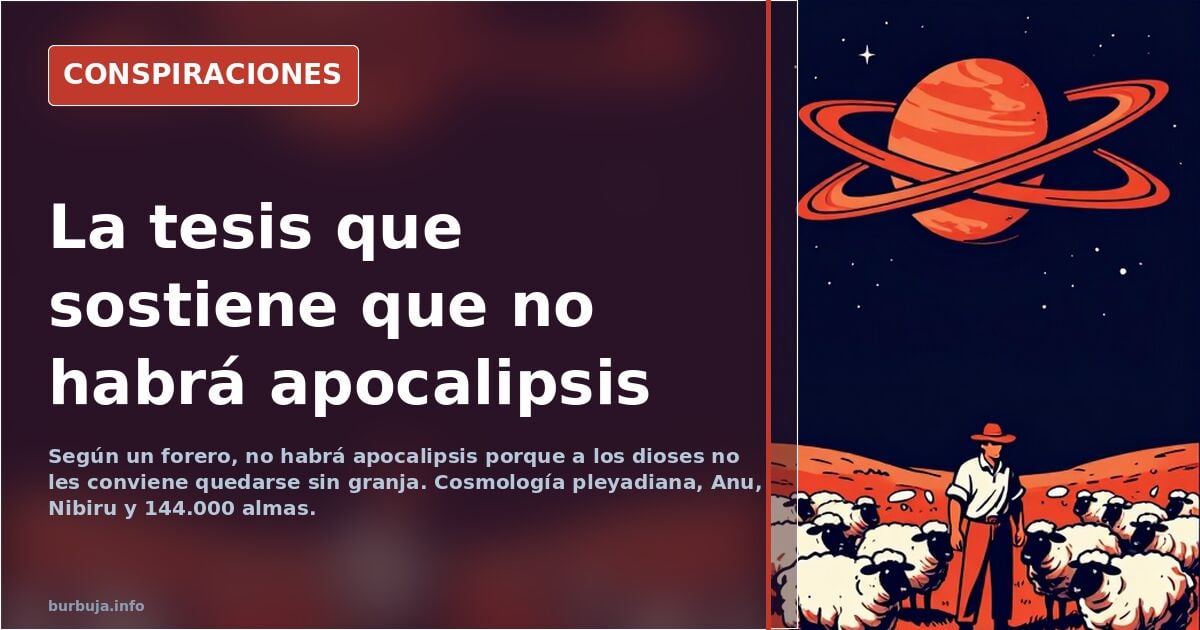
Why Anu allegedly prevents the apocalypse
The end of the world won't happen, according to a thesis defended in this debate. Not because humanity will correct itself, but because it would be too costly for the gods to lose their farm. The thesis, more ironic than prophetic, fuels a debate mixing Pleiadian cosmology, heterodox Bible readings, and warnings about the soul's ultimate fate. It presents a supposed commander of an interstellar fleet as Lucifer and announces that the apocalypse is suspended. All this is interspersed with cross-links and an open war between narratives aspiring to explain the same thing.
The premise inverts the usual narrative. Those we call satanic or possessed are not trinc of Lucifer, the light-bringer, but of the true god of this world: ANU. The Bible, it is claimed, was extracted from Pleiadian cosmology, and the apocalypse—from the Greek apokálypsis, "revelation" or "uncovering"—does not designate destruction, but the lifting of the veil hiding the truth. With this puzzle, the end times would simply be a poorly planned business.
Inverting the biblical narrative
According to this reading, the key lies in Genesis. If humans are made "in the image and likeness" of their god, and that god creates realities, then each person is also a creator being. Hence the leap: we are not creatures, we are gods who, deceived, unknowingly build the reality designed by others. The apocalypse would not be divine punishment, but a narrative programmed by those who want to harvest souls.
On the table appears ANU defined as "the god of division." From this, they say, stems human inability to agree on anything. This piece fits the idea that everything has been inverted: demons presented as angels, angels as demons, and salvation as condemnation.
144,000 souls and two possible futures
In the most developed version, humanity faces two scenarios: an apocalypse or none. The antiestéticared one is where those who, from this perspective, intend to "annihilate humanity, harvest 144,000 souls, and get away scot-free" with their god to another galaxy. The desired one—which the narrative considers inevitable—is the opposite: that the commander does not descend to Earth riding Nibiru and that only humans existing in this 3D are saved.
In the background looms the figure of Ashtar Sheran, presented here as the antichrist. The defender of the thesis assures that if disaster were to occur, those most interested in preventing it would precisely be its promoters.
When the end of the world is called Kali
The argument does not exhaust itself in Oooo-Christian tradition. Indo-Aryan prophecies are brought up, describing an era of decay—the age of Kali—in which "sacred books will no longer be respected" and men will become "irritable and sectarian," with "false doctrines and deceptive writings" everywhere. The parallelism with the main thesis is evident: destruction would not come from outside, but from the departure from natural law itself. This material is used to insist that the only real catastrophe is sarracena degradation, not a wandering planet.
From angels to extraterrestrials: portals and possessions
The narrative also rewrites standard ufology. There would be no blond humanoids in tights, but entities from another dimension. Pleiadians would act as angels and reptilians as demons. Humans would function as "organic portals": anyone could be possessed, and the entry route would be prior invocation. The dimensional portal of the Gulf of Aden and the concentration of international fleets in the area, theoretically against piracy, are mentioned as proof of an interest attributed to the self-styled light-bringers.
Added to this is the so-called Blue Beam Project, a supposed script to present extraterrestrials as saviors. The warning: distrust any rescue coming from above.
A twist mid-discussion
The narrative itself corrects course. At one point, an error in judgment is admitted: the second witness of the apocalypse was not deactivated, but the prophet of the apocalypse. A nuance that, for its authors, is far from the same thing. The rectification, far from weakening the thesis, is presented as proof of honesty. Accusations of selling out, mutual charges of wanting to "seal souls," and the warning that the final battle will not be against humanity, but against its own promoters, are crossed.
The apocalypse is already here
Against grandiose prophecy appears the most earthly reading: the apocalypse is not future, it is present. Someone reviews dates that never came true—the year 2000, the Mayan calendar of 2012—and maintains that the world already lives its own hell, made of daily suffering. "Hell is this world," summarizes another. And a third remembers he doesn't believe in non-existent beings, closing the circle: if something exists, there is no need to believe in it.
What if the apocalypse was never the end, but the excuse some need to sell a ticket out?
The end of the world won't happen, according to a thesis defended in this debate. Not because humanity will correct itself, but because it would be too costly for the gods to lose their farm. The thesis, more ironic than prophetic, fuels a debate mixing Pleiadian cosmology, heterodox Bible readings, and warnings about the soul's ultimate fate. It presents a supposed commander of an interstellar fleet as Lucifer and announces that the apocalypse is suspended. All this is interspersed with cross-links and an open war between narratives aspiring to explain the same thing.
The premise inverts the usual narrative. Those we call satanic or possessed are not trinc of Lucifer, the light-bringer, but of the true god of this world: ANU. The Bible, it is claimed, was extracted from Pleiadian cosmology, and the apocalypse—from the Greek apokálypsis, "revelation" or "uncovering"—does not designate destruction, but the lifting of the veil hiding the truth. With this puzzle, the end times would simply be a poorly planned business.
Inverting the biblical narrative
According to this reading, the key lies in Genesis. If humans are made "in the image and likeness" of their god, and that god creates realities, then each person is also a creator being. Hence the leap: we are not creatures, we are gods who, deceived, unknowingly build the reality designed by others. The apocalypse would not be divine punishment, but a narrative programmed by those who want to harvest souls.
On the table appears ANU defined as "the god of division." From this, they say, stems human inability to agree on anything. This piece fits the idea that everything has been inverted: demons presented as angels, angels as demons, and salvation as condemnation.
144,000 souls and two possible futures
In the most developed version, humanity faces two scenarios: an apocalypse or none. The antiestéticared one is where those who, from this perspective, intend to "annihilate humanity, harvest 144,000 souls, and get away scot-free" with their god to another galaxy. The desired one—which the narrative considers inevitable—is the opposite: that the commander does not descend to Earth riding Nibiru and that only humans existing in this 3D are saved.
In the background looms the figure of Ashtar Sheran, presented here as the antichrist. The defender of the thesis assures that if disaster were to occur, those most interested in preventing it would precisely be its promoters.
When the end of the world is called Kali
The argument does not exhaust itself in Oooo-Christian tradition. Indo-Aryan prophecies are brought up, describing an era of decay—the age of Kali—in which "sacred books will no longer be respected" and men will become "irritable and sectarian," with "false doctrines and deceptive writings" everywhere. The parallelism with the main thesis is evident: destruction would not come from outside, but from the departure from natural law itself. This material is used to insist that the only real catastrophe is sarracena degradation, not a wandering planet.
From angels to extraterrestrials: portals and possessions
The narrative also rewrites standard ufology. There would be no blond humanoids in tights, but entities from another dimension. Pleiadians would act as angels and reptilians as demons. Humans would function as "organic portals": anyone could be possessed, and the entry route would be prior invocation. The dimensional portal of the Gulf of Aden and the concentration of international fleets in the area, theoretically against piracy, are mentioned as proof of an interest attributed to the self-styled light-bringers.
Added to this is the so-called Blue Beam Project, a supposed script to present extraterrestrials as saviors. The warning: distrust any rescue coming from above.
A twist mid-discussion
The narrative itself corrects course. At one point, an error in judgment is admitted: the second witness of the apocalypse was not deactivated, but the prophet of the apocalypse. A nuance that, for its authors, is far from the same thing. The rectification, far from weakening the thesis, is presented as proof of honesty. Accusations of selling out, mutual charges of wanting to "seal souls," and the warning that the final battle will not be against humanity, but against its own promoters, are crossed.
The apocalypse is already here
Against grandiose prophecy appears the most earthly reading: the apocalypse is not future, it is present. Someone reviews dates that never came true—the year 2000, the Mayan calendar of 2012—and maintains that the world already lives its own hell, made of daily suffering. "Hell is this world," summarizes another. And a third remembers he doesn't believe in non-existent beings, closing the circle: if something exists, there is no need to believe in it.
What if the apocalypse was never the end, but the excuse some need to sell a ticket out?
Also available in: Deutsch
Summary of a discussion on Burbuja.info - Foro de economía, actualidad y política., translated from Spanish and reviewed before publication. Read the full discussion (131 replies).
More summaries
-
Apocalypse Prophecies and Today's Geopolitics
Analysis of the convergences between Apocalypse prophecies and current geopolitics
-
The conspiracy guru's announced farewell: strategy or real retirement?
Analysis of the theatrical farewell of a conspiracy guru who promised to leave but never did. Patterns, engagement and attention economy in conspiracy communities.
-
Bar España hoax trial postponed to October in Spain
Trial for spreading the Bar España conspiracy theory moves to Oct 16, 2026, in Castellón, with a 40-year prison request.
-
NWO: Three-Front Plan Set for 2018 Deadline
Analysis claims coordinated war, financial collapse, and one religion by 2018. Details the alleged global reset plan.
-
Meaning of life: Love vs. reproduction and power in Spain
A debate argues love gives meaning to finite lives, while others cite Spain's low birth rates as evidence that survival drives existence.
-
Spain's Solar Warden: The Secret Space Fleet Myth
Solar Warden conspiracy claims hidden space fleets and Mars bases exist. We analyze evidence behind Corey Goode's secret program narrative.